15 Disadvantages of Boarding School in Nigeria
What parents and students need to know before making this decision
A complete Boarding School Guide for Parents & Students
Introduction: Why This Conversation Matters
Every year, hundreds of thousands of Nigerian families face one of the most consequential education decisions they will ever make: should we send our child to a boarding school? The attraction is understandable.
Boarding schools — particularly the Federal Government Colleges, Unity Schools, and reputable private boarding institutions — carry a strong reputation for academic discipline, national unity exposure, and the production of well-rounded alumni who occupy prominent positions across Nigerian professional life.
But there is another side to the boarding school experience that is less often discussed openly — one that parents who are considering this choice deserve to understand fully before making a decision that will shape their child’s formative years. This is not an article that argues boarding schools are bad.
Many Nigerian boarding schools are excellent institutions that have transformed the lives of their students for the better. This is an article that presents the genuine disadvantages of the boarding school system so that every family can make an informed, eyes-open decision.
These disadvantages are real. They are documented. Many of them are widely known among Nigerians who have experienced boarding school life first-hand but are rarely discussed with the same enthusiasm as the advantages.
Whether you are a parent weighing this decision, a student about to begin boarding school, a policy maker thinking about educational reform, or a researcher studying Nigerian education, this guide gives you an honest and comprehensive account of the challenges that the boarding school system presents.
We cover fifteen disadvantages in detail, from the financial burden on families to the psychological impact of separation, from the structural safeguarding concerns to the long-term effects on family relationships.
We also close with practical guidance for families who are considering boarding school despite these challenges — because informed choice, even a difficult choice, is always better than an uninformed one.
IMPORTANT NOTE: This article covers disadvantages only. For a balanced account that also covers the advantages of boarding school, see our companion article: ‘Advantages and Disadvantages of Boarding School in Nigeria.’ The goal here is to ensure that the disadvantages receive the serious attention they deserve.
Quick Reference: The 15 Disadvantages at a Glance
| # | Disadvantage |
| 1 | Separation from family causes emotional and psychological harm |
| 2 | The high financial cost excludes millions of Nigerian families |
| 3 | Poor infrastructure and inadequate facilities in many public boarding schools |
| 4 | Bullying and senior-junior abuse are entrenched in many institutions |
| 5 | Limited parental oversight creates child protection gaps |
| 6 | Inadequate nutrition and poor food quality affects student health |
| 7 | Overcrowded dormitories and poor sanitation create health risks |
| 8 | Delayed detection of academic struggles and learning difficulties |
| 9 | Loss of cultural, religious, and linguistic identity during critical years |
| 10 | Peer pressure in closed environments can lead to harmful behaviour |
| 11 | Sexual harassment and abuse risks in poorly supervised settings |
| 12 | Emotional underdevelopment due to absence of consistent parental guidance |
| 13 | Students develop institutional dependency rather than genuine independence |
| 14 | The family bond is damaged or permanently altered by extended separation |
| 15 | Academic quality in many public boarding schools does not justify the sacrifice |
See more: Nurse vs Teacher: Is a Nurse More Important Than a Teacher?
1. Separation from Family Causes Emotional and Psychological Harm
The most fundamental disadvantage of boarding school in Nigeria — and the one with the most extensively documented impact on student wellbeing — is the psychological cost of prolonged separation from family.
For most Nigerian children entering secondary school at eleven or twelve years old, the transition to boarding school represents the most significant disruption of their lives to date: the sudden removal from the daily presence of parents, siblings, grandparents, and the community environment that has been the entirety of their world.
Check out: How to Create Flashcards for Quick Revision: The Ultimate Guide for Nigerian Students
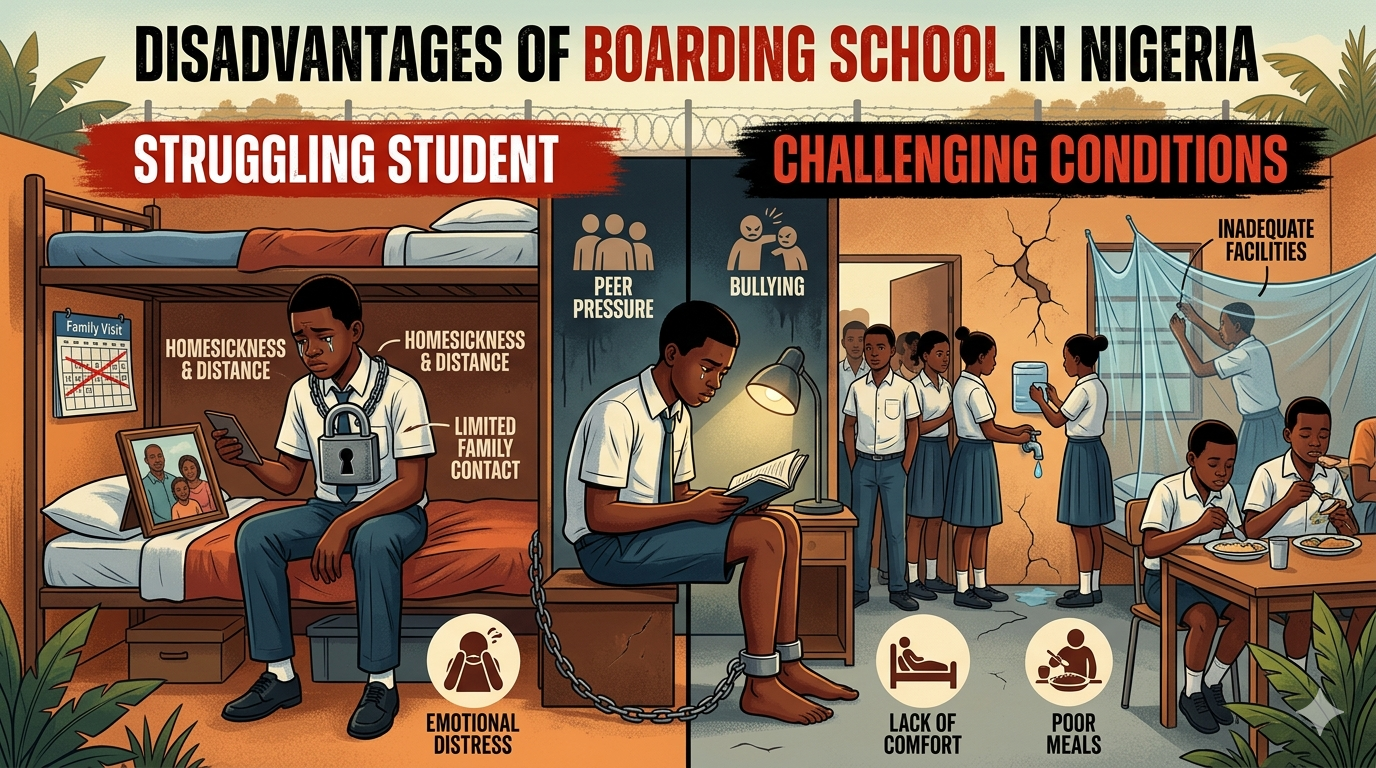
Homesickness is not a minor inconvenience. Child development research is consistent in establishing that homesickness in boarding school children can manifest as clinical-level anxiety, disrupted sleep, reduced appetite, difficulty concentrating, depressive episodes, and psychosomatic symptoms including stomach aches, headaches, and recurring complaints of illness.
For many Nigerian students, particularly those who enter boarding school young and whose family attachment is strong, the first term of boarding school is marked by genuine psychological suffering that significantly undermines the academic experience.
The situation is often made worse by the prevailing institutional culture in many Nigerian boarding schools, which treats homesickness as weakness to be suppressed rather than as a legitimate emotional response to be acknowledged and supported.
The peer culture in some institutions reinforces this — students who openly show distress may face ridicule from more socially established peers. The result is that many students suffer in silence, lacking both the institutional support and the peer permission to express and process what they are going through.
Even for students who adapt and eventually thrive in boarding school, the initial period of psychological adjustment represents a real and often underestimated cost. And for a subset of students — perhaps ten to fifteen percent of boarding school students, based on international research into school-refusal and boarding-related emotional difficulties — the psychological cost of boarding school is a persistent rather than temporary feature of their experience, with long-term implications for mental health that may not become fully visible until years after they have left school.
PARENT ALERT: Watch for signs of persistent homesickness beyond the first few weeks — difficulty eating, refusing to speak about school life, physical complaints with no clear medical cause, and withdrawal during holiday visits. These may indicate that your child is struggling more than they are admitting.
2. The High Financial Cost Excludes Millions of Nigerian Families
Boarding school education in Nigeria is significantly more expensive than day school, and the total financial cost is often underestimated by families who focus on the headline school fees rather than the full expense picture.
In addition to the basic tuition fees, boarding school parents must budget for boarding charges, feeding levies, bedding and household supplies, school uniforms (often purchased at inflated prices from school-approved suppliers), sports kits, textbooks and stationery, toiletries and personal care items, transport to and from school at the beginning and end of each term, and the various sundry levies — development fund contributions, PTA dues, sporting equipment charges, and others — that Nigerian boarding schools routinely impose.
For a reputable private boarding school in Lagos or Abuja, the total annual cost can easily reach five hundred thousand naira or more — a sum that represents the entire annual income of many Nigerian families.
Even the Federal Government Colleges, which are subsidised and therefore more affordable than private institutions, impose costs that many lower-income families struggle to meet, particularly when transportation, supplies, and the informal expenses of boarding life are factored in.
This financial reality has profound equity implications. Boarding school is, in practice, significantly more accessible to upper-middle-class and wealthy Nigerian families than to the majority of Nigerian families managing on modest incomes.
The aspirational families who make real financial sacrifices to send their children to boarding schools — sometimes going into debt, sometimes forgoing other household necessities — take on a financial burden that can create significant household stress and that represents a bet on an uncertain return.
The financial burden does not end with the fees. Students often need additional pocket money for personal needs not covered by school supplies. Emergency expenses — a broken pair of glasses, a medical need, a required school trip — arise unpredictably and must be managed. For families with multiple children of secondary school age, the compounding cost of multiple boarding school placements can be genuinely unsustainable.
FINANCIAL REALITY: Before committing to boarding school, calculate the full annual cost — fees, boarding, feeding, supplies, transport, pocket money, and levies. Compare this to the cost of a good local day school plus private tutoring. In many cases, the day school option is financially superior without significant academic disadvantage.
3. Poor Infrastructure and Inadequate Facilities in Many Public Boarding Schools
While Nigeria’s most prestigious boarding schools — the flagship Federal Government Colleges in well-resourced states and the best private boarding institutions — maintain reasonable to good facilities, the picture across the broader landscape of Nigerian public boarding schools is often significantly less encouraging.
Check out: How to Study for Multiple Choice Questions: The Secret to Acing JAMB and WAEC
Many state government boarding schools and older public boarding institutions operate with infrastructure that has not been meaningfully upgraded in decades, resulting in conditions that would shock parents who have not personally visited the facilities.
Dormitories that were designed for thirty students may house sixty or eighty. Bathroom and toilet facilities that are insufficient for the number of students using them create both hygiene challenges and daily queues that consume time and dignity.
Water supply is frequently unreliable — a serious problem in dormitory environments where students are responsible for their own hygiene and where communal living creates rapid spread of waterborne illness when sanitation standards slip.
Electricity supply is often inadequate, with the power cuts that characterise Nigerian infrastructure nationwide making evening study by artificial light unreliable. Many boarding schools rely on generators that run on schedules that do not necessarily align with student needs.
Academic facilities — laboratories, libraries, computer rooms — in many public boarding schools are either non-existent or so poorly equipped and maintained as to be effectively useless for modern learning. Science practicals are conducted without functional equipment.
Libraries hold outdated books. Computer rooms, where they exist, may have machines that are broken or so old as to be educationally irrelevant. The gap between the facilities described in school prospectuses and what students actually encounter on arrival is, in many Nigerian public boarding schools, significant.
Parents choosing boarding schools based on reputation and historical prestige should be aware that infrastructure quality varies enormously between institutions and that conditions at a specific school may have changed substantially since the school’s reputation was established.
A personal visit to the school facilities — including dormitories, bathrooms, and kitchens — before committing to a placement is essential due diligence.
4. Bullying and Senior-Junior Abuse Are Entrenched in Many Institutions
One of the most serious and most persistent problems in Nigerian boarding schools is the culture of bullying and senior-junior abuse that characterises many institutions. This culture — which in its most entrenched form is sometimes referred to as ‘fagging,’ borrowing the term from British public school tradition — involves the systematic use of junior students as personal servants, messengers, and errand-runners by older students, enforced by the threat of verbal abuse, physical punishment, and social exclusion.
In its milder forms, this senior-junior culture might involve juniors doing tasks like washing senior students’ clothes or fetching water. In its more serious manifestations — which have been documented across various Nigerian boarding schools in complaints raised by students and parents — it involves physical assault, psychological intimidation, sexual humiliation, and the extraction of money or personal property from junior students under duress.
The closed, hierarchical nature of dormitory life, combined with the limited supervision that overstretched boarding school staff can provide, creates conditions in which this kind of systematic abuse can persist across years with limited accountability.
Beyond the senior-junior dynamic, peer-to-peer bullying in boarding schools has features that make it more sustained and more psychologically damaging than day school bullying. In a day school, the bullied child returns home each evening, leaving the bully behind.
Read more: How to Apply for NYSC Relocation: The Complete “No Stress Guide for PCMs
In a boarding school, the bully is in the next bed, in the same dining hall, in the same bathroom, and on the same sports field. There is no escape from the boarding school environment, and there is no daily parental presence to notice and respond to signs of bullying victimisation.
Nigerian boarding school authorities have made varying degrees of effort to address these cultures, with some schools implementing anti-bullying policies and pastoral care systems that genuinely reduce their incidence. But the extent to which traditional senior-junior hierarchies and associated abuses persist in specific institutions is often difficult for prospective parents to assess from outside the school community.
PARENT GUIDANCE: Before enrolling a child in boarding school, speak confidentially to current and recent students and parents — not school management — about the senior-junior culture at that specific institution. The presence of entrenched bullying or fagging traditions should be a serious deterrent to enrollment.
5. Limited Parental Oversight Creates Child Protection Gaps
A fundamental structural feature of boarding school — the fact that children spend nine to ten months of each year living in an institution where parents are not present and where staff-to-student ratios are typically high — creates child protection vulnerabilities that do not exist in day school settings.
Child protection in a boarding school depends entirely on the quality, training, commitment, and ethical standards of the school’s own staff. When those standards fall short — when housemasters are overworked and inattentive, when teachers and administrators prioritise institutional reputation over student safety, when complaint mechanisms are inadequate or actively suppressed — children are at risk.
Nigerian boarding schools have not been immune to serious safeguarding failures. Reports of physical abuse by staff, sexual abuse by both staff and older students, and the systematic suppression of student complaints to protect institutional reputations have emerged from boarding schools across Nigeria over the years.
The pattern in these cases is often consistent: the closed institutional environment of the boarding school, the power differential between students and adults in authority, and the distance from parental oversight combine to create the conditions in which abuse can occur and persist.
Even in the absence of deliberate abuse, the basic child protection challenge of a boarding school environment is real. Who is responsible for a specific child’s safety at three in the morning when the housemaster is asleep and a student is unwell, frightened, or in distress?
How are student complaints about peer behaviour processed, and how confident can a student be that raising a complaint will not result in social retaliation from peers or professional dismissal from staff? These are structural questions that every boarding school must answer, and not all of them answer them adequately.
6. Inadequate Nutrition and Poor Food Quality Affects Student Health
Food is not a peripheral concern in the boarding school context — it is a central one. Students in boarding school have no choice about what they eat. They eat what the school provides, in the quantities the school provides, at the times the school has scheduled.
When the school’s food provision is excellent, this is fine. When it is poor — as it is in a significant number of Nigerian public boarding schools — the consequences for student health and academic performance are real and serious.
In many Nigerian public boarding schools, the food served in the dining hall is nutritionally inadequate — high in carbohydrates from starchy staples like rice, garri, and yam, but low in protein, vegetables, and the micronutrients that growing adolescents need.
Portion sizes are often insufficient for the energy demands of active teenagers. Food preparation standards and kitchen hygiene vary widely, and outbreaks of food-related illness — including typhoid and severe diarrhoea — are documented in Nigerian boarding schools with concerning frequency.
The typical boarding school feeding allowance is fixed at the beginning of term and may not be adjusted as food prices rise. When inflation drives up food costs — as has happened repeatedly in Nigeria in recent years — schools face the choice of reducing portion sizes, substituting cheaper and less nutritious foods, or absorbing the cost difference. The students who suffer are the ones eating the meals.
Students who are unhappy with school food often supplement their diet with snacks purchased from school tuck shops or brought from home — creating a two-tier system where students with more pocket money and more family resources eat better than those without. This economic inequality within the boarding school dining experience is an often-overlooked dimension of the nutritional disadvantage.
HEALTH NOTE: When visiting a prospective boarding school, always request to see the dining hall and, if possible, observe a meal in progress. Ask to see a typical weekly menu. Speak to current students about the quality and quantity of food. Nutritional adequacy is a basic requirement — not a luxury — for adolescent development and academic performance.
7. Overcrowded Dormitories and Poor Sanitation Create Serious Health Risks
Dormitory overcrowding is one of the most visible and most serious infrastructure problems in Nigerian public boarding schools. Dormitories that were designed to accommodate thirty students — with standard measurements for bed spacing, circulation, and ventilation that were calculated on the basis of that number — frequently house twice or three times that number, with beds positioned so close together that movement between them requires sideways negotiation and personal space is essentially non-existent.
The health consequences of dormitory overcrowding are well-documented and directly relevant to the Nigerian boarding school context. Overcrowded sleeping environments are associated with significantly elevated rates of respiratory infections — including tuberculosis, which remains an active public health concern in Nigeria. They facilitate rapid transmission of skin conditions including scabies and ringworm.
They increase the risk of meningococcal disease, which has historically caused outbreaks in dormitory settings. And they create the kind of sustained sleep deprivation — from noise, from heat, from the sheer physical discomfort of insufficient space — that directly undermines academic performance.
Sanitation facilities in overcrowded boarding schools face similarly severe pressure. Bathroom-to-student ratios that were inadequate when the school was built become genuinely crisis-level when student numbers exceed design capacity by a factor of two or three.
The morning rush to use limited bathroom facilities before classes begin is a feature of boarding school life that many alumni recall as among the most stressful aspects of their experience. The hygiene standards that are possible in these conditions are significantly lower than what any health professional would consider adequate for adolescent group living.
8. Academic Struggles and Learning Difficulties Are Detected Late
In a day school setting, a parent who is actively engaged in their child’s education receives continuous, daily feedback on how their child is performing. They notice when homework is being completed with unusual difficulty. They observe when their child’s mood suggests that something has gone wrong academically.
Read also: How to Use the Cornell Method to Take Better Lecture Notes (And Stop Cramming)
They have regular, informal communication with teachers through school events, communications apps, and the easy accessibility of day school staff. When a learning difficulty or academic struggle emerges, a day school parent with appropriate engagement typically identifies it quickly and can act promptly to arrange support.
In a boarding school setting, the feedback loop is dramatically longer. The first formal signal that a student is struggling academically is typically the end-of-term report — by which point several months may have passed since the struggle began. Interim communication between boarding school staff and parents varies enormously in quality and frequency. Some boarding schools maintain regular parent communication; many do not.
The student themselves may not report academic difficulty to parents during holiday visits, either because they do not want to worry their parents, because they hope the situation will improve, or because the social culture of the boarding school makes acknowledging academic struggle uncomfortable.
For students with specific learning difficulties — dyslexia, dyscalculia, attention deficit disorder, processing difficulties — the boarding school’s standardised curriculum and large class sizes may provide little accommodation, and the delayed detection of the difficulty means that they spend months or years struggling in ways that appropriate support could have alleviated.
The longer the difficulty goes undetected, the more educational ground the student loses and the more entrenched the academic difficulty becomes.
9. Loss of Cultural, Religious, and Linguistic Identity During Critical Years
The years of secondary school — roughly ages eleven to seventeen — are among the most critical in the formation of a young person’s identity. It is during these years that adolescents develop their sense of who they are: their values, their cultural heritage, their religious commitment, their language identity, and their understanding of their place in the social and cultural world. This identity formation is profoundly influenced by the daily environment in which it occurs.
The boarding school imposes a uniform institutional identity that, over nine to ten months of the year, substantially displaces the family and community identity that is the raw material of authentic cultural formation.
The Yoruba student at a boarding school far from home spends most of their waking hours in an environment where their mother tongue is not the dominant language, where the food reflects an institutional rather than family culinary tradition, where religious observance follows the school’s schedule rather than the family’s practice, and where the cultural references, jokes, music, and social norms are those of the school community rather than the family community.
Over five years of boarding school, the accumulated effect of this cultural displacement can be significant. Students may return home during holidays noticeably more distant from their mother tongue, less fluent in traditional practices, less connected to extended family networks, and more identified with the institutional culture of their school than with the cultural identity of their community.
For many Nigerian families for whom cultural and linguistic transmission is a primary educational priority, this cultural displacement is among the most significant disadvantages of the boarding school system.
Religious practice is particularly affected. Families with specific religious observance patterns — daily prayers, weekly church attendance, regular mosque participation, fasting observances, religious festivals — find that boarding school imposes a generic institutional approach to religious life that may not align with the family’s specific tradition. Students who have grown up in strong religious households may find their faith identity challenged or attenuated by the boarding school environment.
10. Peer Pressure in Closed Environments Can Lead to Harmful Behaviour
The boarding school’s social environment is more intense, more enclosed, and more insulating from external influence than any social environment that most Nigerian adolescents will ever again experience as adults.
Read more: How to Register for NYSC Mobilization: The Complete Guide for Fresh Graduates
For the most part, this intensity produces positive social dynamics — the deep friendships, the shared experiences, the collective identity that boarding school alumni cherish. But the same intensity and enclosure that produces positive social bonds can also amplify negative peer dynamics in ways that are difficult to detect from outside the school community and difficult for students to resist from within it.
Substance use is a documented problem in some Nigerian boarding schools. Alcohol, cannabis, and in some cases harder substances have been found in boarding school dormitories, brought in by students or, in some documented cases, obtained through connections within the school community.
The social pressure to participate — in an enclosed environment where social acceptance is critical and social exclusion is painful — is real and meaningful for adolescents whose identity and social standing are deeply invested in peer acceptance.
Sexual activity, including in some cases non-consensual or coerced sexual contact, occurs in boarding school environments with less adult oversight than would be possible if students returned home each evening. The consequences of early sexual activity, unintended pregnancy, sexually transmitted infections, emotional harm are serious and can permanently alter the trajectory of a student’s life and education.
More broadly, the social norms of a specific boarding school dormitory — whatever they happen to be, good or bad — are extraordinarily influential on the students embedded within them. A student who enters boarding school with strong values from a strong family background may find those values challenged or eroded by sustained exposure to a dormitory culture that does not share them.
The evening return to family that day school provides — the daily parental counterweight to peer influence — is absent in boarding school, leaving peer culture as the dominant social shaping force for ten months of every year.
11. Sexual Harassment and Abuse Risks in Poorly Supervised Settings
This is the most serious disadvantage on the list, and it deserves the most serious treatment. Sexual harassment and abuse in boarding schools — perpetrated by both staff and older students — has been documented in Nigeria through investigations, court cases, survivor testimonies, and journalistic investigations.
The structural features of the boarding school environment that create child protection vulnerabilities — extended separation from parents, living in close quarters with peers and staff, limited external oversight, power differentials between juniors and seniors — also create conditions in which sexual abuse can occur and in which its detection and reporting are both difficult.
Female students in particular face risks that are not adequately managed in all Nigerian boarding schools. Reports of sexual harassment by male staff members at girls’ boarding schools, of coercive sexual relationships between senior male students and junior female students at mixed-sex institutions, and of sexual assault occurring in dormitory environments represent some of the most serious documented failures of Nigerian boarding school safeguarding. These are not hypothetical risks — they are documented realities at specific institutions.
For parents, the most difficult aspect of this disadvantage is that it is the hardest to assess from outside the school. Schools do not advertise safeguarding failures. Students who have experienced abuse may be too frightened, too ashamed, or too uncertain about what they experienced to report it — particularly if the school’s complaint mechanisms are inadequate or if they fear the consequences of reporting. The annual school report and the holiday visit home do not typically surface this kind of experience.
Every parent considering boarding school should investigate the school’s safeguarding policies actively — not just reading the official policy but asking specific questions about how complaints are made, how they are investigated, what mechanisms protect the complainant from retaliation, and what the school’s record is in responding to safeguarding concerns. These are uncomfortable questions. They are also essential ones.
CRITICAL WARNING: Trust your child. If they seem reluctant to return to school at the start of term, if they are unwilling to talk about school life, or if they show any of the behavioural signs of trauma or abuse — withdrawal, sleep disturbances, regressive behaviour, unusual fearfulness — take these signals seriously and investigate with care and sensitivity.
12. Emotional Underdevelopment Due to Absence of Consistent Parental Guidance
Parenting is not simply the provision of food, shelter, and school fees. It is the ongoing, daily process of emotional guidance, moral formation, and relational modelling that shapes a child’s emotional intelligence, their capacity for empathy, their understanding of healthy relationships, and their ability to navigate the emotional complexity of adult life.
This parenting function cannot be delegated to an institution, however well-intentioned and well-staffed.
The boarding school student receives institutional care — regular meals, supervised study, organised activities — but not parental guidance in the specific, personal, relationship-based sense that emotionally develops a child.
The parent who notices that their child seems to be developing a worrying attitude toward a classmate, or who recognises an emerging behavioural pattern that needs gentle redirection, or who provides the patient, ongoing conversation about values, relationships, and choices that shapes moral development — this parent can only do this work during holiday visits in a boarding school context.
The daily moral and emotional guidance that is the most important dimension of parenting is available to boarding school students for approximately three months of every year.
The long-term consequence of this reduced parental presence during emotional development is that some boarding school students arrive at adulthood with emotional profiles that reflect the institutions that shaped them rather than the families that love them. They may be socially skilled within institutional environments but less emotionally fluent in the more complex, less structured relational world of adult life.
They may have strong peer bonds but less secure attachment relationships. They may have developed sophisticated coping mechanisms for institutional life that do not serve them as well in family and intimate relationships.
13. Students Develop Institutional Dependency Rather Than Genuine Independence
One of the most frequently cited advantages of boarding school is the independence it supposedly develops. There is truth in this claim — boarding school students do develop certain forms of self-sufficiency.
Check out: How to Use the Cornell Method to Take Better Lecture Notes (And Stop Cramming)
But there is an important distinction that boarding school advocates often overlook: the independence developed in a boarding school is, in significant part, institutional independence — the ability to function effectively within an institution’s rules and structure rather than the genuine self-determination that adult life actually requires.
The boarding school student who manages their own laundry, organises their own belongings, and completes their prep assignments without parental reminding is developing self-management skills within an institutional framework that has already made most of the significant choices for them: what to eat, when to sleep, when to study, which activities to participate in, what to wear.
The institution manages the environment; the student manages themselves within it. This is a real skill — but it is not the same as genuine independence, which involves making choices about one’s own environment and life structure rather than simply managing oneself within a structure someone else has created.
Many boarding school alumni report experiencing a significant adjustment challenge when they leave school and must for the first time determine their own structures, make their own choices about how to organise their time, and navigate the full freedom of post-institutional life.
The transition from the highly managed environment of a boarding school to the self-determined environment of university or early adulthood can be jarring in ways that are the mirror image of the day school student’s adjustment challenge. The boarding school student arrives at freedom having been managed; the day school student arrives having practised self-management.
14. The Family Bond Is Damaged or Permanently Altered by Extended Separation
Perhaps the most personally painful disadvantage on this list — and the one that is most difficult to reverse after the fact — is the damage that extended boarding school separation can cause to the parent-child relationship. Family bonds are not static.
They require ongoing investment — daily interaction, shared experience, mutual engagement with the ordinary texture of life — to remain strong and to continue deepening as both parent and child grow and change. When this ongoing investment is replaced by termly visits and holiday reunions, the relationship changes in ways that are often only fully recognised years later.
Parents whose children spend most of secondary school in boarding school sometimes report a growing emotional distance that they struggle to bridge during holiday visits — a sense that their child has become someone they do not fully know, that the intimate daily knowledge of their child has been replaced by a more formal relationship between visitors who share history but not daily life.
The child, meanwhile, may feel more at home in the boarding school environment than in their family home, may struggle to reconnect with family rhythms during holidays, and may find the transition back to family life at the end of term as emotionally dislocating as the transition to school was at the beginning.
In some cases, the relationship effects of boarding school separation become visible in adult life, when grown children maintain less close relationships with their parents than their parents had hoped for, or when the emotional intimacy that was not built during secondary school proves difficult to establish in adulthood.
These are not inevitable outcomes of boarding school — many boarding school students maintain deeply loving family relationships throughout their lives. But they are documented risks that families should weigh carefully.
15. Academic Quality in Many Public Boarding Schools Does Not Justify the Sacrifice
The final and in some ways most pragmatic disadvantage is this: for many Nigerian families, the academic quality of the specific boarding school available to their child does not justify the financial cost, the emotional cost, and the family impact of the boarding arrangement.
The assumption that boarding school equals academic excellence is a significant generalisation that does not hold consistently across the range of Nigerian boarding schools.
The most prestigious boarding schools in Nigeria — the Federal Government Colleges that attract students through competitive national examinations, the top private boarding institutions in Lagos and Abuja, and a handful of state government boarding schools with strong management and resources — do deliver academic quality that justifies serious consideration.
But the broader landscape of Nigerian public boarding schools includes many institutions that provide mediocre to poor academic outcomes, often attributable to chronic underfunding, teacher shortages, infrastructure decay, and institutional management failures that no amount of boarding school discipline can compensate for.
A student who attends a low-performing boarding school in difficult living conditions and produces poor examination results has paid the full emotional and financial cost of boarding school without receiving the academic benefit that is supposed to justify it.
Meanwhile, a well-motivated student at a good local day school, supported by attentive parents and supplementary tutoring, often achieves academic outcomes that equal or exceed those of the boarding school alternative at a fraction of the financial and emotional cost.
The lesson is not that boarding school is never worth the sacrifice — it sometimes is, particularly for students gaining entry to the most competitive institutions. The lesson is that the decision should never be made on the assumption that ‘boarding school’ automatically equals ‘better academic outcomes.’
The specific school, the specific quality of teaching, and the specific fit between the student’s learning needs and the school’s approach must be evaluated carefully and honestly.
KEY QUESTION: Before choosing boarding school, ask yourself honestly: is this specific school’s academic quality, in these specific conditions, worth the financial cost, the family separation, and the emotional impact on my child? If the answer requires significant rationalisation, the answer may be no.
Check out: JAMB 2026 Novel Summary: The Lekki Headmaster by Kabir Alabi Garba (Complete Guide)
Practical Guidance for Families Considering Boarding School
Despite these fifteen disadvantages, boarding school remains a legitimate and in some cases excellent choice for specific children, specific families, and specific circumstances. The goal of this article is informed choice, not blanket avoidance. Here is practical guidance for families who are actively considering boarding school for their child.
1. Visit the School Personally and Comprehensively
Never make a boarding school choice based on reputation alone, or on a school’s self-presentation in a prospectus or on their website. Visit the school in person during a normal school day if at all possible. Request to tour the dormitories, the bathrooms, the kitchen, the dining hall, and the medical facility. Observe student interactions. Assess the visible mood of the student body. A school with happy, well-nourished, physically healthy students who speak positively about their experience tells you more than any reputation.
2. Speak Confidentially to Current Students and Recent Alumni
School management will present the school in its best light. The most honest intelligence about a boarding school’s actual culture — the quality of food, the reality of the senior-junior dynamic, the effectiveness of the pastoral care system, the atmosphere in dormitories at night — comes from students and recent alumni speaking confidentially, without the presence of school staff. Seek out these conversations actively before committing to enrollment.
3. Assess Your Child’s Temperament Honestly
Some children are temperamentally well-suited to boarding school life — they are socially confident, emotionally resilient, adaptable, and motivated. Others are not. A child with an anxious temperament, strong family attachment, a history of separation difficulties, or specific emotional needs may genuinely struggle in a boarding school environment in ways that undermine both their wellbeing and their academic performance. Be honest about who your child is, not who you hope they will become.
4. Maintain Active Communication With Your Child
Once a child is in boarding school, do not allow the institutional structure to replace your parental involvement. Maintain regular communication — phone calls, video calls, letters — and create the conditions in which your child feels safe to tell you honestly when something is wrong. Establish clear signals: ‘If you ever feel unsafe, or if something happens that you do not know how to handle, call me immediately regardless of time or day.’ Parental availability is a form of child protection even from a distance.
5. Monitor Academic Progress Actively
Do not wait for the end-of-term report to find out how your child is doing academically. Request mid-term updates from teachers. Speak to your child about specific subjects during holiday visits. Be alert to signs that they are struggling with specific topics or losing confidence in their academic ability. If tutoring support is needed, arrange it promptly rather than hoping the difficulty resolves itself.
6. Know When to Change Your Decision
Making the choice to send a child to boarding school is not an irreversible commitment. If your child is genuinely unhappy, genuinely suffering, or genuinely underperforming after a reasonable settling-in period, reconsider the placement. The sunk cost of fees already paid is not a good reason to continue an arrangement that is harming your child. Boarding school is a means to an end — the end is your child’s flourishing. If the means is not serving the end, change the means.
Check out: How to Use the Cornell Method to Take Better Lecture Notes (A Guide for Nigerian Students)
Frequently Asked Questions
Are these disadvantages true of all Nigerian boarding schools?
No. The fifteen disadvantages discussed in this article apply in varying degrees to different institutions. Some — particularly the psychological impact of family separation — are inherent to boarding school as a system and apply to some extent in all cases.
Others inadequate nutrition, overcrowded dormitories, poor infrastructure, entrenched bullying — are features of specific institutions and are significantly mitigated in well-managed, well-resourced schools.
The quality range across Nigerian boarding schools is extremely wide, and a generalisation that applies to one type of institution may not apply to another.
Do the disadvantages outweigh the advantages?
This depends entirely on the specific child, the specific family circumstances, the specific school available, and the values the family prioritises.
For some families — particularly those with children who are temperamentally suited to boarding school life, who have access to high-quality institutions, and who place high value on the independence and peer-network advantages of boarding school — the advantages genuinely outweigh the disadvantages.
For others — particularly those whose children have strong family attachment needs, who cannot access high-quality institutions, or who prioritise family connection and cultural continuity — the disadvantages are more significant. There is no universal answer.
What is the most serious disadvantage of Nigerian boarding schools?
The safeguarding and child protection concerns particularly the risks of bullying, abuse, and sexual harassment in poorly supervised environments, are the most serious disadvantages from a child welfare perspective.
These represent not just discomforts or inconveniences but genuine risks of harm that can have lifelong consequences. Families should prioritise safeguarding assessment above all other considerations when choosing a boarding school.
How can I tell if my child is struggling in boarding school?
Signs to watch for during holiday visits and phone calls include: reluctance to return to school at the start of term (beyond normal mild homesickness); unwillingness to talk about school life in any detail; physical signs unexplained weight loss, frequent illness reports, visible fatigue; emotional signs withdrawal, irritability, loss of the enthusiasms and interests they had before boarding school; and any direct or indirect references to feeling unsafe, being treated badly, or not having anyone they can talk to at school.
Read now: How to Visualize Concepts to Make Them Stick: A Guide for Nigerian Students
Conclusion: Make the Decision With Your Eyes Open
Boarding school in Nigeria, at its best, is a genuinely transformative educational experience that builds discipline, resilience, national identity, and lifelong friendships in ways that no day school can fully replicate.
The Federal Government Colleges, the Unity Schools, and the best private boarding institutions have produced some of Nigeria’s most distinguished professionals, thinkers, and leaders. This is a real and important part of the boarding school story.
But the boarding school story also includes the fifteen disadvantages documented in this guide. It includes the child who cried themselves to sleep every night for a whole first term. It includes the student whose learning difficulty went undetected for a year because no one was close enough to notice.
It includes the junior student who spent their early secondary school years being systematically humiliated by seniors in an institution that looked the other way. It includes the family whose relationship with their child was never quite the same after five years of boarding school separation. These stories are also real. They also deserve to be told.
The decision to send a child to boarding school should be made with full knowledge of both sides — the genuine opportunities and the genuine risks. It should be made on the basis of careful assessment of the specific child’s temperament and needs, the specific institution’s quality and culture, the family’s financial capacity to sustain the choice without undue hardship, and an honest reckoning with the emotional and relational costs that boarding school imposes on both children and families.
Make the decision with your eyes open. Visit the school. Talk to the students. Listen to your child. Trust your instincts. And remember that the goal of secondary education is not the prestige of the institution attended but the flourishing of the specific child who attends it.
Your child’s wellbeing is the measure of every educational decision. Let that be your guide.
Education: 15 Disadvantages of Boarding School in Nigeria | Parents & Students Guide