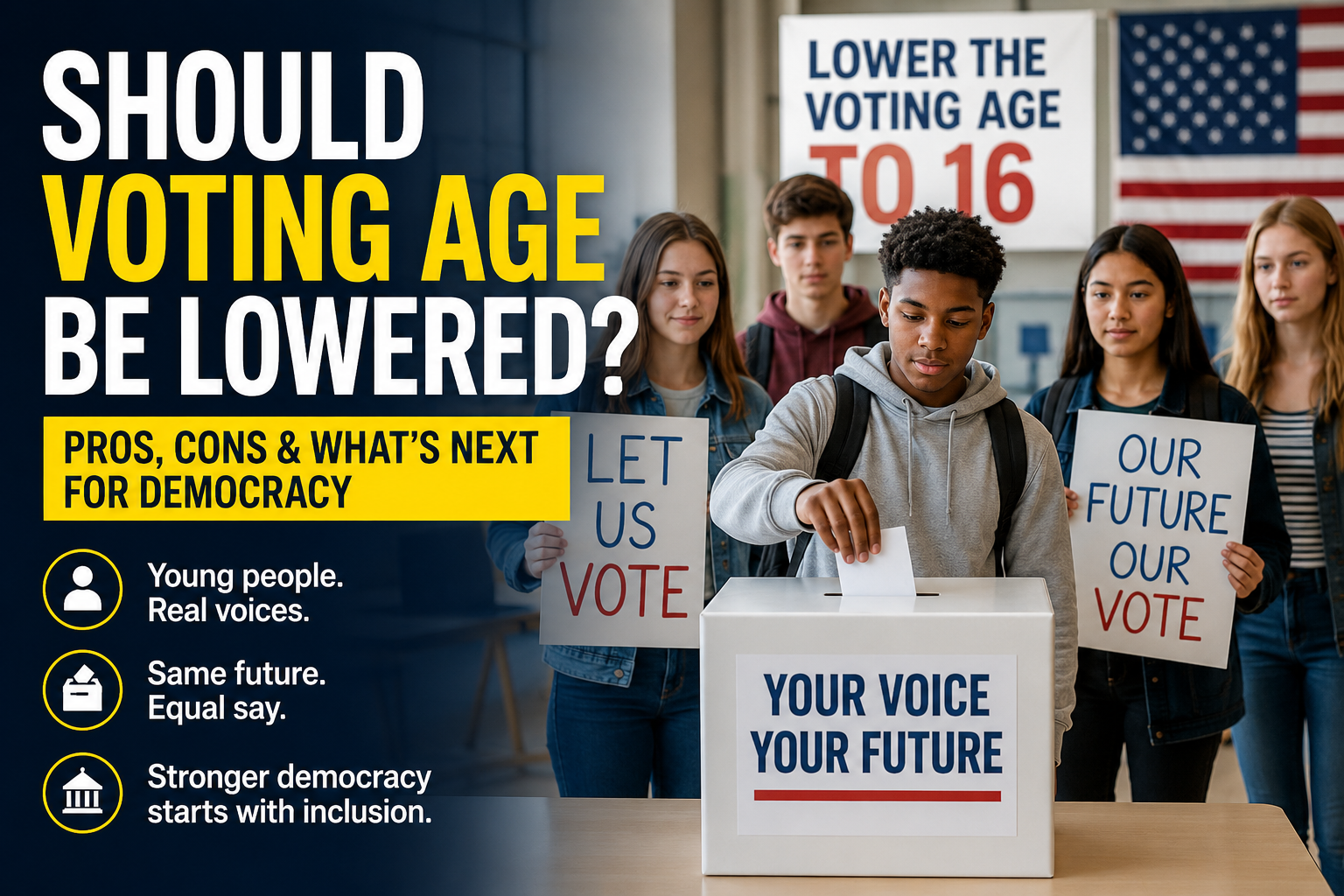
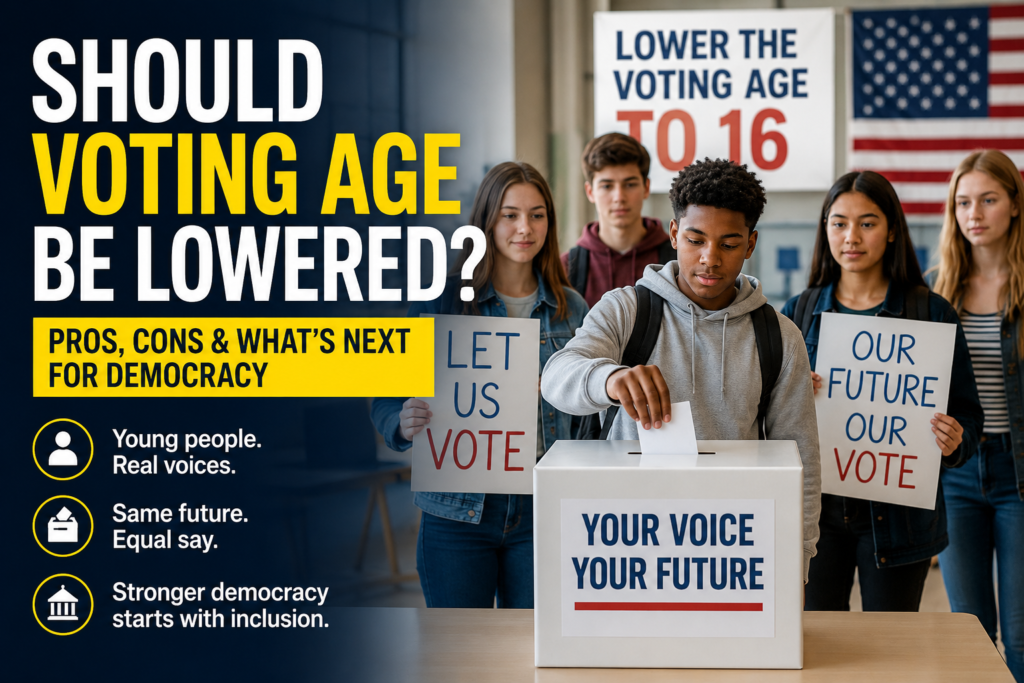
The question of whether the voting age should be lowered is no longer just a classroom debate. It is becoming a serious political conversation in many countries as younger people demand a stronger voice in decisions that affect their future.
Climate policy, education funding, job creation, technology regulation, student debt, national security, healthcare, housing, and economic reforms all shape the lives of young people. Yet in many democracies, 16- and 17-year-olds are still expected to wait until they turn 18 before they can vote.
So, should the voting age be lowered?
The honest answer is this: yes, it should be considered, but only with strong civic education, proper voter registration systems, and clear safeguards against manipulation. Lowering the voting age can strengthen democracy if it is done responsibly. But if it is treated only as a political strategy to win more votes, it may create more controversy than progress.
See more Less Competitive Nigerian Universities 2026: Schools With Higher Admission Chances
What Is the Current Voting Age?
In many countries, the voting age is 18. In Nigeria, for example, the Independent National Electoral Commission states that a voter must be a Nigerian citizen who is 18 years old or above and duly registered.
In the United States, the voting age is also 18. The 26th Amendment says the right of citizens who are 18 or older to vote cannot be denied or abridged because of age.
However, not every country or region follows the same rule. Austria allows voting at 16 in national elections, while Scotland allows 16-year-olds to vote in Scottish Parliament and council elections. Wales also allows voting from age 16 in Senedd elections.
The United Kingdom has also moved toward lowering the voting age. A 2026 UK government policy summary explains plans to extend voting rights to 16- and 17-year-olds under the Representation of the People Bill 2026.
This shows that the debate is not imaginary. Some democracies are already testing or adopting the idea.
Why People Want the Voting Age Lowered
Supporters argue that young people are deeply affected by government decisions, so they should have a say in choosing leaders and policies.
A 16-year-old may not yet be fully independent, but many are already working, paying indirect taxes, helping families, following political news, using public services, and planning their future. They are affected by school policies, university admission systems, job markets, transportation, climate change, public safety, digital rights, and national economic decisions.
The argument is simple: if young people are mature enough to be shaped by government decisions, they should not be completely excluded from choosing the government.
Another reason is habit formation. Voting is a habit. If people start voting early, they may be more likely to continue voting later in life. Research on Austria found that voters first eligible at 16 were more likely to vote in future elections, although the study also noted that reforms can have political consequences and may influence electoral outcomes.
Check out How to Handle Panic Attacks in the Exam Hall: A Survival Guide for Nigerian Students
Why This Topic Is Trending
Searches such as should voting age be lowered, lower voting age to 16, pros and cons of lowering voting age, and youth voting rights are increasing because democracy itself is under pressure in many places.
Low voter turnout, distrust in politicians, youth unemployment, misinformation, and political polarization have made many people ask whether democracy needs to become more inclusive.
For young people, the issue feels personal. They see older generations making decisions about education, technology, climate, housing, and national debt. Yet they often have little formal political power.
For adults, the concern is different. Some worry that teenagers may not be informed enough, independent enough, or emotionally mature enough to vote responsibly.
That tension is exactly why the debate matters.
Arguments in Favor of Lowering the Voting Age
The strongest argument for lowering the voting age is representation. Young people live under the laws of society, so they deserve a voice in shaping those laws.
Many public policies have long-term effects. A 16-year-old will live with the consequences of today’s decisions for decades. Policies on education, employment, climate, national debt, technology, and healthcare may affect young people longer than older voters.
Another argument is that 16- and 17-year-olds are often still in school. This may actually be an advantage. If voting is introduced while students are still in a structured learning environment, schools can connect civic education directly to real elections. Instead of teaching democracy only as theory, teachers can help students understand voter registration, party manifestos, policy comparison, and responsible participation.
Supporters also argue that lowering the voting age can reduce political apathy. Many people turn 18 after leaving secondary school, entering university, starting work, or moving away from home. At that stage, they may be disconnected from civic structures. Allowing voting at 16 may capture young citizens earlier, when they are easier to reach through schools and community institutions.
See more How to Handle Panic Attacks in the Exam Hall: A Survival Guide for Nigerian Students
Research from Austria has also challenged the assumption that younger voters are automatically too uninformed to participate. One study on voting at 16 found that young voters were not substantially worse than older first-time voters in political interest, knowledge, and vote choice quality.
Arguments Against Lowering the Voting Age
Opponents of lowering the voting age believe that voting should be reserved for those who have reached legal adulthood.
Their argument is that 16-year-olds may still depend heavily on parents, teachers, social media, peer groups, and emotional influences. They may not have enough life experience to evaluate complex issues such as taxation, national security, budgets, foreign policy, public debt, or economic reform.
Another concern is consistency. If society says a person must be 18 to enter certain contracts, serve on juries, buy certain products, or take on full adult responsibilities, critics ask why voting should be treated differently.
There is also the fear of political manipulation. Some opponents believe political parties may support lowering the voting age not because of democratic principle, but because they expect younger voters to favor them. In the UK debate, for example, critics of lowering the voting age have argued that the reform could be politically motivated.
Another serious concern is civic preparedness. If schools are weak, civic education is poor, and misinformation is widespread, lowering the voting age alone may not improve democracy. It may simply add more voters who are not properly prepared.
Should 16-Year-Olds Be Allowed to Vote?
There is a strong case for allowing 16-year-olds to vote, especially in local elections, school board elections, or elections directly connected to education and community development.
Local elections are often the best starting point because the issues are closer to young people’s daily lives. A 16-year-old may understand problems in schools, public transport, neighborhood safety, youth employment, internet access, and local infrastructure very clearly.
A gradual approach may be wiser than immediately lowering the voting age for every election. Countries or states could begin with local elections, measure turnout, improve civic education, and then decide whether to expand the right to national elections.
Read more Less Competitive Nigerian Universities 2026: Schools With Higher Admission Chances
The Role of Civic Education
Lowering the voting age without improving civic education would be a mistake.
Young people should not only be given ballots. They should be taught how democracy works. They should understand political parties, manifestos, campaign promises, government structure, public finance, misinformation, voter secrecy, electoral offences, and the importance of peaceful participation.
In countries where vote buying, misinformation, tribal politics, religious manipulation, or political violence are major concerns, civic education becomes even more important.
For Nigeria, for example, the bigger issue may not only be whether 16-year-olds can vote. It may also be whether all voters, young and old, are properly educated, protected, registered, and confident that their votes count.
Possible Benefits of Lowering the Voting Age
Lowering the voting age can increase youth participation. It can make young people feel seen and respected by the political system. It can also encourage schools to take civic education more seriously.
It may also force politicians to pay attention to youth issues. When young people cannot vote, politicians may ignore them. But when they become a voting bloc, leaders are more likely to speak about education, job creation, digital skills, climate policy, youth entrepreneurship, and affordable housing.
Another benefit is long-term democratic culture. If young people learn to vote early, they may grow into adults who see voting as a normal civic duty rather than an occasional activity.
Possible Risks of Lowering the Voting Age
The risks are real too.
If young voters are not educated properly, they may be easily influenced by propaganda. If political parties target them with emotional campaigns, misinformation, celebrity endorsements, or social media manipulation, the quality of democracy may suffer.
There may also be administrative challenges. Electoral bodies would need to update registration systems, protect young voters’ data, adjust voter education materials, and ensure that schools are not turned into partisan battlegrounds.
Another risk is public distrust. If the reform is introduced too quickly or appears to favor one political party, opponents may reject it as unfair. For such a change to succeed, it must be transparent, constitutional, and widely debated.
See more Oppose the Motion: A Female Child Is Better Than a Male Child
Best Way to Lower the Voting Age
The best approach is not to lower the voting age carelessly. A responsible reform could follow these steps:
First, begin with strong civic education in secondary schools.
Second, introduce voter pre-registration for 16- and 17-year-olds.
Third, allow young people to vote first in local or school-related elections.
Fourth, monitor turnout, voter understanding, and public trust.
Fifth, expand the reform only if the evidence supports it.
This approach avoids rushing the process while still giving young people a meaningful path into democracy.
People Also Ask: Should the Voting Age Be Lowered to 16?
The voting age can be lowered to 16 if a country believes young people are mature enough to participate and if the law is changed properly. The strongest argument is that 16-year-olds are affected by government decisions and can build voting habits early.
However, lowering the voting age should be accompanied by civic education. It should not be done merely for political advantage.
People Also Ask: What Are the Advantages of Lowering the Voting Age?
The main advantages are better youth representation, stronger civic engagement, earlier voting habits, and more attention to youth issues.
It can also make civic education more practical. Students would not just learn about democracy; they would participate in it.
People Also Ask: What Are the Disadvantages of Lowering the Voting Age?
The disadvantages include concerns about maturity, political manipulation, misinformation, and lack of life experience.
Critics also argue that if 16-year-olds are not treated as full adults in many areas of law, society should be careful about giving them voting rights too quickly.
People Also Ask: Which Countries Allow Voting at 16?
Austria, Argentina, Brazil, and some other countries allow voting at 16 in certain elections. Scotland and Wales also allow 16-year-olds to vote in devolved or regional elections.
The exact rules differ by country, so it is important to check the specific election type and legal system.
People Also Ask: Is 18 the Best Voting Age?
Age 18 is widely used because it is commonly associated with legal adulthood. It is also the voting age in countries such as Nigeria and the United States.
However, “widely used” does not always mean “perfect.” The debate is about whether political maturity can begin before full legal adulthood.
Final Verdict: Should Voting Age Be Lowered?
The voting age should be lowered only if it is supported by strong civic education, proper voter registration, and a fair legal process.
A good compromise is to start at 16 for local elections, school board elections, or community-level elections. This gives young people a real voice while allowing society to test the reform carefully.
Democracy becomes stronger when more people participate responsibly. Young people should not be ignored simply because they are young. But voting is also a serious civic duty, and every new voter should be properly prepared.
So, should the voting age be lowered?
Yes—but wisely, gradually, and with education at the center.