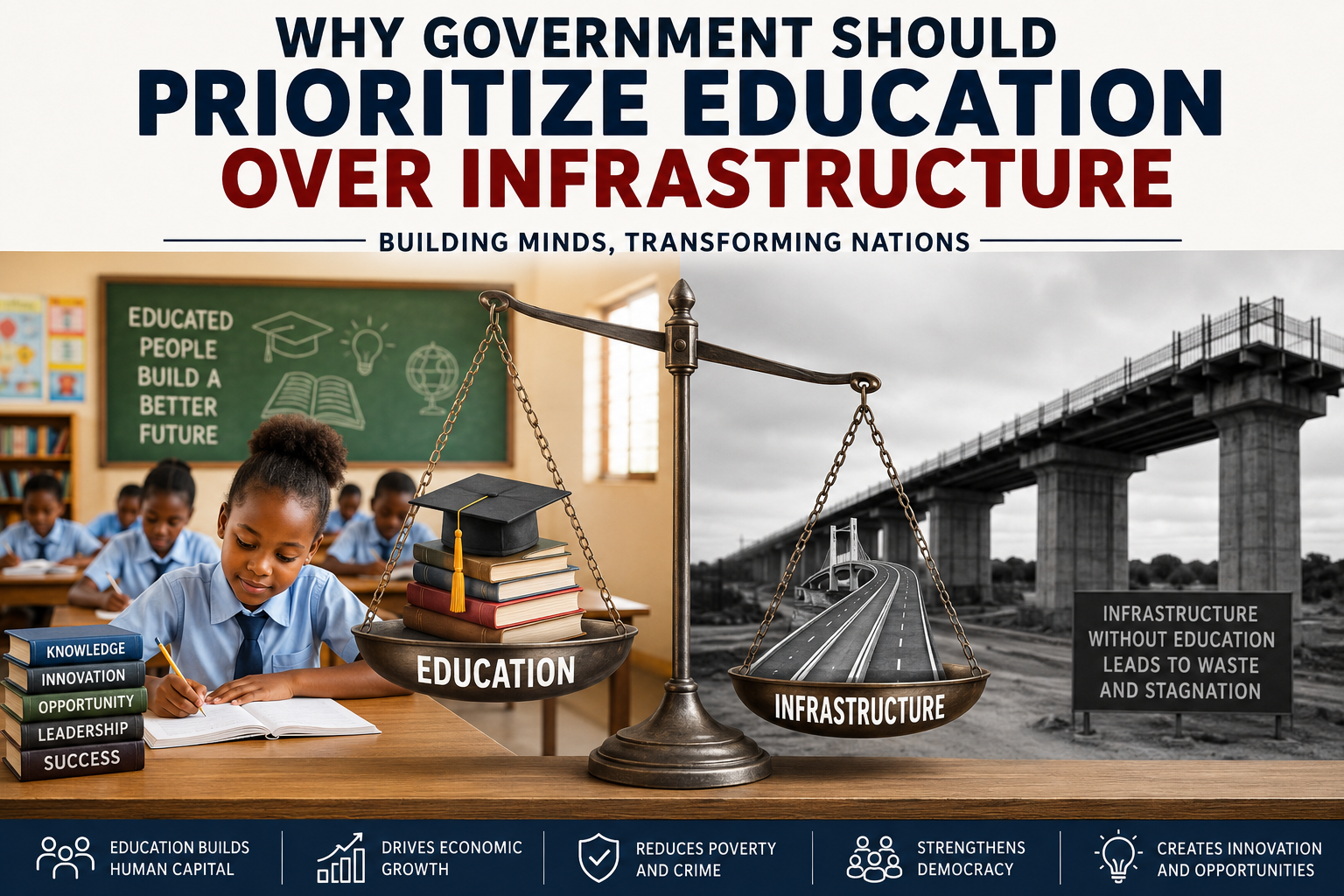
Every government has limited resources. There is never enough money to fix every road, build every bridge, fund every hospital, and improve every school at once. Because of this, leaders must decide what deserves urgent attention. While infrastructure is important for national development, education should come first because it builds the people who will design, maintain, improve, and protect every other sector.
A country can build beautiful roads, airports, and government buildings, but if its citizens lack quality education, those structures may not create lasting progress. Education produces skilled workers, informed voters, innovative entrepreneurs, ethical leaders, and responsible citizens. Infrastructure helps a nation move, but education helps a nation think.
This is why the government should prioritize education over infrastructure. Not because roads, railways, power, water, and housing are unimportant, but because education is the foundation that makes every other investment more useful and sustainable.
Education Builds Human Capital
The greatest resource of any country is not oil, gold, land, or buildings. It is people. A nation becomes strong when its citizens are educated, skilled, creative, and productive.
Education develops human capital. It gives people the knowledge and ability to solve problems, create businesses, use technology, manage resources, and contribute meaningfully to society. When the government invests in schools, teachers, libraries, research, vocational training, and digital learning, it is investing in the future workforce.
Infrastructure can support economic activity, but educated people drive that activity. Engineers design roads. Architects plan buildings. Accountants manage funds. Doctors protect public health. Teachers shape young minds. Technicians maintain power systems. Entrepreneurs create jobs.
Without education, infrastructure may exist, but there may not be enough skilled people to use, maintain, or improve it.
See also Should Students Use Mobile Phones in Class? Benefits, Risks, and the Best Way Forward
Education Reduces Poverty
One of the strongest reasons government should prioritize education is that it helps reduce poverty. A child who receives quality education has a better chance of getting a job, learning a skill, starting a business, or improving the condition of their family.
Poverty continues when people have no access to knowledge, training, or opportunity. Education breaks that cycle. It gives children from poor homes a chance to rise above the circumstances they were born into.
When more citizens are educated, they can earn better incomes, make informed financial decisions, and contribute to the economy. This reduces dependence on government support and improves the overall standard of living.
Infrastructure may create temporary jobs during construction, but education creates long-term earning power. A road may help people travel, but education helps them become employable, competitive, and independent.
Education Improves the Economy
A strong economy depends on skilled people. Countries with better education systems often have stronger industries, better innovation, and higher productivity.
When citizens are educated, they can work in healthcare, technology, agriculture, finance, manufacturing, engineering, law, media, and other important sectors. They can also create new industries and attract investment.
Businesses are more likely to grow in places where they can find skilled workers. Investors want locations with trained professionals, reliable managers, and a workforce that can adapt to modern technology.
Infrastructure is useful for business, but it cannot replace human skill. A modern airport is valuable, but it needs trained staff, engineers, security experts, logistics managers, and digital systems operators. A good road network is helpful, but it becomes more powerful when it connects educated people, active businesses, and productive communities.
Education does not just support the economy. It multiplies economic opportunity.
See also How to Use the Cornell Method to Take Better Lecture Notes (A Guide for Nigerian Students)
Education Encourages Innovation
The world is changing quickly. Technology, artificial intelligence, renewable energy, digital banking, online learning, and modern healthcare are reshaping how societies work. A government that wants long-term development must prepare its citizens for the future.
Education is the key to innovation. It teaches people how to think critically, ask questions, test ideas, and create solutions. It produces scientists, inventors, researchers, software developers, engineers, and entrepreneurs.
Infrastructure alone cannot make a country innovative. A nation may have modern buildings and highways, but if its schools are weak, it will depend on other countries for technology, expertise, and ideas.
When education is strong, citizens can design better infrastructure, improve farming methods, build digital platforms, create medical solutions, and develop local industries. Instead of only consuming what others produce, educated societies create their own solutions.
Education Strengthens Democracy
A democratic society needs educated citizens. People must be able to understand policies, question leaders, reject false information, and make wise decisions during elections.
When citizens lack education, they are easier to manipulate. They may vote based on fear, money, tribe, religion, or false promises rather than real policies and performance. This weakens democracy and allows poor leadership to continue.
Education helps people understand their rights and responsibilities. It teaches civic awareness, critical thinking, communication, and social responsibility. Educated citizens are more likely to demand accountability from leaders and participate in national development.
Infrastructure may impress people physically, but education empowers them mentally. A beautiful road cannot question corruption. A new bridge cannot demand justice. Educated citizens can.
Education Improves Public Health
Education also affects health. People with better education are more likely to understand hygiene, nutrition, disease prevention, maternal care, family planning, and the importance of medical treatment.
A government may build hospitals, but if people are not educated about health, they may not use those hospitals properly. They may ignore medical advice, rely on harmful myths, or delay treatment until conditions become worse.
Health education in schools can help young people make better choices. It can reduce preventable diseases, improve sanitation, and promote healthier families.
This shows again that infrastructure works better when people are educated. Hospitals, water systems, and sanitation projects are important, but education helps citizens use them wisely.
Read now Day School Is Better Than Boarding School: 12 Strong Debate Points
Education Reduces Crime and Social Problems
Lack of education can contribute to unemployment, poverty, frustration, and crime. When young people have no access to good schools or useful skills, they may become vulnerable to crime, violence, drug abuse, extremism, or exploitation.
Education gives people hope and direction. It teaches discipline, values, problem-solving, and useful skills. It also creates more legal pathways to income and success.
A society with more educated citizens is more likely to enjoy peace, stability, and social progress. Schools can become places where young people learn not only academic subjects, but also respect, teamwork, leadership, and responsibility.
Infrastructure can beautify a city, but education can transform the mindset of its people.
Infrastructure Without Education Is Not Sustainable
Some people argue that infrastructure should come first because roads, electricity, transport, and public buildings are visible signs of development. This argument has some truth. A country needs infrastructure to grow.
However, infrastructure without education is difficult to sustain. Roads need engineers and maintenance teams. Power systems need technicians. Water projects need managers. Public buildings need trained workers. Digital infrastructure needs IT experts.
If the government builds infrastructure but neglects education, the country may end up with projects that are poorly maintained, mismanaged, or underused. This leads to waste.
Education protects infrastructure investment. It ensures that there are enough skilled people to plan, operate, repair, and improve public assets.
Education Helps Rural and Urban Communities
Prioritizing education benefits both rural and urban areas. In rural communities, good schools can give children access to opportunities beyond farming, early marriage, or low-paying informal work. It can also improve agriculture by helping farmers learn modern methods, financial literacy, and technology use.
In cities, education helps young people compete for better jobs and adapt to fast-changing industries. It also reduces pressure on families by improving earning potential.
When education improves across the country, development becomes more balanced. People do not have to depend only on where they were born. They can use knowledge and skill to create a better life.
Government Should Invest in Quality, Not Just Access
Prioritizing education does not mean simply building more classrooms. The government must focus on quality.
See more Oppose the Motion: A Female Child Is Better Than a Male Child
A strong education policy should include:
- Well-trained and properly paid teachers
- Safe and equipped classrooms
- Updated curriculum
- Digital learning tools
- Vocational and technical training
- Affordable higher education
- Early childhood education
- Support for girls’ education
- School feeding programs where needed
- Scholarships for poor students
- Libraries and laboratories
- Strong monitoring of school performance
Education should prepare students for real life, not just examinations. Students need literacy, numeracy, digital skills, critical thinking, communication, financial literacy, and practical skills.
When education becomes useful and relevant, it produces citizens who can contribute to national growth.
A Balanced Approach Is Still Necessary
Saying education should be prioritized over infrastructure does not mean infrastructure should be ignored. No serious country can develop without roads, electricity, hospitals, housing, internet access, and clean water.
The point is about order and foundation. Education should receive stronger attention because it builds the people who will sustain every other sector.
The best approach is to invest in infrastructure that directly supports education. For example, the government can build roads to schools, provide electricity for classrooms, supply internet access to rural schools, and improve water and sanitation in learning environments.
This way, infrastructure supports education instead of competing with it.
Conclusion: Education Is the Strongest Foundation for Development
The government should prioritize education over infrastructure because education creates the human capacity needed for lasting development. Roads can connect cities, but educated people connect ideas. Buildings can change the look of a country, but education changes the future of its citizens.
Infrastructure is important, but it is not enough. Without education, a nation may have modern structures but weak systems, poor leadership, low innovation, and limited opportunity.
Education reduces poverty, strengthens the economy, improves health, supports democracy, reduces crime, and prepares citizens for the future. It is the foundation upon which every other form of development depends.
A government that truly wants progress should start with the mind of the people. When citizens are educated, they can build, protect, and improve the nation for generations to come.