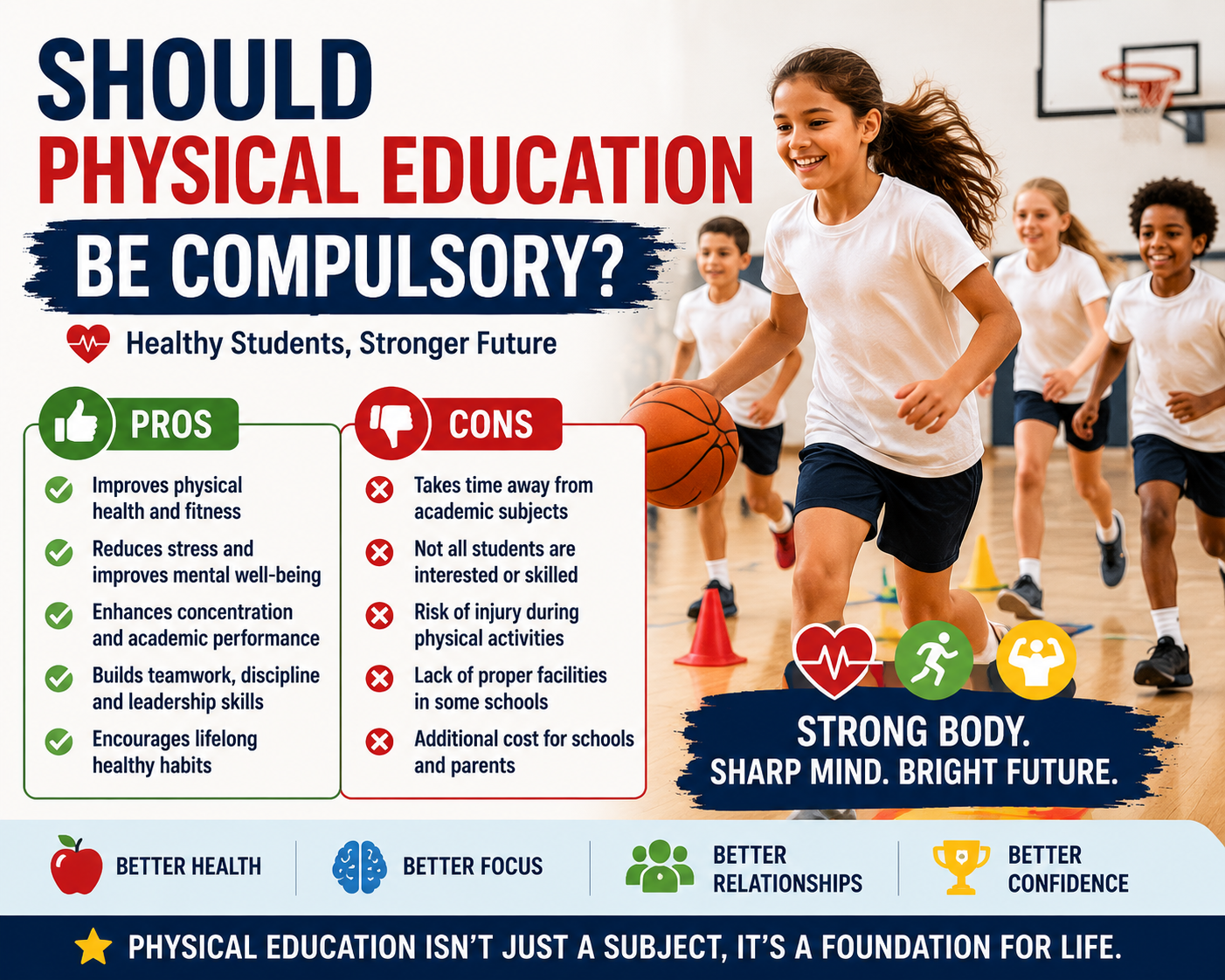
The question “Should physical education be compulsory?” continues to spark debate among educators, parents, and policymakers worldwide. In many schools, physical education (PE) is treated as a secondary subject compared to mathematics, science, and language studies. Yet, its importance in shaping a child’s physical, mental, and emotional development is becoming harder to ignore.
In a world where childhood obesity, stress, and sedentary lifestyles are increasing, many experts argue that physical education is not just important—it is essential. Others, however, believe that academic pressure and limited school time make compulsory PE difficult to justify.
So, should physical education be compulsory in schools? Let’s explore both sides of the argument in detail.
What Is Physical Education?
Physical education (PE) is a structured school subject that focuses on developing physical fitness, coordination, teamwork, and overall health through sports, exercises, and movement-based activities.
It includes activities such as:
- Running and athletics
- Team sports like football, basketball, and volleyball
- Gymnastics and stretching exercises
- Dance and rhythm activities
- Fitness training and endurance exercises
PE is not just about sports—it is about building lifelong habits of health, discipline, and teamwork.
Why Physical Education Is Important
Before answering whether PE should be compulsory, it is important to understand its role in a student’s development.
Physical education contributes to:
- Physical health
- Mental well-being
- Social skills
- Emotional resilience
- Academic performance
It is one of the few school subjects that directly improves both body and mind.
Arguments for Making Physical Education Compulsory
1. Improves Physical Health
One of the strongest arguments for compulsory PE is its direct impact on physical health. Regular exercise helps students:
See more The Lekki Headmaster: Themes and Symbolism (Complete Literature Guide)
- Maintain healthy body weight
- Strengthen muscles and bones
- Improve cardiovascular health
- Boost immune function
With rising cases of childhood obesity and lifestyle-related diseases, PE can serve as a preventive health tool.
2. Enhances Mental Health
Physical activity is closely linked to mental well-being. Exercise releases endorphins—chemicals in the brain that reduce stress and improve mood.
Students who participate in regular PE often experience:
- Reduced anxiety
- Better emotional balance
- Improved focus
- Lower stress levels
In an era of academic pressure and digital overload, PE provides a necessary mental break.
3. Improves Academic Performance
Contrary to the belief that PE takes away study time, research shows that physically active students often perform better academically.
Exercise improves:
- Concentration
- Memory retention
- Brain function
- Classroom behavior
A healthy body supports a healthy mind, which leads to better learning outcomes.
4. Encourages Discipline and Teamwork
Sports and physical activities teach students valuable life skills such as:
- Discipline
- Leadership
- Cooperation
- Communication
- Fair play
These skills extend far beyond the classroom and prepare students for real-world challenges.
5. Builds Lifelong Healthy Habits
Compulsory PE helps children develop habits that can last a lifetime. When students learn to enjoy physical activity early, they are more likely to stay active as adults.
This reduces long-term health risks such as:
- Heart disease
- Diabetes
- Obesity
- Hypertension
Arguments Against Making Physical Education Compulsory
Read also Parents Are NOT Solely to Blame for the Misconduct of Their Children
1. Academic Pressure and Limited Time
One common argument is that school time is already limited. Adding compulsory PE may reduce time available for academic subjects like mathematics and science.
Some educators believe that academic achievement should remain the top priority.
2. Not All Students Are Athletically Inclined
Another concern is that not every student enjoys sports or physical activity. Forcing PE on all students may create discomfort or anxiety for those who are less physically inclined.
3. Risk of Injury
Sports and physical activities carry some risk of injury. Critics argue that compulsory participation may expose students to unnecessary physical risks, especially in poorly supervised environments.
4. Lack of Proper Facilities
In some schools, especially in developing regions, there may be:
- Limited sports equipment
- Poor infrastructure
- Lack of trained PE teachers
This raises concerns about the effectiveness of compulsory PE programs.
Should Physical Education Be Compulsory?
Despite the challenges, most modern education experts agree that physical education should be compulsory, but with flexibility and inclusivity.
Rather than focusing solely on competitive sports, schools can offer:
- Fitness-based activities
- Non-competitive exercises
- Yoga and stretching
- Recreational games
- Personalized fitness programs
This ensures that all students benefit, regardless of athletic ability.
How Schools Can Improve Physical Education
To make PE more effective and inclusive, schools can:
- Train qualified PE instructors
- Provide proper sports facilities
- Introduce diverse activities beyond traditional sports
- Focus on participation rather than competition
- Encourage students with different fitness levels
- Integrate health education with physical activity
The Role of Parents and Society
Physical education is not only the responsibility of schools. Parents and society also play a key role in encouraging active lifestyles.
Parents can:
- Encourage outdoor play
- Limit excessive screen time
- Participate in family physical activities
- Promote sports participation
A supportive environment at home reinforces what children learn at school.
See more Should Students Use Mobile Phones in Class? Benefits, Risks, and the Best Way Forward
Frequently Asked Questions
Why should physical education be compulsory?
Physical education should be compulsory because it improves physical health, mental well-being, academic performance, and social skills among students.
Does PE affect academic performance?
Yes, positively. Regular physical activity improves focus, memory, and classroom behavior, which can enhance academic performance.
What are the disadvantages of compulsory PE?
The main disadvantages include time constraints, lack of facilities, risk of injury, and the fact that not all students enjoy sports.
Can PE be inclusive for all students?
Yes. Schools can offer non-competitive and flexible activities such as yoga, walking, fitness exercises, and recreational games.
What is the main goal of physical education?
The main goal is to promote lifelong health, fitness, and well-being through structured physical activity and education.
Conclusion
So, should physical education be compulsory?
The answer is a strong yes—with thoughtful implementation.
While academic subjects are important, they should not come at the expense of physical and mental health. Physical education plays a vital role in developing healthier, happier, and more well-rounded students.
Rather than treating PE as a secondary subject, schools should embrace it as an essential part of education—one that builds discipline, confidence, teamwork, and lifelong wellness.
In a world increasingly affected by sedentary lifestyles and digital dependence, physical education is no longer optional. It is a necessity for raising a healthy generation.