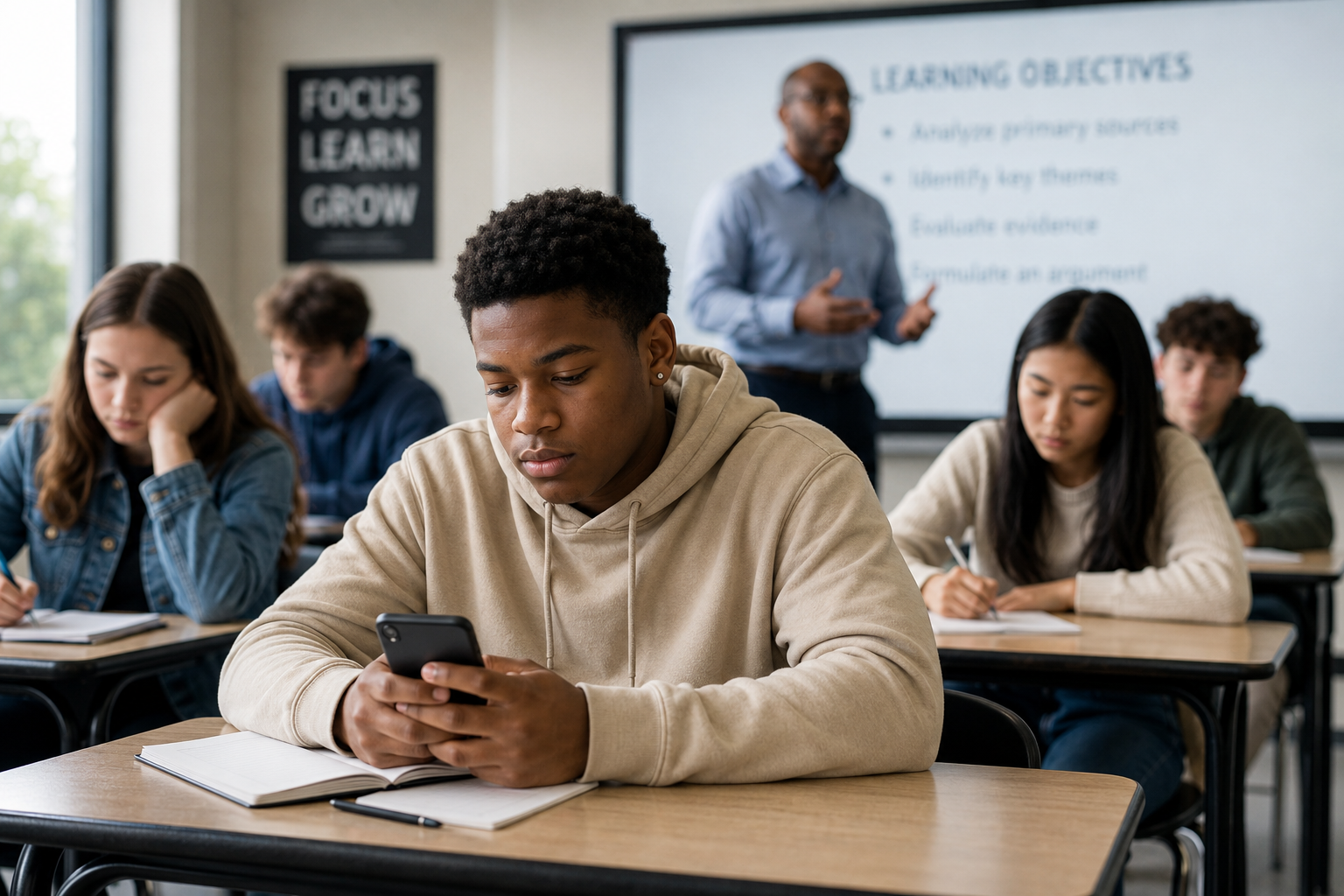
Mobile phones have become an important part of everyday life. Students use them to communicate, search for information, take photographs, access educational applications, and organise their schedules. However, when phones enter the classroom, they can either support learning or become a major distraction.
This raises an important question: Should students use mobile phones in class?
There is no simple yes-or-no answer. Mobile phones can be valuable educational tools when used with clear rules and a specific learning purpose. At the same time, unrestricted phone use can reduce concentration, encourage cheating, disrupt lessons, and expose students to inappropriate content.
The most effective approach may not be a complete ban or unlimited access. Instead, schools should create balanced classroom phone policies that allow teachers to use mobile technology when it benefits learning while limiting it during explanations, assessments, discussions, and independent work.
Why Is Mobile Phone Use in Class So Controversial?
Mobile phones place communication, entertainment, social media, games, cameras, calculators, books, and internet access in one small device. This versatility makes them useful, but it also makes them difficult to control.
A student may begin by searching for information related to a lesson and quickly become distracted by a message, video, game, or social media notification. Teachers may also struggle to determine whether students are using their phones for schoolwork or unrelated activities.
The debate is therefore not simply about whether phones are good or bad. It is about whether students can use them responsibly and whether schools can create an environment in which technology supports rather than weakens education.
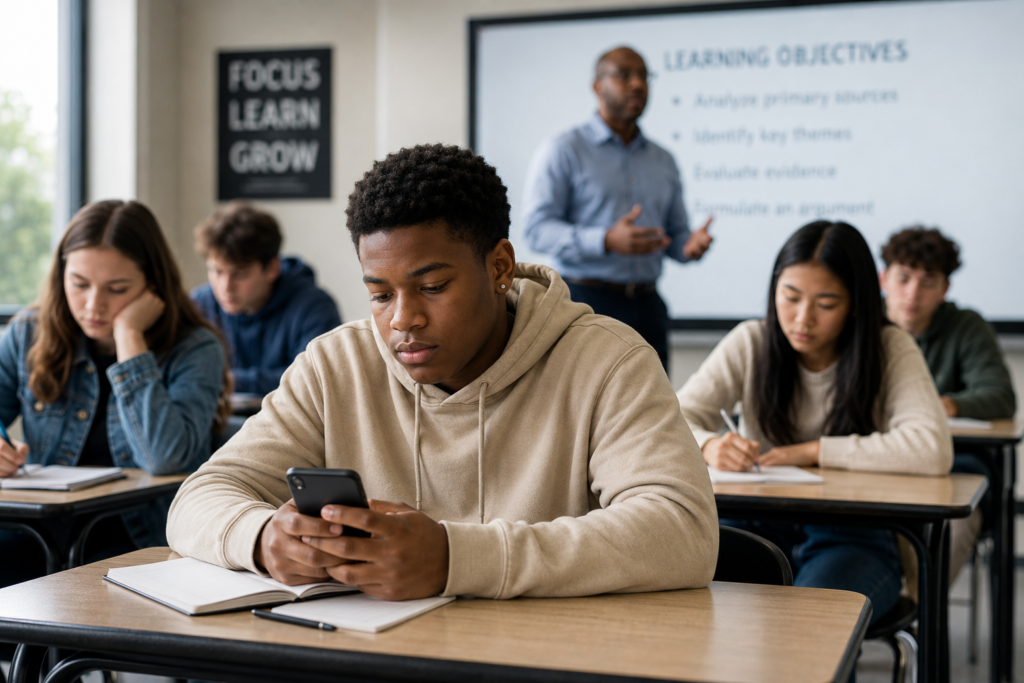
Benefits of Allowing Students to Use Mobile Phones in Class
1. Quick Access to Educational Information
One of the strongest arguments for allowing mobile phones in class is that they give students immediate access to information.
Read now How to Use the Cornell Method to Take Better Lecture Notes (And Stop Cramming)
Students can use their phones to:
- Research unfamiliar terms
- Check facts and definitions
- Read digital books and articles
- Watch educational demonstrations
- Access online dictionaries
- Find current examples connected to a lesson
This can make learning more interactive and help students explore topics beyond the information contained in a printed textbook.
However, online research should still be guided by the teacher. Students must learn how to identify reliable sources, compare information, and avoid copying inaccurate material.
2. Access to Learning Applications
Many mobile applications are designed to support education. Students can use apps for mathematics, science, languages, writing, coding, revision, flashcards, and classroom quizzes.
Interactive applications can make lessons more engaging by allowing students to answer questions, participate in polls, practise new skills, and receive immediate feedback.
For example, a language teacher may ask students to use a pronunciation app, while a science teacher may use a digital simulation to explain a difficult concept.
When chosen carefully, these applications can improve participation and make abstract topics easier to understand.
3. Improved Digital Literacy
Students are growing up in a technology-driven world. They will likely need digital skills in higher education and the workplace.
Allowing controlled mobile phone use in class can teach students how to:
- Search for information effectively
- Evaluate online sources
- Communicate professionally
- Protect their privacy
- Manage digital distractions
- Use technology responsibly
- Follow rules in shared environments
Simply banning phones does not necessarily teach responsible behaviour. Guided use can help students understand when technology is appropriate and when it should be put away.
4. Support for Students With Different Learning Needs
Mobile phones can provide useful accessibility features for students with disabilities or additional learning needs.
These may include:
- Text-to-speech tools
- Speech-to-text applications
- Screen magnification
- Digital note-taking
- Translation tools
- Audiobooks
- Reminders and organisational apps
For some students, a mobile phone is not merely a social device. It may be an important tool that helps them participate more independently in the classroom.
Schools should therefore consider individual needs before introducing strict rules that apply to every student in exactly the same way.
5. Better Organisation and Time Management
Students can use their phones to record homework, set reminders, check deadlines, access school platforms, and organise revision schedules.
A student who regularly forgets assignments may benefit from calendar alerts or task-management applications. Teachers may also use school-approved platforms to share lesson materials, announcements, and submission dates.
Used responsibly, mobile phones can help students become more organised and accountable.
6. Communication During Emergencies
Parents often want their children to carry phones for safety reasons. During an emergency, a mobile phone can provide a direct means of communication.
Students may need to contact a parent after school, report a transport problem, or receive an urgent family message.
However, emergency access does not mean students need unrestricted phone use throughout every lesson. Schools can allow students to carry phones while requiring them to remain silent and stored unless permission is given.
Disadvantages of Mobile Phones in the Classroom
1. Distraction From Learning
The biggest disadvantage of mobile phones in class is distraction.
Notifications, messages, games, videos, and social media can easily pull students away from a lesson. Even when students do not actively use their phones, seeing or hearing a notification may interrupt their concentration.
Frequent interruptions can make it harder for students to understand instructions, remember information, complete tasks, and participate in discussions.
One distracted student may also distract the people sitting nearby.
2. Reduced Classroom Participation
Meaningful learning often requires listening, asking questions, discussing ideas, and interacting with classmates. Students who constantly check their phones may become less engaged with the teacher and the people around them.
This can weaken classroom relationships and reduce opportunities for collaboration.
A classroom should be a place where students practise communication, patience, teamwork, and respectful attention. Excessive phone use can make face-to-face interaction more difficult.
See now Mother Is More Important Than Father Debate: Arguments, Facts, and Perspectives
3. Increased Risk of Cheating
Mobile phones can make cheating easier during tests and assignments.
Students may use them to:
- Search for answers online
- Send questions to other students
- Photograph test papers
- Access stored notes
- Use artificial intelligence tools without permission
- Communicate with someone outside the classroom
For this reason, phones should normally be turned off and stored away during examinations and formal assessments.
Clear consequences should also be established for students who use devices dishonestly.
4. Cyberbullying and Inappropriate Content
Mobile phones can be used to send hurtful messages, share embarrassing images, record people without permission, or access inappropriate websites.
Cyberbullying can continue during school hours and may be difficult for teachers to detect. A student may appear to be quietly using a phone while participating in harmful online behaviour.
Schools need strong safeguarding procedures and clear rules about photography, recording, messaging, and online conduct.
Students must understand that digital actions have real consequences.
5. Privacy Concerns
The cameras and recording features on mobile phones create serious privacy concerns.
Students may photograph classmates, record teachers, or share classroom content without consent. Even a recording made as a joke can cause emotional harm or damage someone’s reputation.
A responsible classroom phone policy should prohibit unauthorised photography, audio recording, and video recording.
Permission should always be obtained before capturing or sharing another person’s image or voice.
6. Social and Economic Inequality
Not every student has access to the same type of phone, internet connection, or data plan.
If teachers regularly require students to use personal devices, those with older phones or no phones may feel embarrassed or excluded.
Schools should not assume that every student owns suitable technology. Any mobile-based activity should have an alternative, such as a school tablet, shared device, printed resource, or computer.
Educational opportunities should not depend on the cost of a student’s phone.
7. Dependence on Technology
Mobile phones can provide fast answers, but constant access may reduce students’ willingness to think deeply, remember information, or solve problems independently.
Students may become too dependent on calculators, search engines, translation apps, or artificial intelligence tools.
Technology should support thinking rather than replace it. Teachers should still provide opportunities for students to write by hand, calculate mentally, discuss ideas, read carefully, and complete tasks without digital assistance.
Should Mobile Phones Be Completely Banned in Schools?
A complete ban may reduce distractions and make classroom rules easier to enforce. It may also encourage students to interact more directly with teachers and classmates.
However, a total ban has limitations.
Mobile phones can support accessibility, emergency communication, research, organisation, and digital learning. A strict ban may also be difficult to enforce consistently, especially when students are already allowed to bring devices onto school property.
Rather than banning phones in every situation, schools may achieve better results through a controlled-use policy.
Under this approach, students can bring phones to school, but they must keep them silent and stored unless a teacher gives permission for an educational activity.
What Does a Good Classroom Phone Policy Look Like?
An effective policy should be clear, realistic, consistent, and easy for students to understand.
A balanced classroom phone policy may include the following rules:
- Phones must remain silent during lessons.
- Devices should be stored in bags, lockers, or designated phone holders unless the teacher gives permission.
- Phones may be used only for an approved learning activity.
- Photography, audio recording, and video recording are prohibited without consent.
- Phones must be switched off and stored during tests and examinations.
- Students who need phones for accessibility or medical reasons should receive appropriate support.
- Schools should provide alternative devices for students who do not own suitable phones.
- Consequences for misuse should be fair, gradual, and applied consistently.
- Parents should contact the school office during lesson time rather than repeatedly messaging students.
- Teachers should model responsible phone use themselves.
The goal should not be to punish students for owning technology. The goal should be to establish boundaries that protect concentration, privacy, safety, and academic integrity.
Read also How to Avoid Daydreaming/Zoning Out in the Library: A Student’s Guide to Staying Focused
How Teachers Can Use Mobile Phones Productively
Teachers who allow phones for learning should provide clear instructions before students take out their devices.
They can explain:
- Which application or website students should use
- How long the activity will last
- Whether students may work alone or in groups
- What information they should record
- What they should do when the activity ends
Teachers can also walk around the classroom, monitor screens where appropriate, and use short time limits to reduce off-task behaviour.
Once the activity is complete, students should be instructed to put their phones away before the lesson continues.
This creates a clear distinction between educational use and personal use.
The Role of Parents
Parents also play an important role in helping students develop responsible phone habits.
They can support schools by:
- Avoiding non-urgent messages during lesson time
- Discussing online safety at home
- Setting limits on social media and gaming
- Encouraging healthy sleep routines
- Teaching children to respect other people’s privacy
- Supporting reasonable school rules
- Avoiding pressure on children to respond immediately during class
When parents, teachers, and students follow the same expectations, phone policies are more likely to succeed.
The Role of Students
Students should understand that using a mobile phone in class is a privilege, not an automatic right.
Responsible students should be able to:
- Follow the teacher’s instructions
- Keep the device silent
- Avoid unrelated applications
- Respect privacy
- Use reliable sources
- Put the phone away when asked
- Avoid cheating
- Report harmful online behaviour
Learning how to control digital habits is an important life skill. Students who can manage their attention will be better prepared for university, employment, and adult responsibilities.
Final Verdict: Should Students Use Mobile Phones in Class?
Students should be allowed to use mobile phones in class only when the devices have a clear educational purpose or meet an approved accessibility need.
Unrestricted phone use should not be permitted because it can distract students, reduce participation, encourage cheating, create privacy problems, and disrupt the learning environment.
At the same time, a complete ban may prevent schools from using valuable digital tools and teaching responsible technology habits.
The best solution is a balanced policy: phones away by default, but available with the teacher’s permission for specific educational activities.
Mobile phones are neither completely good nor completely bad. Their impact depends on how, when, and why they are used. With clear expectations, consistent supervision, and responsible behaviour, phones can support learning without taking control of the classroom.
Frequently Asked Questions
Should students be allowed to bring phones to school?
Students may be allowed to bring phones for safety, transport arrangements, accessibility, and communication after school. However, the devices should normally remain silent and stored during lessons unless a teacher gives permission.
Do mobile phones improve learning?
Mobile phones can improve learning when students use educational applications, research tools, digital books, quizzes, and accessibility features. They are less helpful when students use them for social media, games, or unrelated messaging during class.
What is the biggest disadvantage of phones in class?
The biggest disadvantage is distraction. Messages, notifications, videos, and games can reduce concentration and make it harder for students to understand and remember lesson content.
Should phones be banned during examinations?
Yes. Phones should normally be switched off and stored away during tests and examinations because they can be used to search for answers, access notes, communicate with others, or photograph assessment materials.
How can schools control mobile phone use?
Schools can introduce a clear policy requiring phones to remain silent and stored unless a teacher authorises their use. Policies should also address recording, cyberbullying, cheating, accessibility needs, and consequences for misuse.
Can phones help students with disabilities?
Yes. Mobile phones can provide speech-to-text, text-to-speech, magnification, reminders, translation, audiobooks, and other accessibility tools. Schools should make reasonable exceptions for approved learning, medical, and accessibility needs.
What is the best classroom phone rule?
A practical rule is: phones away unless the teacher says otherwise. This protects students’ attention while allowing devices to be used when they genuinely improve the lesson.
Conclusion
The question is not simply whether students should use mobile phones in class. The more important question is whether schools can teach students to use technology with purpose, discipline, and respect.
A phone should never replace attentive listening, independent thinking, classroom discussion, or meaningful human interaction. However, when used under clear supervision, it can provide access to information, learning tools, accessibility features, and valuable digital skills.
Schools should therefore focus on responsible, limited, and purposeful use rather than choosing between complete prohibition and unlimited access.