Choosing the right school is one of the most important decisions a parent can make. For many families, the debate comes down to two options: public school or private school.
Private schools are often associated with smaller classes, exclusive programs, and impressive facilities. However, those advantages do not automatically make them the better choice. Public schools offer many benefits that are sometimes overlooked, including free education, greater diversity, stronger community connections, wider access to student services, and more accountability.
In fact, for many children and families, public schools provide a more practical, inclusive, and well-rounded educational experience.
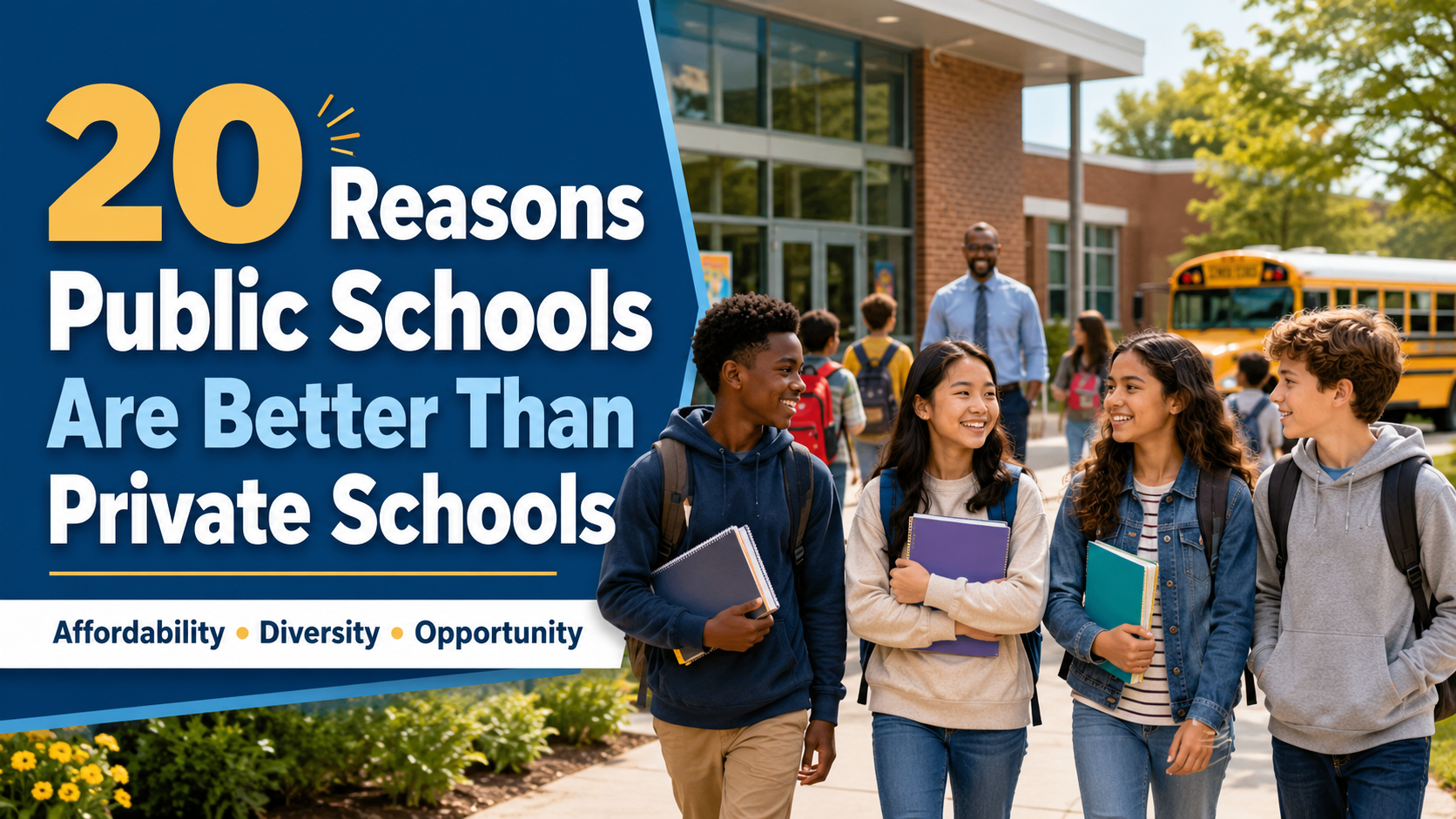
This article explores 20 reasons why public schools are better than private schools and why parents should not assume that paying tuition always leads to a better education.
Are Public Schools Better Than Private Schools?
Public schools can be better than private schools for families who value affordability, diversity, accessibility, public accountability, special education services, and community involvement.
Of course, school quality varies. An excellent private school may outperform a struggling public school, while a strong public school may offer better academics, extracurricular activities, and student support than many private institutions.
Read now How to Use the Cornell Method to Take Better Lecture Notes (A Guide for Nigerian Students)
Therefore, the most accurate comparison is not simply public versus private. Parents should compare individual schools, teachers, programs, student outcomes, safety policies, and support services.
Even so, public education has several major advantages.
1. Public Schools Are Free to Attend
The most obvious benefit of public schools is that they do not charge tuition.
Public education is funded mainly through government revenue and taxes, allowing children to receive an education regardless of their parents’ income.
Private school tuition can place significant pressure on a household budget. In addition to tuition, families may have to pay for uniforms, transportation, books, technology, meals, sports, excursions, and other activities.
Public schools make education accessible without requiring parents to sacrifice savings, take on debt, or reduce spending on other family needs.
The money saved can be used for tutoring, educational technology, family travel, extracurricular lessons, college savings, or other opportunities that support a child’s development.
2. Public Schools Welcome Students From All Backgrounds
Public schools generally serve all eligible children living within their attendance areas.
They do not exist only for families who can afford tuition or meet selective admissions standards. This creates a more inclusive learning environment.
Children attend school with classmates from different cultures, income levels, religions, family structures, and life experiences. This exposure can help students become more open-minded, understanding, and respectful.
See more Nurse vs Teacher: Is a Nurse More Important Than a Teacher?
The real world is diverse. Public schools often reflect that reality more closely than highly selective institutions.
3. Public Schools Offer Greater Social and Cultural Diversity
One of the strongest arguments in the public schools versus private schools debate is diversity.
In many communities, public school students regularly interact with people whose lives may be very different from their own. They learn to communicate, collaborate, solve problems, and build friendships across social and cultural differences.
These experiences can prepare students for universities, workplaces, and communities where they will meet people with different perspectives.
Diversity is not only about ethnicity. It may also include language, disability, economic background, academic ability, beliefs, and personality.
A diverse classroom can help students develop empathy and social awareness.
4. Public Schools Are More Closely Connected to Their Communities
Public schools are usually deeply connected to the neighborhoods they serve.
Students may attend school with people who live nearby, participate in local events, use community facilities, and build long-term friendships within their area.
Parents may also find it easier to become involved through parent associations, school boards, sports programs, volunteer activities, and community meetings.
A strong neighborhood school can become a center for local relationships, youth programs, public events, and family support.
5. Public Schools Usually Provide Transportation
Many public school systems provide bus transportation for eligible students.
This can be a major advantage for working parents, families without reliable vehicles, and students who live far from school.
Private school transportation may be unavailable, limited, or offered at an additional cost.
Reliable school transportation can reduce daily stress and help ensure that students arrive safely and consistently.
6. Public Schools Must Follow Government Education Standards
Public schools are required to follow state or national academic standards.
These standards typically outline what students should learn in subjects such as mathematics, science, reading, social studies, and language arts.
Public schools are also subject to inspections, testing requirements, curriculum rules, teacher qualification standards, and financial oversight.
Although standardized systems are not perfect, they provide a level of public accountability. Parents can review school performance, policies, budgets, and educational outcomes.
Private schools may have greater freedom in how they operate, but that freedom can also mean less consistent oversight.
7. Public School Teachers Must Meet Certification Requirements
Public school teachers are generally required to meet government-approved education, training, and certification standards.
They may need to complete a teaching degree, practical classroom experience, examinations, background checks, and ongoing professional development.
Certification does not guarantee that every teacher will be excellent. However, it creates a minimum professional standard.
Some private schools hire highly qualified educators, but others may have more flexibility to employ teachers without the same certification requirements.
8. Public Schools Often Have More Special Education Services
Public schools are legally required to provide appropriate services for eligible students with disabilities.
Depending on the school system, these services may include:
- Individualized education plans
- Speech and language therapy
- Occupational therapy
- Physical therapy
- Behavioral support
- Classroom accommodations
- Specialized instruction
- Educational assessments
- School psychologists
- Assistive technology
Private schools may offer some of these services, but availability can vary widely. Some private institutions may not have the staff, funding, or legal obligation to support every student’s needs.
For families with children who need specialized assistance, public schools may provide stronger protection and a wider support system.
9. Public Schools Offer Support for English Language Learners
Students who are still learning the main language of instruction may receive additional support in public schools.
This may include language development classes, bilingual education, translation services, specialized teachers, and assistance for parents.
These programs can help immigrant and multilingual families participate more effectively in the school community.
Some private schools offer excellent language support, but it is not always available or included in tuition.
10. Public Schools Often Have Larger Course Selections
Large public middle schools and high schools may offer a wide range of subjects.
Students may have access to:
- Advanced mathematics
- Laboratory sciences
- Computer science
- Foreign languages
- Business studies
- Engineering
- Journalism
- Music
- Fine arts
- Theater
- Career and technical education
- Advanced Placement courses
- College-credit programs
Some private schools have strong academic programs, but smaller institutions may not have enough teachers or students to provide the same variety.
A broad course selection allows students to explore their interests before choosing a college major or career.
11. Public Schools May Offer More Extracurricular Activities
Public schools often provide numerous extracurricular opportunities, especially in larger districts.
Activities may include athletics, debate, drama, robotics, student government, school newspapers, music groups, academic clubs, community service, and cultural organizations.
These programs help students develop confidence, leadership, teamwork, creativity, and communication skills.
Because public schools may have larger student populations, they can sometimes support more teams and clubs than smaller private institutions.
12. Public Schools Provide Access to School Meals
Many public schools offer breakfast and lunch programs.
Eligible students may receive free or reduced-price meals, helping to ensure that financial hardship does not prevent them from eating during the school day.
Nutrition can directly affect concentration, behavior, energy, and academic performance.
Public school meal programs can provide valuable support for families facing financial pressure.
Some schools also offer meals during holidays, summer programs, or after-school activities.
13. Public Schools Can Offer Strong Sports Programs
Public schools often have established athletic departments, playing fields, gymnasiums, coaches, leagues, and competitions.
Students may be able to participate in football, basketball, soccer, athletics, swimming, wrestling, tennis, baseball, volleyball, and other sports.
School athletics can improve physical health while teaching discipline, cooperation, time management, resilience, and leadership.
Although some private schools are famous for sports, many public schools also have highly competitive and well-supported athletic programs.
14. Public Schools Prepare Students for the Real World
Public schools bring together students with different strengths, challenges, personalities, and backgrounds.
As a result, students must learn how to interact with a wide range of people.
They may encounter different viewpoints, communication styles, family experiences, and cultural traditions.
This environment can help students develop adaptability. They learn that not everyone thinks, speaks, behaves, or lives in the same way.
These are valuable lessons for adult life.
15. Public Schools Are More Publicly Accountable
Public schools answer to taxpayers, education departments, elected boards, parents, and government agencies.
Read also Woman’s Education Does Not End in the Kitchen: A Powerful Debate
Their performance information, spending decisions, policies, board meetings, and improvement plans may be available to the public.
Parents can often raise concerns through formal channels, attend meetings, request records, or communicate with elected representatives.
Private schools are accountable to their owners, boards, religious organizations, or parent communities, but their decision-making processes may not be as publicly accessible.
16. Public Schools Cannot Easily Remove Struggling Students
Private schools may have greater freedom to reject applicants, decline reenrollment, or dismiss students whose academic, behavioral, or support needs become difficult to manage.
Public schools generally have a responsibility to educate eligible children in their communities.
This means public educators often work with students who have complex academic, emotional, behavioral, economic, or family challenges.
Although this can place pressure on school resources, it also reflects an important principle: every child deserves access to education.
17. Public Schools May Offer Better Career and Technical Education
Many public school districts offer career and technical education programs that prepare students for both employment and further study.
Students may receive practical training in areas such as:
- Information technology
- Automotive repair
- Healthcare
- Construction
- Agriculture
- Culinary arts
- Graphic design
- Welding
- Engineering
- Business administration
- Digital media
These programs may include industry certifications, apprenticeships, internships, and partnerships with local employers.
Private schools often emphasize college preparation, but they may not always offer the same range of vocational and technical pathways.
18. Public Schools Give Parents a Voice in Education Policy
Parents of public school students may vote in school board elections, attend public meetings, join parent committees, and participate in policy discussions.
This provides an opportunity to influence decisions related to school funding, safety, curriculum, facilities, staffing, and student services.
The amount of influence varies by district, but public education is designed to involve the wider community.
At a private school, major decisions may be made by a small board, owner, church, or administrative team.
19. Public Schools Can Make Changing Schools Easier
Families sometimes move because of employment, housing, family responsibilities, or financial changes.
A child enrolled in public education can usually transfer into another public school without facing new tuition fees.
Private school families may have to search for another suitable institution, complete an admissions process, pay new fees, and adjust to a different curriculum.
Public school systems can provide greater continuity for mobile families, particularly when schools follow similar government standards.
20. Paying Tuition Does Not Guarantee Better Education
One of the biggest misconceptions about education is that a more expensive school must be a better school.
Tuition can pay for smaller classes, attractive facilities, specialized programs, or exclusive activities. However, it does not guarantee excellent teaching, healthy school culture, strong leadership, student safety, or academic success.
A motivated student with supportive parents and skilled teachers can thrive in a public school.
Meanwhile, a student in an expensive private school may still experience poor instruction, social pressure, limited support, or an environment that does not suit their needs.
Parents should judge a school by what it actually provides—not by its price.
Public School vs Private School: Which Is Better?
There is no single answer that applies to every family.
A private school may be the right choice when it offers a specific religious environment, teaching method, specialist program, or support system that matches a child’s needs.
A public school may be better when a family values affordability, neighborhood connections, diverse friendships, student services, career programs, and public accountability.
Parents should visit the schools they are considering and ask questions about:
- Teacher experience
- Class sizes
- Academic performance
- School safety
- Student discipline
- Special education
- Extracurricular activities
- Bullying prevention
- Parent communication
- Mental health support
- Transportation
- Technology
- Graduation rates
- Student wellbeing
The name “public” or “private” does not tell the whole story.
Read now The Lekki Headmaster: Themes and Symbolism (Complete Literature Guide)
Frequently Asked Questions
Do Public School Students Perform Better Than Private School Students?
Student performance depends on many factors, including family income, parental involvement, teaching quality, school resources, student motivation, and access to academic support.
Private school students may sometimes achieve higher average test scores, but that does not automatically prove that the school itself caused the difference. Private schools may enroll students from families with more educational and financial resources.
Strong public schools can produce excellent academic outcomes.
Why Do Parents Choose Public Schools?
Parents choose public schools because they are tuition-free, accessible, diverse, community-based, and required to provide important student services.
Public schools may also offer transportation, meal programs, sports, advanced courses, vocational education, and special education support.
Are Public Schools More Diverse Than Private Schools?
Public schools are often more socially, culturally, academically, and economically diverse because they serve children throughout a geographic community.
However, the level of diversity depends on the location and local population.
Are Public School Teachers More Qualified?
Public school teachers are generally required to meet government certification standards.
Private school requirements vary. Many private schools hire highly qualified teachers, while others may be allowed to employ instructors without the same formal certification.
Can Public Schools Provide a High-Quality Education?
Yes. Many public schools offer excellent teachers, advanced academic programs, modern technology, competitive sports, performing arts, career training, and strong college preparation.
Quality varies between schools, which is why parents should research individual institutions carefully.
Final Thoughts
Public schools are not perfect. Some face overcrowding, funding shortages, staff turnover, outdated facilities, or academic challenges.
However, private schools also have weaknesses, and paying tuition does not automatically eliminate educational problems.
Public schools offer something especially valuable: broad access to education. They welcome students from different backgrounds, provide essential support services, connect families with their communities, and prepare children to live and work in a diverse society.
For many families, public education is not merely the cheaper alternative. It is the better one.