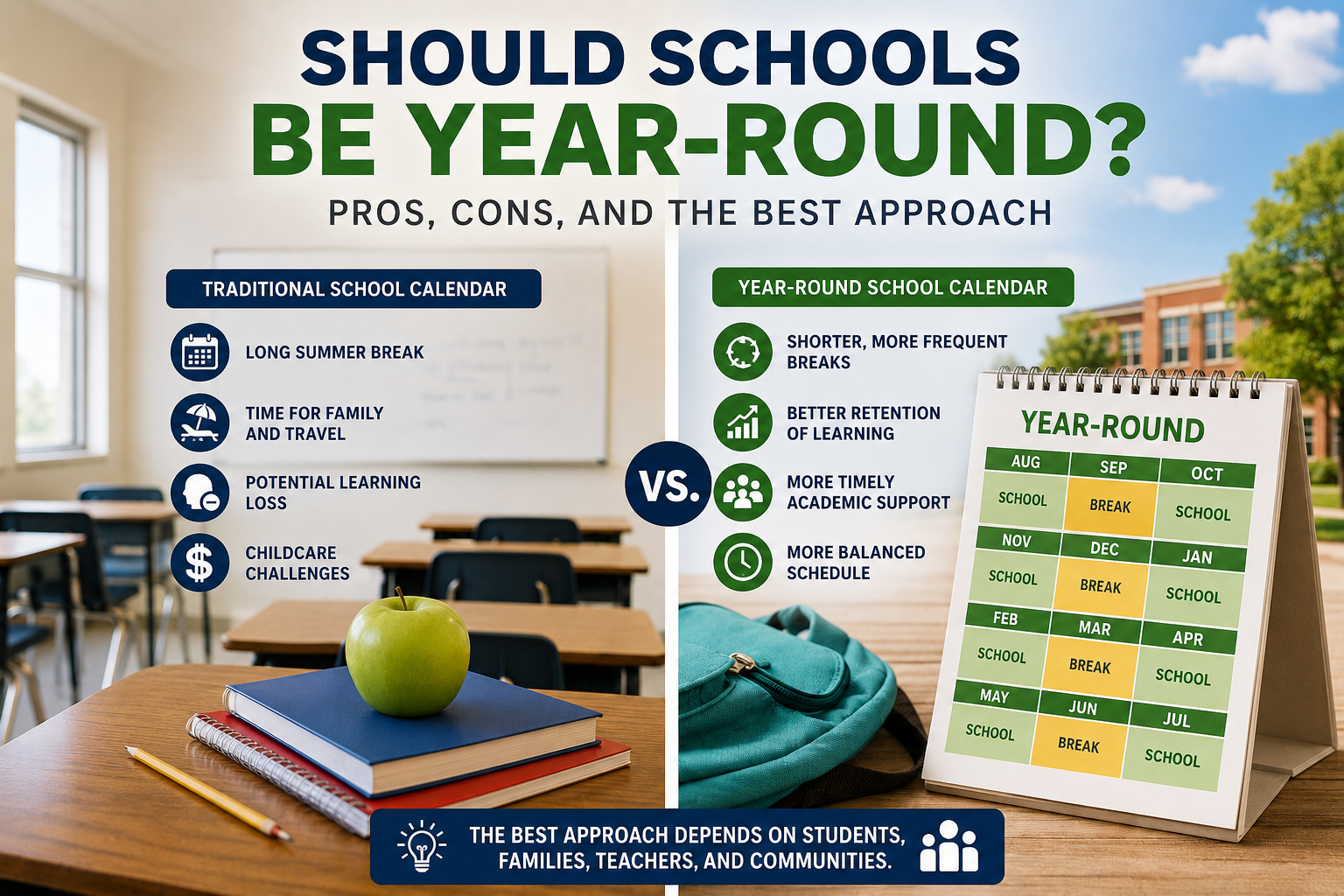
The traditional school calendar is familiar to most families: students attend classes for several months, receive short breaks during the year, and then enjoy a long summer holiday.
But is that still the best way to organise education?
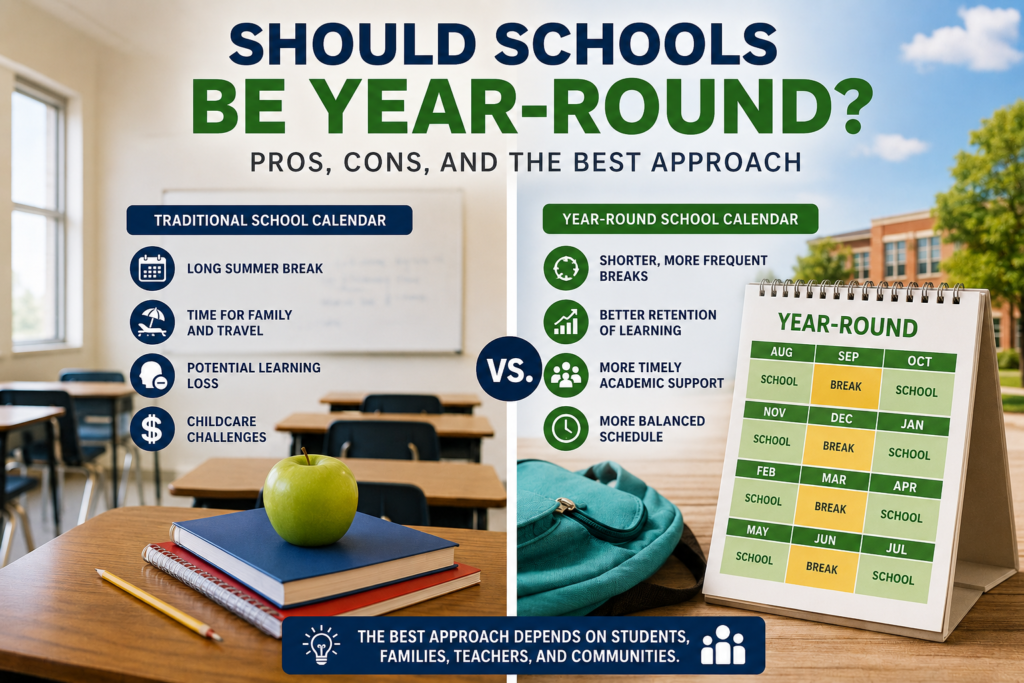
Supporters of year-round schooling argue that shorter, more frequent breaks can help students retain what they have learned, reduce the pressure placed on families during long holidays, and give struggling learners more regular opportunities for support.
Critics, however, believe year-round school could interfere with family life, increase operating costs, complicate childcare arrangements, and leave teachers and students without enough time to rest.
This raises an important question: Should schools be year-round?
The answer depends on how the calendar is designed, the needs of the community, and whether the school has the resources to make the transition successful. Year-round education may benefit some students and districts, but it is not automatically the best choice for every school.
What Is Year-Round School?
Year-round school does not always mean students attend classes every day of the year.
See more Should Students Use Mobile Phones in Class? Benefits, Risks, and the Best Way Forward
In many year-round school systems, students attend approximately the same number of instructional days as students following a traditional calendar. The major difference is how those days and holidays are distributed.
Instead of one long summer break, a year-round calendar may include:
- Several weeks of instruction
- A shorter break
- Another period of instruction
- Another scheduled break
For example, students may attend school for several weeks and then receive a two- or three-week break before the next learning period begins.
These shorter holidays are sometimes called intersessions. During an intersession, some students may rest, travel, spend time with family, or attend optional academic support programmes.
The purpose is not necessarily to increase the number of school days. It is often to create a more balanced calendar with fewer extended interruptions.
Why Are Schools Considering Year-Round Education?
Schools are under pressure to improve academic performance while also meeting the changing needs of families.
A long summer holiday can create practical challenges. Parents may need to pay for childcare, camps, or other supervised activities. Students may also spend several weeks away from reading, writing, mathematics, and structured learning.
When school resumes, teachers may need time to review lessons that students have forgotten.
Year-round education is presented as one possible solution. By shortening the summer break and distributing holidays across the year, schools may create a more continuous learning experience.
However, changing the calendar affects far more than classroom instruction. It can influence transportation, sports, childcare, school meals, family travel, teacher contracts, building maintenance, and community programmes.
That is why the decision requires careful planning.
Benefits of Year-Round School
1. Students May Forget Less During Long Breaks
One of the strongest arguments for year-round schooling is that shorter breaks may reduce learning loss.
When students are away from school for an extended period, they may forget important skills, particularly when they do not read, practise mathematics, or participate in educational activities during the holiday.
Teachers may then spend the first part of a new school year reviewing previous material.
A balanced calendar could help students stay connected to learning throughout the year. With shorter interruptions, lessons may feel more continuous, and teachers may need less time to rebuild old skills.
This does not mean students never forget anything during shorter breaks. However, regular contact with school may make the transition back to classroom learning easier.
2. More Frequent Breaks May Reduce Burnout
A long school term can be exhausting.
Students are expected to attend classes, complete assignments, prepare for examinations, participate in activities, and manage social pressure. Teachers also spend long periods planning lessons, marking work, supervising students, and responding to administrative demands.
More frequent breaks may give both students and teachers time to recover before stress becomes overwhelming.
A short rest after an intensive learning period could help students return with greater focus. Teachers may also use the break to rest, prepare, or participate in professional development.
The success of this approach depends on the length and timing of the breaks. If holidays are too short or filled with mandatory work, they may not provide meaningful rest.
3. Struggling Students Could Receive Faster Support
In a traditional calendar, a student who falls behind may have to wait until the next term, after-school tutoring, or summer school to receive additional assistance.
A year-round calendar can include academic support during intersessions.
Students who need help may receive:
- Small-group instruction
- Reading support
- Mathematics practice
- Examination preparation
- Individual tutoring
- Opportunities to complete unfinished work
This support can happen sooner, while the learning difficulties are still fresh.
Students who are performing well may also benefit from enrichment programmes in science, art, technology, writing, music, or leadership.
In this way, the break does not have to be identical for every student.
4. Families May Face Fewer Problems During a Long Summer
A long summer holiday can be difficult for working parents.
Many families must arrange childcare for several weeks. Summer camps and programmes can be expensive, and they may not be available in every community.
Year-round schooling could reduce the length of the longest break, making childcare arrangements more manageable for some households.
It may also provide greater stability for children who depend on school meals, supervised activities, counselling, or other support services.
However, year-round calendars do not eliminate childcare needs. Parents may still need to arrange care during several shorter breaks throughout the year.
5. School Buildings Could Be Used More Efficiently
Some school districts use multi-track year-round calendars to serve more students within the same building.
Under this system, different groups of students attend school and take breaks at different times. While one group is on holiday, another group uses the classrooms.
This can reduce overcrowding in rapidly growing communities where building a new school may be difficult or expensive.
However, multi-track calendars can be complicated. Children from the same family may be assigned to different schedules, and teachers may find it harder to plan school-wide activities.
6. Learning Could Become More Consistent
Year-round education may create a steadier rhythm.
Instead of spending months learning, stopping for a long summer, and then starting again, students move through shorter cycles of work and rest.
This pattern may help schools maintain routines and expectations.
Students who struggle with major transitions may find shorter breaks easier to manage. Returning after two or three weeks may feel less disruptive than returning after several months.
See more How to Use the Cornell Method to Take Better Lecture Notes (A Guide for Nigerian Students)
Disadvantages of Year-Round School
1. Family Schedules Could Become More Complicated
Many parents organise work leave, travel, childcare, and family events around the traditional school calendar.
A year-round schedule may make it difficult to plan long trips or visit relatives who live far away.
Problems can become more serious when children attend different schools with different calendars. One child may be on break while another is still in class.
Families with children in primary school, secondary school, and university may struggle to find a time when everyone is available.
Before changing the calendar, schools must consider how the decision will affect the entire household.
2. Summer Activities May Be Disrupted
Many students use the summer holiday for activities that are difficult to complete during a short break.
These may include:
- Summer employment
- Internships
- Sports camps
- Religious programmes
- Community service
- Extended family visits
- Travel
- Academic courses
- Music or arts programmes
Older students may depend on summer employment to save money for personal expenses or future education.
A shorter summer break could reduce these opportunities.
Schools may create alternative programmes during shorter intersessions, but they may not fully replace the flexibility of a long holiday.
3. Year-Round School May Cost More
Keeping a school open during more parts of the year can increase operating expenses.
Schools may face higher costs for:
- Electricity
- Air conditioning
- Cleaning
- Transportation
- Food services
- Administrative staffing
- Security
- Building maintenance
Older buildings may not be designed for classes during extremely hot periods.
If a school lacks proper ventilation or cooling systems, year-round operation may create uncomfortable or unsafe learning conditions.
The financial impact will vary by location and calendar design.
4. Teachers May Have Less Time for Training and Preparation
The summer break is not always a complete holiday for teachers.
Many use part of it to plan lessons, attend training, complete professional qualifications, organise classrooms, or work on curriculum development.
A shorter summer may reduce the amount of uninterrupted time available for these activities.
Frequent breaks could create new opportunities for preparation, but short intersessions may not be suitable for major projects.
Teacher contracts, professional development, and planning time must be considered before introducing a new calendar.
5. Student Achievement May Not Improve Automatically
See now Education Is a Scam vs Education Is the Key: A Balanced Debate for Today’s World
Changing the calendar does not automatically improve education.
A school can operate throughout the year and still struggle with:
- Overcrowded classrooms
- Inadequate learning materials
- Poor teaching quality
- Student absenteeism
- Weak leadership
- Limited special education support
- Lack of technology
- Unsafe learning environments
The calendar is only one part of the education system.
If students are not receiving effective instruction, redistributing the holidays may make little difference.
Year-round schooling works best when it is combined with strong teaching, targeted support, appropriate funding, and clear academic goals.
6. Students Still Need Meaningful Rest
Some students value the long summer holiday because it gives them time to relax completely.
School can be emotionally and mentally demanding. A longer break allows students to step away from examinations, deadlines, social pressure, and structured routines.
Shorter holidays may feel as though the next term begins before students have fully recovered.
The quality of rest matters as much as the number of days away from school.
Schools should avoid creating a year-round calendar that keeps students under constant academic pressure.
Does Year-Round School Improve Academic Performance?
Year-round schooling may help some students by reducing long interruptions and providing more regular academic support.
However, the calendar alone is unlikely to transform student achievement.
Academic performance is also influenced by:
- Teacher quality
- Class size
- Family support
- Attendance
- School leadership
- Curriculum
- Student health
- Access to books and technology
- Special education services
- Community resources
A poorly managed year-round school may perform worse than a well-managed traditional school.
The most important question is not simply whether the school operates year-round. It is whether students receive high-quality instruction and timely support.
Is Year-Round School Better for Teachers?
Year-round education can offer both advantages and disadvantages for teachers.
More frequent breaks may reduce exhaustion and provide opportunities to plan between instructional periods.
Teachers may also find it easier to continue lessons when students have been away for only a short time.
On the other hand, teachers may lose the extended summer period they use for rest, additional employment, professional study, and lesson preparation.
Some teachers may prefer a balanced calendar, while others may strongly favour the traditional schedule.
Schools should consult teachers before making a decision. A calendar imposed without staff support may create low morale and retention problems.
Is Year-Round School Better for Parents?
The answer depends on the family.
Working parents may appreciate a shorter summer holiday because it reduces the need for several consecutive weeks of childcare.
Other parents may struggle with repeated breaks throughout the year.
Families may also face problems if local childcare providers, sports organisations, religious groups, and community programmes continue to follow the traditional calendar.
A year-round system works more effectively when the wider community adapts with it.
Schools should speak with parents, employers, childcare providers, transport services, and community organisations before changing the calendar.
How Does Year-Round School Affect Students?
Students may respond differently depending on their age, learning needs, family circumstances, and personality.
Some may benefit from:
- Shorter gaps between lessons
- More frequent rest periods
- Regular academic support
- Consistent routines
- Reduced pressure before a long summer
Others may dislike:
- Less time for travel
- Shorter summer employment periods
- Conflicts with sports and activities
- Different holidays from friends or relatives
- The feeling of always returning to school quickly
Students should be included in discussions about calendar reform. Their daily experience is one of the most important factors to consider.
Should Schools Eliminate Summer Break?
Schools do not necessarily need to eliminate summer break completely.
A balanced year-round calendar can still include a summer holiday. It may simply be shorter than the traditional break.
For example, schools could reduce the length of summer while adding longer breaks at other points in the year.
This compromise may provide some of the benefits of year-round education without removing the summer holiday entirely.
A shorter summer could support learning continuity, while regular breaks during the year could help students rest.
Read more How to Avoid Daydreaming/Zoning Out in the Library: A Student’s Guide to Staying Focused
What Is the Best School Calendar?
There is no single calendar that will work perfectly for every school.
The best schedule depends on:
- Student needs
- Local climate
- Family preferences
- Teacher contracts
- Childcare availability
- School funding
- Building conditions
- Transport arrangements
- Community programmes
- Academic goals
A densely populated urban district may use year-round scheduling to reduce overcrowding.
A rural community may depend on a traditional calendar because of transport, agriculture, local employment, or limited childcare options.
Schools should avoid copying another district without studying local conditions.
Should All Schools Adopt Year-Round Education?
Year-round schooling should not be imposed on every school without local research and consultation.
A better approach would be to allow interested schools or districts to test a balanced calendar through a carefully planned pilot programme.
Before expanding the system, leaders could examine:
- Student attendance
- Academic progress
- Teacher satisfaction
- Parent feedback
- Operating costs
- Childcare difficulties
- Staff retention
- Student wellbeing
- Participation in support programmes
If the results are positive, the programme could be expanded gradually.
If serious problems appear, the calendar could be adjusted.
This evidence-based approach is more responsible than making a permanent change without understanding the consequences.
How Can Schools Make Year-Round Education Successful?
A successful year-round calendar requires more than changing holiday dates.
Schools should:
Consult the Community
Parents, teachers, students, staff members, childcare providers, and community organisations should have opportunities to share their concerns.
Create a Clear Calendar Early
Families need enough notice to arrange childcare, holidays, employment, and transportation.
Provide Intersession Programmes
Schools should offer tutoring, enrichment, meals, and supervised activities during at least some breaks.
Support Teachers
Teachers need adequate planning time, professional development, and meaningful rest.
Coordinate With Other Schools
Where possible, schools within the same community should use compatible calendars, especially when families have children at different educational levels.
Review Costs Carefully
Leaders should calculate the financial impact of transport, staffing, electricity, cooling, meals, and maintenance.
Evaluate the Results
The school should monitor academic progress, attendance, wellbeing, and family satisfaction instead of assuming the new calendar is successful.
See also The Importance of Girl Child Education in Nigeria Debate: Why It Matters More Than Ever
Year-Round School Pros and Cons
The debate can be summarised clearly.
Potential Advantages
- Shorter interruptions in learning
- More frequent rest periods
- Faster academic support
- Reduced summer childcare burden
- More consistent routines
- Better use of school buildings
- Opportunities for intersession programmes
Potential Disadvantages
- Complicated family schedules
- Reduced summer employment and travel
- Higher operating costs
- Conflicts with sports and community programmes
- Less uninterrupted teacher preparation time
- Childcare needs during multiple breaks
- No guarantee of improved academic results
Schools must decide whether the benefits outweigh the disadvantages in their particular community.
Final Verdict: Should Schools Be Year-Round?
Schools should consider year-round education, but it should not become a universal requirement.
A balanced calendar may benefit students who need continuous academic support, families who struggle with long summer childcare, and districts dealing with overcrowding.
However, changing the calendar will not solve every educational problem.
Year-round schooling can create new difficulties involving costs, family schedules, teacher preparation, sports, travel, and community programmes.
The best solution is a flexible and locally informed approach.
Schools should consult their communities, test the calendar carefully, provide support during intersessions, and evaluate whether students are genuinely benefiting.
The question should not be, “Is year-round school always better?”
The better question is, “Which calendar gives the students in this community the strongest opportunity to learn, rest, and succeed?”
Frequently Asked Questions
What is the main purpose of year-round school?
The main purpose is to distribute school breaks more evenly throughout the year. This may reduce long interruptions in learning and provide students with more frequent periods of rest and academic support.
Does year-round school mean more school days?
Not necessarily. Many year-round schools have approximately the same number of instructional days as traditional schools. The holidays are simply arranged differently.
Is year-round school better for learning?
It may help some students retain information and receive support more regularly. However, strong teaching, attendance, resources, and family support remain important.
Do students still get a summer holiday?
Most year-round calendars still include a summer break, but it is usually shorter than the traditional summer holiday.
Is year-round school more expensive?
It can be, particularly if schools need additional air conditioning, transport, food services, cleaning, and staffing during periods when buildings would normally be closed.
Can year-round school reduce student burnout?
Frequent breaks may help some students and teachers rest more regularly. However, the breaks must be long enough to provide meaningful recovery.
Why do some parents oppose year-round school?
Parents may be concerned about childcare during repeated breaks, family travel, different schedules for siblings, summer employment, and conflicts with sports or community programmes.
Should every school use the same calendar?
No. Different communities have different educational, financial, climatic, and family needs. The most suitable calendar should be determined locally.
Conclusion
The debate over year-round schooling is not simply a choice between more education and more holiday time.
It is a question of how schools can organise learning in a way that supports academic progress, student wellbeing, family life, and teacher effectiveness.
A year-round calendar offers promising advantages, particularly when it reduces long learning gaps and provides timely support. But it also creates practical and financial challenges that schools cannot ignore.
Rather than adopting the system everywhere, education leaders should test it carefully, listen to the people affected, and focus on measurable outcomes.
A school calendar should serve students—not tradition, convenience, or political pressure.
When designed thoughtfully, either a traditional or year-round calendar can work. What matters most is the quality, stability, and support students receive while they are in school.