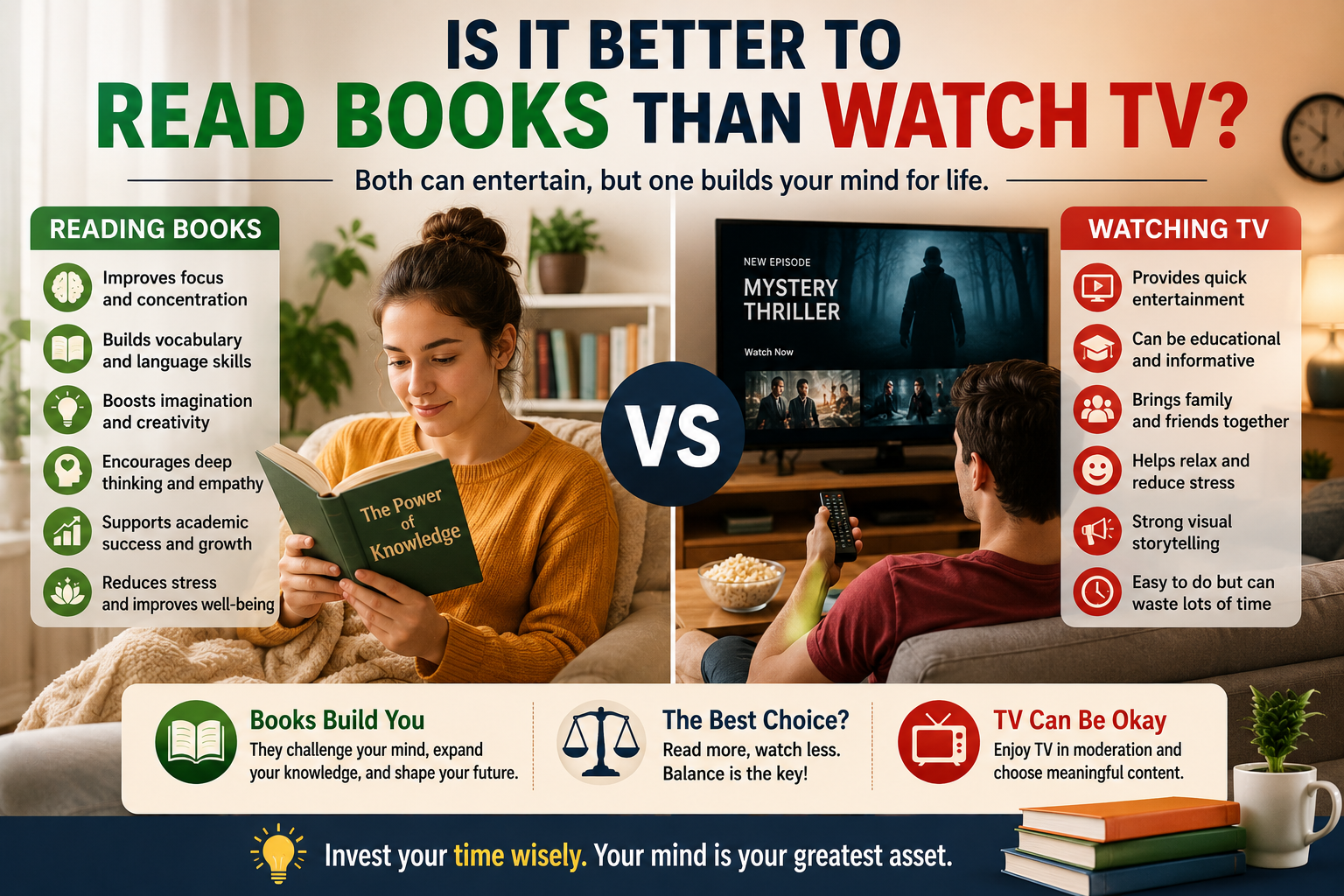
Many people relax by watching TV. Others prefer opening a book and getting lost in a story, idea, or lesson. Both activities can be enjoyable, entertaining, and even educational. But one question often comes up: Is it better to read books than watch TV?
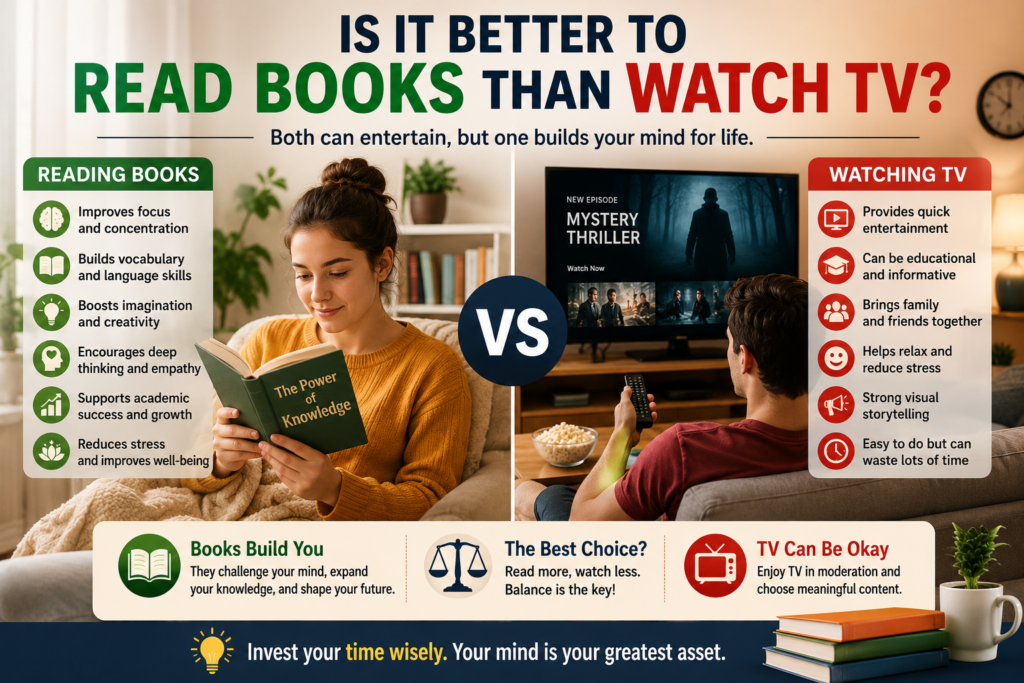
The simple answer is yes, reading books is generally better for the brain, focus, imagination, vocabulary, and long-term learning. However, this does not mean TV is always bad. Watching television can also be useful when it is done in moderation and when the content is educational, inspiring, or meaningful.
The real issue is balance.
Reading books tends to be more active because your mind has to imagine, interpret, remember, and think deeply. Watching TV is usually more passive because the images, sounds, emotions, and scenes are already created for you.
So, if the goal is to improve concentration, language skills, creativity, memory, and personal growth, reading books has a stronger advantage. If the goal is quick entertainment, visual learning, or relaxation after a long day, TV can still have its place.
Why This Question Matters Today
We live in a screen-heavy world.
Many people wake up and check their phones. Students use tablets for schoolwork. Workers spend hours on computers. In the evening, people often watch TV, stream shows, scroll social media, or watch short videos until bedtime.
Because screens are everywhere, reading can feel slower and less exciting at first. A book does not flash. It does not autoplay the next chapter. It does not give instant noise, colour, or drama.
But that is exactly why reading is powerful.
Reading trains the mind to slow down, focus, imagine, and process information carefully. In a world full of distractions, that kind of attention is becoming rare and valuable.
Benefits of Reading Books
1. Reading Improves Focus and Concentration
Reading requires attention.
When you read a book, you follow sentences, paragraphs, characters, arguments, and ideas. Your mind has to stay with the page to understand what is happening.
This strengthens concentration over time.
Watching TV, on the other hand, often requires less mental effort. The story moves forward whether you are fully focused or not. You can look away, check your phone, or half-listen and still understand part of what is happening.
Books demand more from your brain.
This is one reason reading can help students, professionals, and anyone who wants to improve focus in daily life.
2. Reading Builds Vocabulary and Language Skills
Books expose readers to new words, sentence structures, expressions, and writing styles.
The more you read, the more language you absorb.
This can improve:
- Vocabulary
- Grammar
- Spelling
- Writing ability
- Speaking confidence
- Reading comprehension
- Communication skills
This is especially important for students. A student who reads regularly may find it easier to write essays, understand exam questions, explain ideas, and perform better in language-based subjects.
Television can also expose viewers to language, but reading usually provides deeper contact with words. You see how sentences are formed. You notice descriptions. You follow arguments. You learn how ideas are built.
Read also How to Avoid Daydreaming/Zoning Out in the Library: A Student’s Guide to Staying Focused
3. Reading Strengthens Imagination
When you read a novel, your brain creates the world.
You imagine the characters, settings, voices, colours, emotions, and actions. Even if the writer gives details, your mind still does much of the creative work.
This makes reading a powerful exercise for imagination.
TV does most of that work for you. The actors, background music, costumes, locations, and expressions are already supplied. You receive the image rather than building it yourself.
This does not mean TV has no creativity. Many films and shows are beautifully made. But reading activates the imagination in a different and deeper way.
4. Reading Encourages Deep Thinking
Books often require reflection.
A good book may make you pause and ask questions. Why did the character behave that way? Do I agree with this argument? What lesson can I apply to my life? How does this idea connect to something I already know?
Reading gives space for thought.
TV moves quickly. Scenes change. Music directs emotions. Episodes end and another begins. There is often less time to stop and reflect unless you intentionally pause.
Books allow the reader to control the pace. You can reread a paragraph, underline a sentence, take notes, or sit quietly with an idea.
That kind of deep thinking supports personal growth.
5. Reading Reduces Stress
Reading can be calming.
Sitting with a book can help the mind slow down after a busy day. Fiction can transport you into another world. Nonfiction can help you understand life better. Poetry can help you process emotions.
Unlike TV, reading does not usually involve bright moving images, loud sounds, or constant stimulation.
This can make it a healthier bedtime habit. Many people sleep better when they read a physical book before bed instead of watching screens late into the night.
6. Reading Supports Academic Success
For students, reading is one of the strongest habits for academic improvement.
Students who read regularly often develop better comprehension, writing skills, attention span, and general knowledge.
Reading can help with:
- Essay writing
- Exam preparation
- Critical thinking
- Subject understanding
- Research skills
- Communication
- Confidence in class discussions
Even reading outside school subjects can help. A student who reads novels, biographies, history books, or science articles is constantly training the brain to understand information.
7. Reading Can Improve Empathy
Books allow readers to enter another person’s mind.
Through stories, readers experience different cultures, struggles, emotions, decisions, and perspectives. This can build empathy because the reader begins to understand what life feels like for someone else.
TV can also create emotional connection, but books often go deeper into thoughts and inner feelings.
A novel may show not only what a character does, but why they do it, what they fear, what they regret, and what they hope for.
This can help readers become more thoughtful and emotionally aware.
Benefits of Watching TV
Although reading has many advantages, TV is not completely useless. It depends on what you watch, how long you watch, and why you watch.
1. TV Can Be Educational
Documentaries, news programmes, history shows, science channels, interviews, language programmes, and educational series can teach useful information.
Some people learn better visually. Seeing an experiment, location, historical event, or process on screen can make it easier to understand.
For example, a student learning about volcanoes may benefit from watching real footage of eruptions. Someone studying wildlife may understand animal behaviour better through a documentary.
TV can support learning when the content is chosen carefully.
2. TV Can Help People Relax
After a stressful day, watching a good show or movie can help people unwind.
Not every activity has to be serious or productive. Rest is also important.
A funny show can improve mood. A family movie can bring people together. A documentary can inspire curiosity. A drama can create emotional release.
The problem begins when TV becomes excessive or replaces healthier habits.
3. TV Can Create Shared Experiences
Families and friends often bond over shows, movies, sports, or special events.
Watching something together can create conversation and connection.
For example, a family movie night can become a positive routine. Friends may discuss a documentary or debate a character’s decision in a series.
In moderation, TV can support social connection.
See more Woman’s Education Does Not End in the Kitchen: A Powerful Debate
4. TV Can Teach Through Visual Storytelling
Some stories are powerful because they are visual.
Film and television combine acting, music, images, movement, and sound. This can create emotional impact and make certain topics easier to understand.
A well-made historical film or social documentary can make people think deeply about real issues.
So, while books are excellent for imagination and language, TV can be strong in visual explanation and emotional presentation.
Disadvantages of Watching Too Much TV
1. TV Can Reduce Productivity
One episode can easily become three. A short break can become an entire evening.
Because many streaming platforms automatically play the next episode, it is easy to lose track of time.
This can affect homework, work, exercise, sleep, reading, and family responsibilities.
TV is not harmful only because of what people watch. It can also be harmful because of what it replaces.
2. TV Can Weaken Attention Span
Fast-moving entertainment can make slower activities feel boring.
If someone becomes used to constant visual stimulation, reading a book may feel difficult. Studying may feel too slow. Quiet thinking may feel uncomfortable.
This is especially important for children and students. Too much screen entertainment can make it harder to concentrate on schoolwork.
3. TV Can Affect Sleep
Watching TV late at night can interfere with sleep, especially when the content is exciting, violent, emotional, or addictive.
Screens can keep the brain alert when it should be winding down.
Poor sleep can affect mood, memory, learning, and physical health.
Reading a calm book before bed is often a better choice than watching several episodes late into the night.
4. TV Can Encourage Passive Consumption
TV often gives viewers ready-made images and ideas.
If a person watches too much without thinking critically, they may become used to receiving information passively.
Reading, on the other hand, requires more mental participation.
This does not mean every TV viewer is passive or every reader is thoughtful. But generally, reading asks more from the mind.
5. TV Can Expose Viewers to Negative Content
Some TV content includes violence, unhealthy stereotypes, unrealistic lifestyles, excessive advertising, or harmful messages.
Children and teenagers may be especially influenced by what they watch.
This is why parents and viewers should choose content carefully and avoid treating all entertainment as harmless.
Books vs TV: Which Is Better for the Brain?
Books are usually better for the brain because they strengthen imagination, memory, language, focus, and critical thinking.
Reading requires the brain to decode words, create mental images, follow ideas, and remember details.
TV can also stimulate the brain, especially when the content is educational or thought-provoking. But because it provides images and sounds directly, it usually requires less mental effort.
A useful way to think about it is this:
Reading is like exercise for the mind. TV is more like entertainment for the senses.
Both can have value, but they do not produce the same effect.
Is Reading Better Than Watching TV for Students?
Yes, reading is generally better than watching TV for students.
Students need strong reading skills for almost every subject. Even mathematics and science require reading instructions, understanding questions, and interpreting explanations.
Regular reading can improve school performance by building comprehension, vocabulary, attention, and writing ability.
TV can support learning when students watch educational programmes, documentaries, or curriculum-related videos. But entertainment TV should not replace reading, homework, sleep, or physical activity.
A student who reads daily is likely to develop stronger academic habits than a student who spends most free time watching TV.
Is Watching TV Always Bad?
See also How to Use the Cornell Method to Take Better Lecture Notes (A Guide for Nigerian Students)
No, watching TV is not always bad.
The problem is not TV itself. The problem is excessive, careless, or low-quality viewing.
Watching one educational documentary is different from watching random shows for six hours. Watching a family movie on the weekend is different from staying awake every night binge-watching.
TV becomes harmful when it:
- Replaces reading
- Reduces sleep
- Encourages laziness
- Distracts from responsibilities
- Exposes children to unsuitable content
- Becomes the main source of entertainment
- Prevents physical activity
- Reduces family conversation
Moderation matters.
How Much TV Is Too Much?
TV becomes too much when it starts interfering with important parts of life.
Warning signs include:
- Skipping homework to watch TV
- Sleeping late because of TV
- Avoiding books completely
- Watching out of habit, not enjoyment
- Losing interest in hobbies
- Watching while eating every meal
- Feeling unable to relax without TV
- Neglecting exercise or family time
There is no single number that fits everyone, but the key question is simple: Is TV controlling your time, or are you controlling it?
How to Build a Better Reading Habit
Many people want to read more but struggle to start.
Here are simple ways to make reading easier:
- Start with short books
- Read topics you genuinely enjoy
- Set a small daily goal
- Keep a book near your bed
- Read before checking your phone
- Join a book club
- Use audiobooks if needed
- Replace one TV episode with reading time
- Read for 10 minutes daily
- Avoid forcing yourself to finish every book
The goal is not to impress anyone. The goal is to make reading part of your life.
How to Balance Books and TV
You do not have to choose books and reject TV completely.
A healthy balance may look like this:
- Read for 20–30 minutes daily
- Watch TV after important tasks are done
- Choose educational shows sometimes
- Avoid screens close to bedtime
- Read physical books when possible
- Watch TV with family instead of alone every time
- Discuss what you watch
- Use TV as relaxation, not escape
- Let reading become a regular habit
Books should have a permanent place in your life. TV should have boundaries.
Final Verdict: Is It Better to Read Books Than Watch TV?
Yes, it is generally better to read books than watch TV.
Reading strengthens focus, vocabulary, imagination, memory, empathy, and critical thinking. It supports academic success, personal development, and lifelong learning.
TV can be useful for relaxation, visual learning, and entertainment, but it should be used in moderation. Too much TV can waste time, reduce concentration, affect sleep, and encourage passive habits.
The best approach is not to ban TV completely. The best approach is to prioritise reading and use TV wisely.
Read more. Watch less. Choose better content. Protect your time.
That balance can improve your mind, your learning, and your daily life.
See more Art Is Better Than Science: 15 Powerful Reasons Creativity Shapes the World
Frequently Asked Questions
Is reading books better than watching TV?
Yes, reading books is generally better because it improves focus, vocabulary, imagination, memory, and critical thinking. TV can be useful too, but it is usually more passive.
Why is reading better than watching television?
Reading is better because it forces the brain to imagine, interpret, and think deeply. Television provides ready-made images and sounds, which usually requires less mental effort.
Can watching TV be educational?
Yes, TV can be educational when the content is carefully chosen. Documentaries, history programmes, science shows, and language programmes can support learning.
Is TV bad for students?
TV is not always bad for students, but too much entertainment TV can reduce study time, affect sleep, weaken concentration, and distract from reading.
How does reading help the brain?
Reading helps the brain by improving concentration, language processing, memory, imagination, empathy, and analytical thinking.
Should children read more than they watch TV?
Yes, children should generally spend more time reading than watching TV because reading supports school success and brain development.
Is it okay to watch TV every day?
Watching TV every day can be okay if it is limited and does not interfere with sleep, schoolwork, reading, physical activity, or responsibilities.
How can I read more and watch less TV?
Start small. Replace one TV episode with 10–20 minutes of reading, keep a book nearby, choose topics you enjoy, and avoid turning on the TV automatically.
Conclusion
Books and TV both have a place in modern life, but they do not offer the same value.
Reading builds the mind slowly and deeply. It improves language, imagination, focus, and understanding. Watching TV can entertain and sometimes educate, but it can also become a habit that consumes time without giving much back.
If you want to grow intellectually, communicate better, perform well in school, or develop stronger focus, reading should come first.
TV can remain part of life, but it should not dominate your free time.
In the end, the question is not only whether reading is better than watching TV. The bigger question is: what kind of person are your daily habits helping you become?
Choose the habit that builds you.