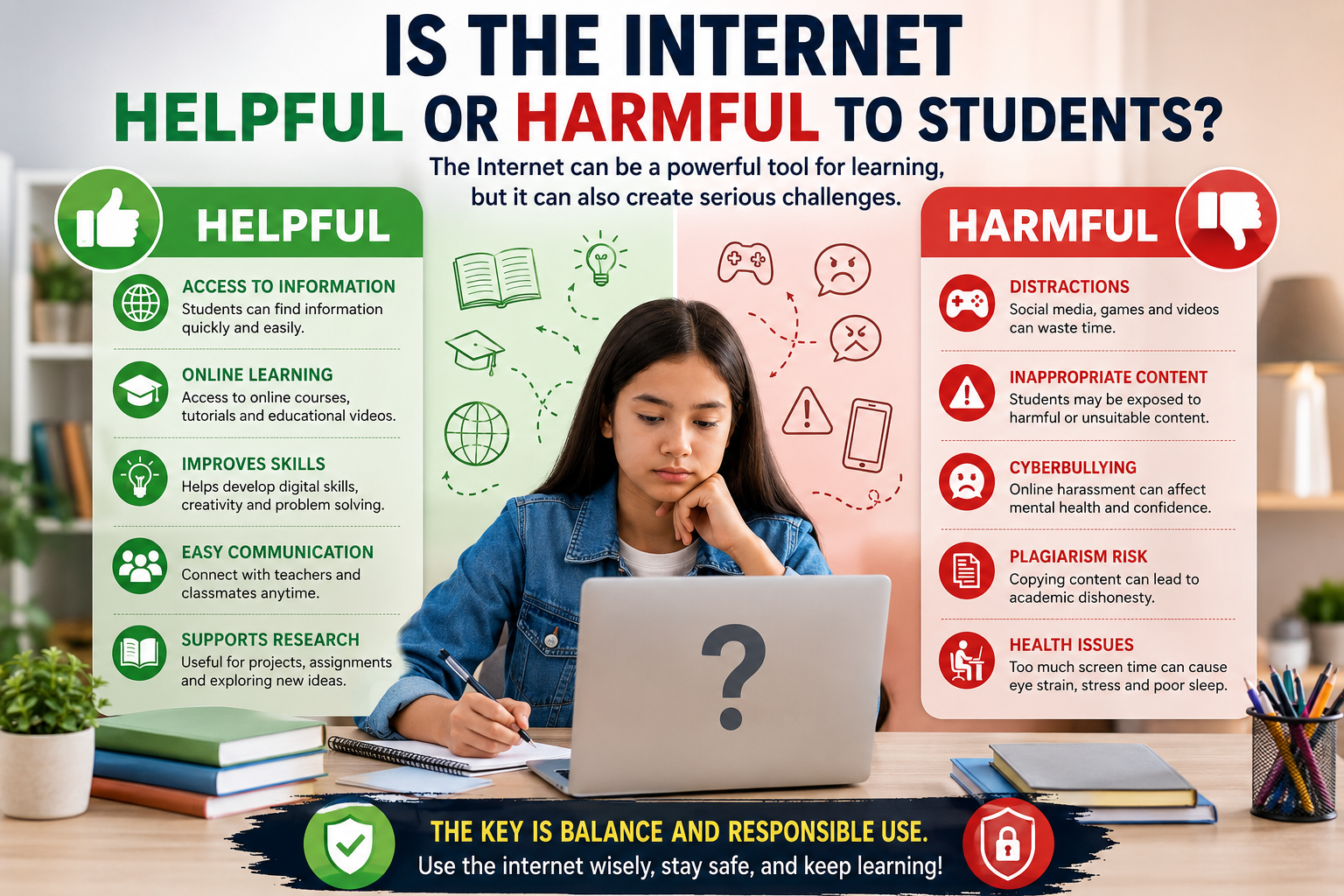
The internet has become one of the most powerful tools in modern education. Students use it to research assignments, watch tutorials, attend online classes, communicate with teachers, and access learning materials that were once limited to libraries or expensive textbooks.
At the same time, the internet can also distract students, expose them to harmful content, encourage plagiarism, reduce deep thinking, and affect their mental health when used without control.
So, is the internet helpful or harmful to students?
The honest answer is that the internet can be both. It is helpful when students use it responsibly for learning, research, creativity, and communication. It becomes harmful when it replaces independent thinking, encourages distraction, or exposes students to unsafe online behaviour.
The real issue is not whether students should use the internet. They already do. The bigger question is how schools, parents, and students can make internet use safer, smarter, and more productive.
Why the Internet Matters in Education
Education has changed dramatically because of the internet.
In the past, students often depended mainly on textbooks, classroom notes, libraries, and teachers for information. Today, a student with a phone, tablet, or computer can access explanations, videos, articles, digital textbooks, research papers, language tools, educational games, and online courses within seconds.
This access can make learning more flexible and inclusive. A student who does not understand a maths topic in class can watch a step-by-step video later. A student preparing for an exam can practise with online quizzes. A student in a rural area can learn from teachers and resources that may not be available locally.
However, easy access does not automatically mean better learning. The internet contains useful information, but it also contains misinformation, distractions, low-quality content, and unsafe spaces.
That is why students need guidance, not just access.
Check out Education Is a Scam vs Education Is the Key: A Balanced Debate for Today’s World
Benefits of the Internet for Students
1. The Internet Gives Students Quick Access to Information
One of the biggest advantages of the internet is speed.
Students can quickly search for definitions, examples, historical facts, scientific explanations, current events, and educational resources. This can help them complete assignments, understand difficult topics, and develop curiosity beyond the classroom.
For example, a student studying climate change can read articles, watch documentaries, view charts, and compare different explanations. A student learning a new language can use online dictionaries, pronunciation videos, and grammar exercises.
The internet makes learning less limited by location, school size, or available textbooks.
Still, students must learn how to judge whether information is accurate. Not every website is reliable. Some pages are outdated, biased, incomplete, or simply wrong.
2. Online Learning Makes Education More Flexible
The internet has made online learning more common and more accessible.
Students can now attend virtual classes, download lecture notes, submit assignments online, join study groups, and learn through educational platforms.
This flexibility is useful for students who are sick, travelling, living far from school, or trying to revise outside normal classroom hours.
Online learning also allows students to learn at their own pace. A student who understands a topic quickly can move ahead. Another student who needs more time can pause, rewind, and repeat lessons until the idea becomes clearer.
This is one reason the internet can support different learning styles.
3. Students Can Learn Beyond the School Curriculum
The internet allows students to explore topics that may not be fully covered in school.
A student interested in coding can take beginner programming lessons online. A student who loves music can learn an instrument through video tutorials. A student interested in business can study entrepreneurship, digital marketing, or personal finance.
This kind of independent learning can help students discover talents and career interests early.
The internet can also expose students to global ideas. They can learn about different cultures, international events, scientific discoveries, and career paths that may not be discussed deeply in class.
When used well, the internet can turn students into lifelong learners.
4. The Internet Improves Communication
Students can use the internet to communicate with teachers, classmates, and study groups.
They can ask questions by email, join class discussion forums, collaborate on group projects, and receive feedback more quickly.
This is especially helpful for shy students who may feel uncomfortable speaking in front of the whole class. Online communication can give them another way to participate.
Teachers can also share reminders, assignments, learning materials, and announcements more easily.
However, online communication must be respectful. Students should understand that messages, comments, and shared content can affect others, even when sent from behind a screen.
5. The Internet Supports Research and Critical Thinking
Good internet use can help students become better researchers.
They can compare different sources, examine arguments, check evidence, and form their own opinions.
For example, when writing an essay, a student can read multiple viewpoints before deciding what position to take. This can improve critical thinking and help students understand that complex topics often have more than one side.
However, this benefit only happens when students are taught how to research properly. Copying the first answer from a search result is not research. Real research requires patience, comparison, and judgment.
6. Educational Apps and Tools Can Improve Learning
The internet provides access to many digital learning tools.
Students can use apps for:
- Mathematics practice
- Language learning
- Science simulations
- Spelling and grammar
- Flashcards
- Coding
- Exam preparation
- Digital note-taking
- Time management
- Reading support
These tools can make learning more interactive and engaging.
For students with learning difficulties or disabilities, the internet can also provide accessibility support such as text-to-speech, speech-to-text, audiobooks, screen readers, translation tools, and visual learning aids.
See now Oppose the Motion: A Female Child Is Better Than a Male Child
This can help more students participate in education with confidence.
Harmful Effects of the Internet on Students
1. The Internet Can Easily Distract Students
One of the biggest disadvantages of the internet is distraction.
A student may go online to research homework but quickly end up watching videos, scrolling social media, playing games, or chatting with friends.
The problem is not only the time wasted. Constant distraction can reduce attention span and make it harder for students to focus deeply on reading, writing, problem-solving, or classroom learning.
Notifications, short videos, and endless content can train students to expect quick entertainment instead of patient thinking.
This can affect academic performance over time.
2. Students May Depend Too Much on the Internet
The internet can provide fast answers, but students may become too dependent on it.
Instead of thinking through a problem, some students immediately search for the answer. Instead of reading a book, they may look for a short summary. Instead of writing in their own words, they may copy or paraphrase online content.
This can weaken independent thinking.
Students still need to develop memory, reasoning, creativity, writing skills, and problem-solving ability. The internet should support learning, not replace the effort required to learn.
A student who depends on the internet for every answer may struggle when asked to think without digital help.
3. The Internet Can Encourage Plagiarism and Cheating
Online access has made cheating easier.
Students can copy essays, use answer websites, share exam questions, or submit work generated by online tools without understanding the topic.
This creates a serious academic problem.
Plagiarism does not only break school rules. It also prevents real learning. A student who copies an assignment may receive a grade, but they lose the opportunity to build knowledge and skill.
Schools must teach students the difference between research and copying. Students should learn how to quote, paraphrase, cite sources, and produce original work.
4. Misinformation Can Mislead Students
The internet contains a huge amount of information, but not all of it is true.
Students may encounter fake news, misleading statistics, biased opinions, conspiracy theories, and outdated information.
Young students may not always know how to separate reliable sources from unreliable ones.
This can affect schoolwork and personal beliefs. A student may confidently repeat false information simply because it appeared online.
Digital literacy is therefore essential. Students should learn to ask:
- Who created this information?
- Is the source trustworthy?
- When was it published?
- Is there evidence?
- Do other reliable sources agree?
- Is the writer trying to inform, persuade, or manipulate?
These questions help students become smarter internet users.
5. The Internet Can Affect Mental Health
Excessive internet use can affect students emotionally.
Social media, in particular, can create pressure to compare appearance, lifestyle, popularity, grades, talents, and achievements with others.
Some students may feel left out, anxious, insecure, or addicted to online approval.
Cyberbullying is another serious concern. Hurtful messages, rumours, embarrassing pictures, and public insults can spread quickly online and cause deep emotional pain.
Students need to understand that online behaviour has real consequences. Schools and parents must take cyberbullying seriously and create safe ways for students to report harmful behaviour.
Read more How to Use the Cornell Method to Take Better Lecture Notes (And Stop Cramming)
6. Students May Be Exposed to Inappropriate Content
Without proper supervision, students can access content that is not suitable for their age.
This may include violence, explicit material, gambling, hate speech, dangerous challenges, extremist content, or harmful advice.
Even when students are not looking for inappropriate content, they may encounter it through ads, pop-ups, social media, video recommendations, or shared links.
Parents and schools should use safety settings, content filters, and open conversations to reduce this risk.
However, filters alone are not enough. Students also need values, judgment, and confidence to leave harmful online spaces.
7. Too Much Screen Time Can Affect Health
Excessive internet use can lead to too much screen time.
This may contribute to:
- Eye strain
- Headaches
- Poor posture
- Reduced physical activity
- Sleep problems
- Fatigue
- Difficulty concentrating
Many students use screens for schoolwork during the day and entertainment at night. This can make it difficult to rest properly.
Healthy internet use should include breaks, physical movement, outdoor activity, and limits on late-night screen time.
Is the Internet More Helpful or Harmful to Students?
The internet is more helpful than harmful when students use it with purpose and discipline.
It becomes harmful when there are no boundaries.
A textbook can be helpful if a student reads it. It can also be useless if ignored. In the same way, the internet is a tool. Its value depends on how it is used.
A student who uses the internet to study, research, practise skills, and communicate responsibly can benefit greatly. A student who uses it mainly for distraction, copying, comparison, and entertainment may experience negative effects.
The goal should not be to remove the internet from education. That is unrealistic.
The goal should be to teach students how to use it wisely.
How Parents Can Help Students Use the Internet Better
Parents play a major role in shaping healthy internet habits.
They can help by:
- Setting screen time limits
- Keeping devices out of bedrooms at night
- Encouraging educational use
- Discussing online safety
- Teaching children not to share private information
- Checking what younger children access online
- Encouraging reading and offline hobbies
- Talking about cyberbullying
- Modelling responsible phone and internet use
Parents should not only punish misuse. They should also explain why boundaries matter.
Students are more likely to follow rules when they understand the reason behind them.
How Schools Can Promote Safe Internet Use
Schools should not assume students automatically know how to use the internet responsibly.
Digital literacy should be part of modern education.
Schools can teach students how to:
- Identify reliable sources
- Avoid plagiarism
- Cite online materials
- Protect personal data
- Recognise online scams
- Report cyberbullying
- Manage screen time
- Use educational platforms
- Communicate respectfully online
- Balance technology with offline learning
Teachers can also design assignments that require original thinking, not just copying information from websites.
For example, instead of asking students to simply “find facts,” teachers can ask them to compare sources, explain their opinion, solve a real problem, or apply information to a new situation.
How Students Can Use the Internet Responsibly
See also How to Study for Multiple Choice Questions: The Secret to Acing JAMB and WAEC
Students must also take responsibility for their own internet habits.
Helpful internet use means going online with a purpose.
Before using the internet, students can ask:
- What am I trying to learn?
- How long should this take?
- Which websites are reliable?
- Am I using this information in my own words?
- Is this helping my schoolwork or distracting me?
- Do I need a break from the screen?
Students should also avoid sharing private information, clicking suspicious links, insulting others online, or believing everything they see.
The internet rewards curiosity, but it also requires caution.
Should Students Use the Internet for Homework?
Yes, students can use the internet for homework, but they should use it properly.
The internet can help students understand difficult subjects, find examples, access educational videos, and gather research.
However, students should not simply copy answers or depend on online tools to complete assignments without understanding them.
A good rule is this: use the internet to learn, not to escape learning.
Students should read, think, write in their own words, and ask questions when they do not understand.
Should Schools Limit Internet Access?
Schools should limit internet access in smart and reasonable ways.
A complete ban would prevent students from using valuable educational tools. Unlimited access, however, can create distraction and safety problems.
The best approach is guided access.
Schools can allow educational websites and learning platforms while blocking harmful or distracting content. Teachers can also set clear rules for when students may use the internet and when devices should be put away.
Internet access should support the lesson, not take control of it.
Internet Safety Tips for Students
Students can protect themselves online by following simple safety rules:
- Do not share passwords
- Do not post private personal information
- Do not meet strangers from the internet without trusted adult supervision
- Do not click suspicious links
- Do not download unknown files
- Do not send hurtful messages
- Report cyberbullying
- Check sources before believing information
- Take breaks from screens
- Ask an adult for help when something feels wrong
These habits can prevent many online problems.
See now Art Is Better Than Science: 15 Powerful Reasons Creativity Shapes the World
Final Verdict: Is the Internet Helpful or Harmful to Students?
The internet is helpful to students when it is used for learning, research, communication, creativity, and skill development.
It is harmful when it leads to distraction, cheating, misinformation, cyberbullying, unhealthy comparison, inappropriate content, or excessive screen time.
Therefore, the internet itself is not the enemy. Lack of guidance is the real problem.
Students need access to the internet, but they also need digital discipline. Parents need to supervise without creating fear. Schools need to teach online responsibility as seriously as reading, writing, and mathematics.
Used wisely, the internet can open doors to knowledge and opportunity. Used carelessly, it can damage focus, confidence, and academic growth.
The best solution is balance.
Students should use the internet as a learning tool, not as a replacement for thinking.
Frequently Asked Questions
Is the internet good for students?
Yes, the internet is good for students when they use it for research, online learning, revision, communication, and skill development. It becomes a problem when it is used mainly for distraction, copying, or harmful online activities.
What are the advantages of the internet for students?
The internet gives students quick access to information, online classes, educational videos, research materials, learning apps, digital books, and communication tools.
What are the disadvantages of the internet for students?
The disadvantages include distraction, cyberbullying, misinformation, plagiarism, too much screen time, exposure to inappropriate content, and reduced concentration.
Can the internet improve student performance?
Yes, the internet can improve performance when students use reliable sources, practise with educational tools, watch helpful tutorials, and revise regularly. However, it will not improve performance if students use it to avoid studying or copy answers.
How does the internet affect students’ mental health?
The internet can affect mental health through social comparison, cyberbullying, online pressure, addiction, and lack of sleep. Healthy boundaries and supportive conversations can reduce these risks.
Should students be allowed to use the internet in school?
Yes, students should be allowed to use the internet in school for educational purposes. However, access should be guided, monitored, and limited to appropriate learning activities.
How can students avoid internet distractions?
Students can avoid distractions by turning off notifications, using website blockers, setting study timers, keeping phones away during homework, and going online with a clear learning goal.
Why is digital literacy important for students?
Digital literacy helps students identify reliable information, avoid scams, protect privacy, communicate respectfully, and use online tools responsibly.
Conclusion
The internet has changed education permanently. It gives students access to knowledge, teachers, tools, and opportunities that previous generations could hardly imagine.
But every powerful tool requires responsibility.
Students who learn how to use the internet wisely can become more informed, creative, independent, and prepared for the future. Students who use it without boundaries may struggle with distraction, misinformation, unhealthy comparison, and poor academic habits.
The internet should not be seen as completely helpful or completely harmful. It is both a doorway and a danger, depending on how it is used.
For students, the best path is not avoidance. It is responsible use.
Parents, schools, and students must work together to make the internet a tool for growth—not a trap for distraction.