Debates help students develop critical thinking, communication skills, and the ability to consider different viewpoints. One topic that frequently appears in schools is “Mother Is Better Than Father.” While this statement is meant for academic discussion rather than to diminish either parent, it encourages students to explore the unique roles mothers and fathers play in raising children.
In reality, both parents contribute significantly to a child’s emotional, physical, educational, and moral development. However, when speaking for the motion, participants are expected to present reasons supporting why a mother may be considered more influential in certain aspects of family life.
This article provides well-organized arguments supporting the motion, followed by counterarguments, rebuttals, and a balanced conclusion suitable for school debates and essay writing.
What Does the Debate Topic Mean?
The topic “Mother Is Better Than Father” asks participants to defend the idea that mothers play a greater role in a child’s upbringing than fathers.

It does not mean fathers are unimportant or less valuable. Instead, it focuses on highlighting the qualities, sacrifices, and contributions that mothers often make within families.
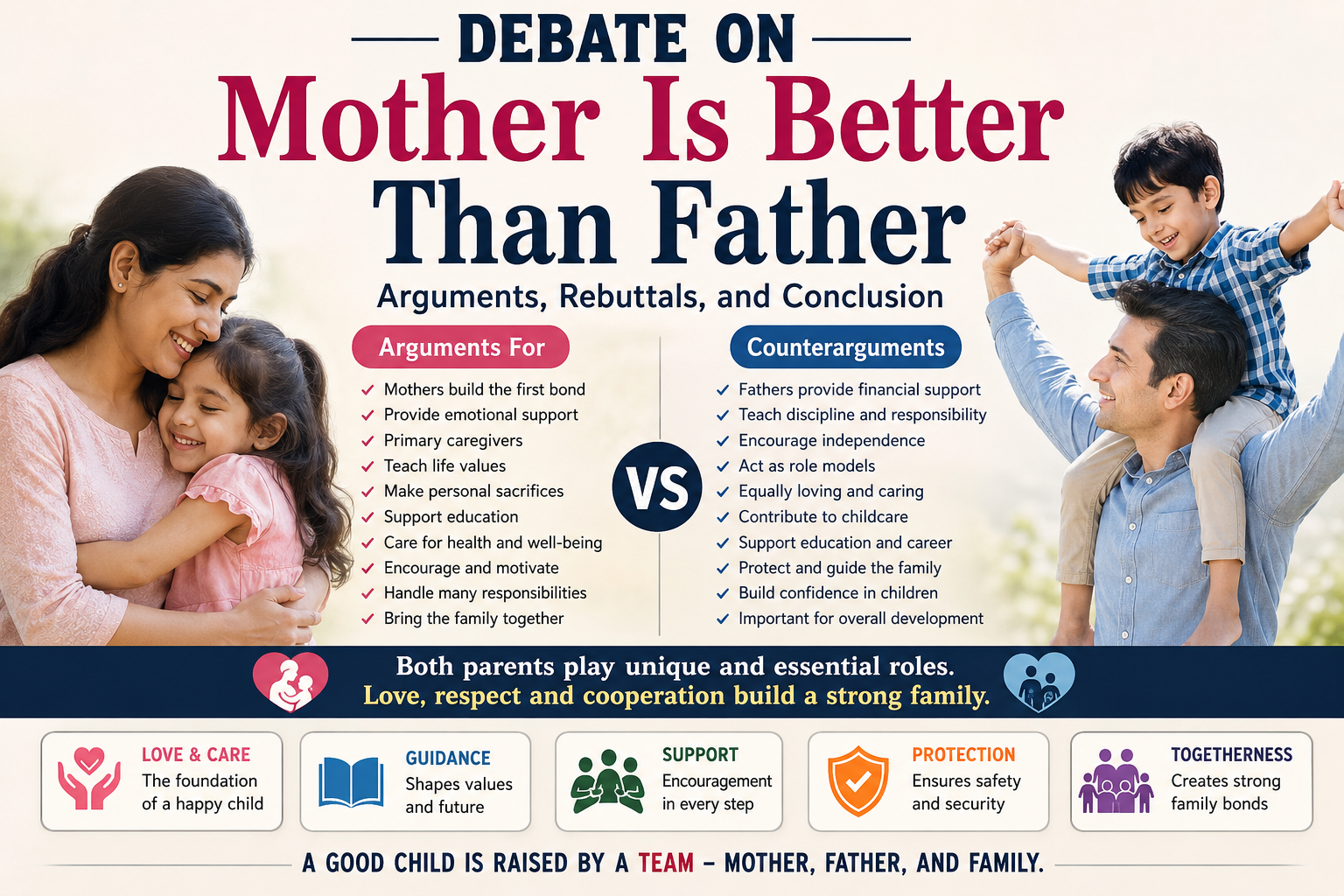
Arguments Supporting the Motion
1. Mothers Usually Build the First Bond With Their Children
A mother’s relationship with her child begins during pregnancy. From conception to birth, she provides nourishment, protection, and care. This early connection often creates a strong emotional bond that continues throughout childhood.
Many children naturally turn to their mothers for comfort because they have known them from the very beginning of life.
2. Mothers Often Serve as Primary Caregivers
In many families, mothers spend more time caring for children during their early years.
Their responsibilities may include:
- Feeding the baby
- Bathing and dressing children
- Helping with homework
- Preparing meals
- Taking children to school
- Caring for sick family members
Because of these daily responsibilities, mothers often become deeply involved in every stage of their children’s development.
3. Mothers Provide Emotional Support
Children often find it easier to share their worries, fears, and personal problems with their mothers.
Mothers frequently:
- Listen patiently
- Offer encouragement
- Comfort children during difficult moments
- Celebrate achievements
- Help children manage emotions
This emotional support can help children build confidence and resilience.
4. Mothers Teach Important Life Values
Children often learn kindness, honesty, respect, discipline, and compassion through their mothers’ daily example.
Simple lessons such as saying “please” and “thank you,” respecting elders, and helping others are often reinforced at home through a mother’s guidance.
5. Mothers Make Many Personal Sacrifices
Many mothers sacrifice sleep, personal hobbies, career opportunities, and leisure time to care for their families.
Whether staying awake with a sick child or balancing work and household responsibilities, mothers often place their children’s needs before their own.
6. Mothers Pay Close Attention to Children’s Health
Mothers frequently monitor their children’s well-being by ensuring they:
- Eat nutritious meals
- Attend medical appointments
- Take prescribed medications
- Get enough rest
- Maintain good hygiene
This constant attention helps promote healthy growth and development.
7. Mothers Often Support Academic Success
Many mothers play an active role in their children’s education by:
- Supervising homework
- Reading with younger children
- Communicating with teachers
- Encouraging good study habits
- Celebrating academic achievements
Their involvement often motivates children to perform better in school.
read now The Government Should Prioritize Education Over Infrastructure
8. Mothers Are Often Excellent Multitaskers
Managing a household requires balancing numerous responsibilities at once.
Many mothers successfully juggle:
- Employment
- Childcare
- Household management
- Meal preparation
- Family finances
- Community involvement
Their ability to handle multiple responsibilities demonstrates remarkable organization and dedication.
9. Mothers Provide Constant Encouragement
Children face many challenges while growing up.
Whether learning to ride a bicycle, preparing for examinations, or recovering from disappointment, mothers often provide reassurance and encouragement that helps children persevere.
10. Mothers Help Build Strong Family Relationships
Mothers frequently organize family activities, celebrations, holidays, and gatherings that strengthen family bonds.
They often serve as the emotional center of the home by promoting love, communication, and unity.
Counterarguments: Why Some Believe Fathers Are Equally Important
A balanced debate also considers opposing viewpoints.
Those against the motion may argue that fathers contribute in equally valuable ways.
Common arguments include:
- Fathers provide financial support for many families.
- Fathers teach discipline and responsibility.
- Fathers encourage independence and confidence.
- Fathers serve as role models for hard work.
- Fathers participate actively in childcare in many modern families.
- Many fathers are loving, caring, and emotionally supportive.
These points highlight that fathers also make meaningful contributions to their children’s lives.
Rebuttals to the Counterarguments
Supporters of the motion may respond respectfully by saying:
- Financial support, while important, is only one aspect of parenting.
- Emotional care and daily nurturing are equally essential.
- Mothers often contribute financially as well as emotionally.
- Many household responsibilities still fall primarily on mothers in numerous families.
- Children’s earliest experiences are often shaped most closely by their mothers’ care and attention.
These rebuttals strengthen the proposition while maintaining respect for fathers.
Why This Debate Matters
This topic encourages students to think critically about family roles rather than promoting competition between parents.
It also reminds us that successful parenting depends on love, commitment, communication, and cooperation.
Families are diverse, and parenting responsibilities vary widely from one household to another.
See more Art Is Better Than Science: 15 Powerful Reasons Creativity Shapes the World
Frequently Asked Questions
Is a Mother Better Than a Father?
There is no universal answer. Every family is different. Some children may feel closer to their mothers, while others have stronger relationships with their fathers. Both parents can play equally important roles in raising responsible, confident children.
Why Are Mothers Often Considered Primary Caregivers?
In many families, mothers spend more time caring for young children during their early years. This often leads to stronger day-to-day involvement in feeding, education, healthcare, and emotional support.
Why Are Fathers Important?
Fathers contribute through guidance, encouragement, protection, financial support, discipline, and emotional care. Modern fathers are increasingly active in childcare and household responsibilities.
What Makes a Good Parent?
A good parent is someone who provides love, safety, guidance, encouragement, discipline, and support. These qualities can be demonstrated by mothers, fathers, guardians, or other caregivers.
Which Parent Influences a Child More?
Research and personal experiences vary. Children’s development is typically shaped by the combined influence of both parents and other caregivers. The quality of the relationship often matters more than whether the parent is the mother or father.
Conclusion
The proposition “Mother Is Better Than Father” provides an opportunity to highlight the many sacrifices and contributions mothers make in raising children. Mothers often nurture, teach, comfort, encourage, and support their children from infancy through adulthood. These qualities make them deserving of appreciation and respect.
At the same time, it is important to recognize that this topic is intended for educational debate rather than as a statement of fact. Fathers also make invaluable contributions through love, guidance, protection, and support. In healthy families, mothers and fathers work together, complementing each other’s strengths to provide children with the care they need to thrive.
Ultimately, the goal should not be to determine which parent is “better,” but to celebrate the unique and essential role each plays in building strong, loving families.