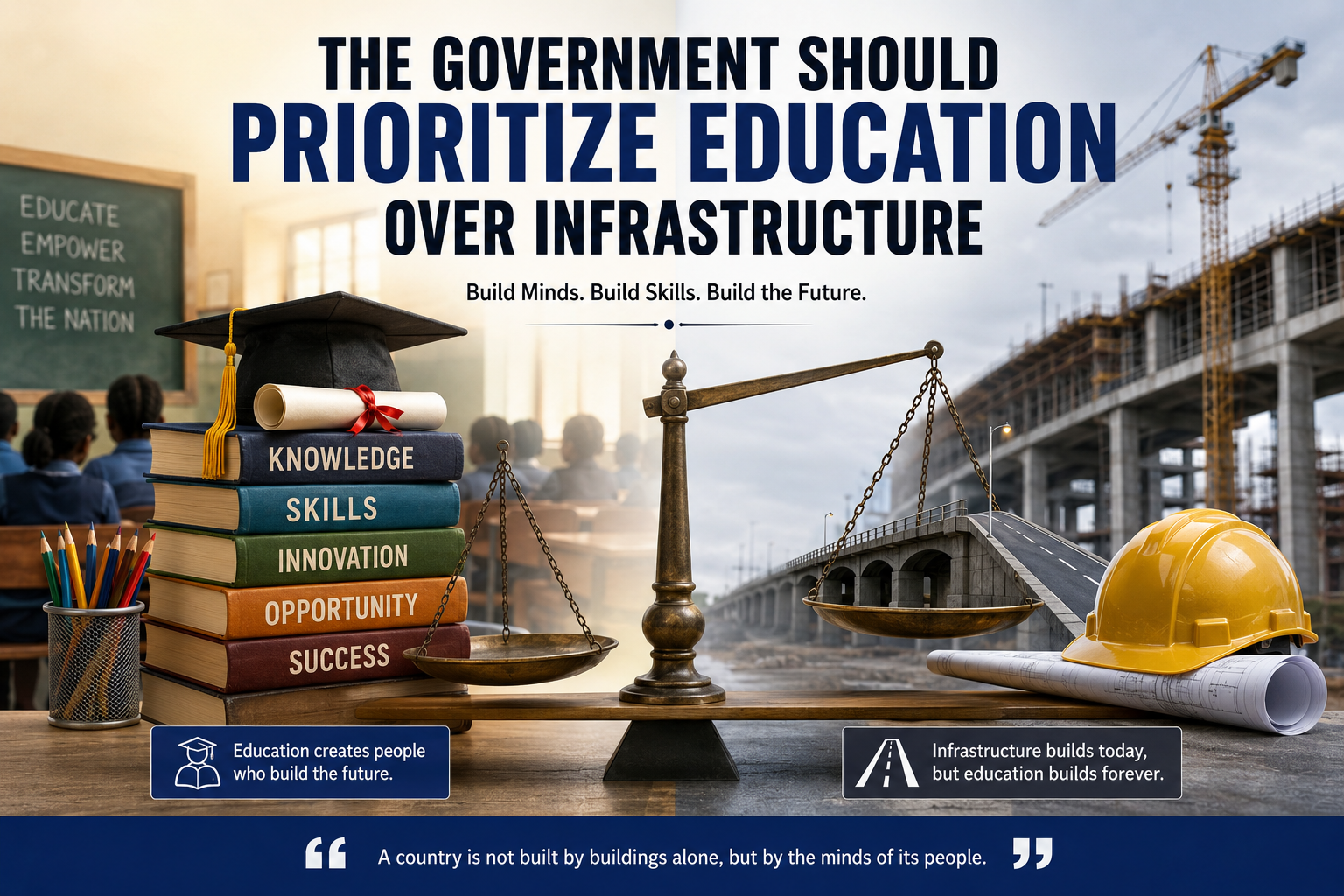
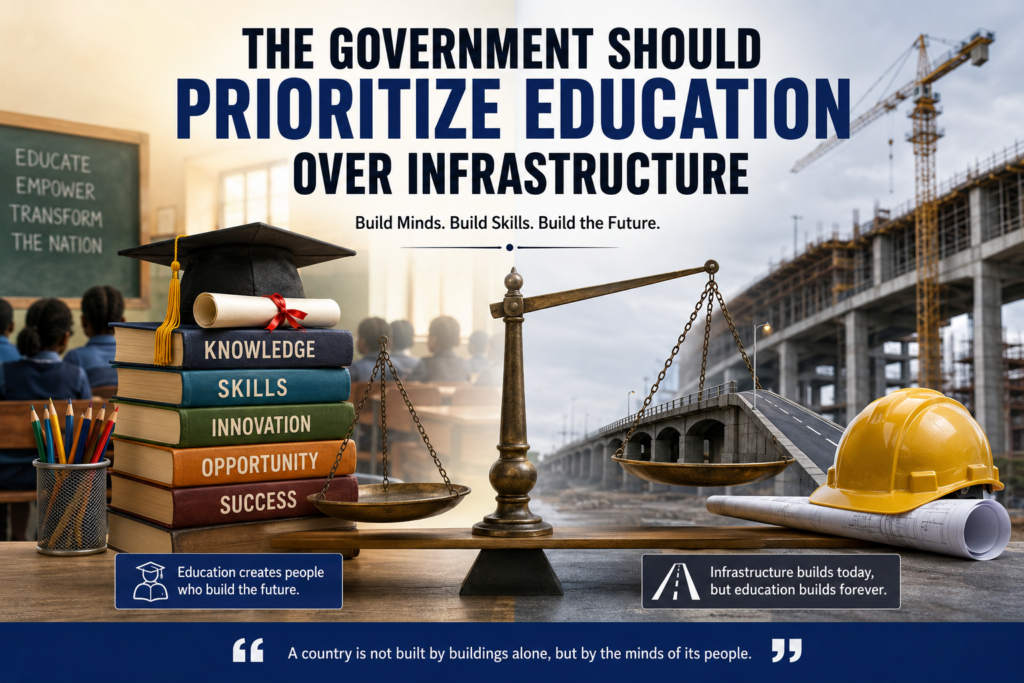
Every government has limited resources. Leaders must decide where public money should go first: roads, bridges, schools, hospitals, power supply, security, transportation, technology, housing, or social welfare.
Among these competing needs, one debate remains important: Should the government prioritize education over infrastructure?
Infrastructure is essential. A country needs good roads, reliable electricity, clean water, transportation systems, hospitals, and public buildings to function properly. Without infrastructure, economic activity becomes slower and more expensive.
However, education should still be the higher priority because it builds the people who will design, manage, maintain, and improve that infrastructure in the future. Roads can move people, but education moves a nation forward.
A society with strong infrastructure but weak education may enjoy short-term development, but it will struggle to sustain progress. A society that invests deeply in education creates skilled citizens, better workers, responsible leaders, stronger families, more innovation, and long-term economic growth.
In simple terms, infrastructure builds the country’s physical foundation, but education builds the human foundation. Without educated people, even the best infrastructure will eventually fail.
Why This Debate Matters
Government budgets are not unlimited.
When leaders spend heavily on infrastructure, they may gain visible results quickly. A new road can be seen. A new bridge can be photographed. A new airport can be commissioned. These projects often make governments look active and successful.
Education, on the other hand, takes time to show results. A child who enters a better school today may not become a doctor, engineer, teacher, business owner, or public servant for many years.
This makes education less politically attractive in the short term.
But true national development should not be measured only by what can be seen immediately. It should also be measured by the quality of citizens a country is preparing for the future.
A government that neglects education may build impressive structures but still produce unemployment, poverty, poor leadership, low productivity, insecurity, and dependence on foreign expertise.
That is why education deserves priority.
What Does It Mean to Prioritize Education?
Prioritizing education does not mean abandoning infrastructure completely.
It means placing education at the centre of national planning and funding decisions. It means the government treats schools, teachers, learning materials, digital access, research, vocational training, and student welfare as urgent investments rather than optional expenses.
A government that prioritizes education should focus on:
- Building and renovating schools
- Training and paying teachers properly
- Providing textbooks and learning materials
- Expanding access to technology
- Supporting early childhood education
- Improving public universities and colleges
- Funding technical and vocational training
- Making education affordable
- Reducing school dropout rates
- Supporting girls’ education
- Improving special needs education
- Strengthening research and innovation
- Linking education to real job opportunities
Education priority is not only about classrooms. It is about developing the knowledge, skills, values, and creativity needed for national progress.
Education Builds Human Capital
Human capital refers to the skills, knowledge, health, discipline, and abilities of people.
A country’s greatest resource is not oil, minerals, buildings, roads, or machines. Its greatest resource is its people.
Natural resources can be wasted when citizens lack the knowledge to manage them. Infrastructure can decay when there are not enough skilled engineers, technicians, planners, and administrators. Public institutions can fail when leaders are poorly trained or ethically weak.
Education develops the human capital needed to run society.
Through education, people become:
- Teachers
- Doctors
- Engineers
- Nurses
- Accountants
- Entrepreneurs
- Farmers
- Technicians
- Lawyers
- Researchers
- Public servants
- Builders
- Designers
- Innovators
- Responsible citizens
Infrastructure may help these people move around and do their work, but education is what prepares them to contribute meaningfully.
Without education, infrastructure becomes underused, mismanaged, or poorly maintained.
Education Creates Long-Term Economic Growth
One of the strongest reasons government should prioritize education is that it supports long-term economic growth.
Educated citizens are more likely to get better jobs, start businesses, pay taxes, use technology, solve problems, and contribute to national productivity.
A country with a skilled workforce can attract investors because companies need trained workers. Investors may build factories, offices, and service centres where there are people capable of doing the work.
Education also reduces dependence on foreign labour. If a country lacks skilled engineers, doctors, scientists, or technicians, it may have to import expertise at a high cost.
When citizens are well educated, the country can produce more locally and compete globally.
Infrastructure can support economic growth, but education creates the people who drive that growth.
Education Reduces Poverty
Poverty is not only about lack of money. It is also about lack of opportunity.
Education gives people access to better opportunities. A child from a poor family may use education to gain skills, secure employment, start a business, or improve their standard of living.
When education is weak or inaccessible, poverty can continue from one generation to the next. Children born into poor families may remain poor because they do not receive the knowledge and skills needed to change their situation.
A government that prioritizes education gives citizens a fairer chance.
Education can help people:
- Read and write
- Understand money
- Learn a trade
- Access better jobs
- Make informed decisions
- Avoid exploitation
- Improve health practices
- Participate in society
- Build businesses
- Support their families
Infrastructure can help reduce poverty too, especially through roads, electricity, and water. But education attacks poverty at its root by empowering people.
Education Improves Leadership and Governance
Poor leadership is one of the biggest obstacles to development.
Check out Education Is a Scam vs Education Is the Key: A Balanced Debate for Today’s World
A country may have roads, buildings, and natural resources, but if leaders are corrupt, unprepared, or unable to make wise decisions, development will suffer.
Education helps produce better leaders.
A strong education system teaches not only academic knowledge but also critical thinking, civic responsibility, ethics, communication, problem-solving, and respect for the rule of law.
Educated citizens are also more likely to hold leaders accountable. They can understand policies, question public spending, vote wisely, and demand transparency.
This creates a stronger democracy and better governance.
Infrastructure can be built by leaders, but education shapes the quality of leaders a society produces.
Education Supports Better Infrastructure
One reason education should come first is that good infrastructure depends on educated people.
Who designs roads? Engineers.
Who plans cities? Urban planners.
Who manages construction budgets? Accountants and project managers.
Who maintains power systems? Technicians and electrical engineers.
Who checks building safety? Surveyors, inspectors, and safety professionals.
Who develops digital infrastructure? Software engineers, network specialists, and cybersecurity experts.
All these people require education and training.
If a government invests in infrastructure without investing enough in education, the country may rely too much on foreign contractors and consultants. That can become expensive and unsustainable.
But if the government invests in education first, citizens can develop the skills needed to build and maintain infrastructure themselves.
In this way, education does not compete with infrastructure. It strengthens it.
Education Promotes Innovation
Infrastructure can support development, but innovation creates new possibilities.
Innovation comes from educated minds.
When students receive strong education in science, technology, engineering, mathematics, business, agriculture, medicine, arts, and social sciences, they can create new solutions to local problems.
They may develop better farming methods, affordable medical tools, new software, cleaner energy systems, improved building materials, smarter transportation systems, and local business models.
Countries that lead the world economically are not only those with roads and buildings. They are countries that invest heavily in knowledge, research, creativity, and technology.
Education is the foundation of innovation.
A government that wants future growth must invest in the minds that will create it.
Education Reduces Crime and Insecurity
Lack of education can contribute to unemployment, frustration, poverty, and social instability.
When young people lack access to quality education and meaningful opportunities, some may become vulnerable to crime, violence, extremism, drug abuse, or exploitation.
Education does not solve every security problem, but it helps reduce some of the conditions that create insecurity.
Schools can provide structure, discipline, values, mentorship, skills, and hope. Vocational education can help young people learn practical trades and become productive.
An educated population is also more likely to understand laws, respect others, and participate peacefully in society.
Infrastructure such as roads and police stations may help security operations, but education helps prevent some problems before they grow.
Education Improves Health and Social Wellbeing
Education affects health.
Educated people are more likely to understand hygiene, nutrition, disease prevention, family planning, child care, and medical advice.
A mother who is educated may be better equipped to care for her children’s health. A community with better education may respond more effectively to public health campaigns.
Education can also reduce harmful beliefs, improve decision-making, and encourage healthier lifestyles.
This means education supports not only economic development but also social wellbeing.
Infrastructure like hospitals and clinics is important, but educated citizens are more likely to use health services properly and make informed choices.
Education Helps Reduce Inequality
Read now Is the Internet Helpful or Harmful to Students?
A society becomes unfair when only wealthy families can access quality education.
When public education is weak, poor families suffer the most. Wealthy families may send their children to expensive private schools, while low-income children remain trapped in underfunded public schools.
This widens inequality.
Government investment in education helps reduce this gap. When public schools are strong, every child has a better chance, regardless of family background.
Education can improve social mobility. It allows talented children from poor homes to rise, contribute, and change their families’ future.
Infrastructure can benefit society broadly, but education directly opens doors for individuals.
Why Infrastructure Still Matters
A balanced argument must admit that infrastructure is also important.
A country needs good roads to transport goods and people. It needs power supply for businesses and homes. It needs water systems for health. It needs internet infrastructure for modern communication. It needs hospitals, housing, and transport systems.
Without infrastructure, education itself can suffer.
Students need roads to reach school. Schools need electricity. Digital learning requires internet access. Teachers need safe transportation. Universities need laboratories and facilities.
So the argument is not that infrastructure should be ignored.
The argument is that education should receive greater priority because it produces the human capacity needed to use infrastructure effectively.
The best government policy is not education alone or infrastructure alone. It is education first, supported by strategic infrastructure.
Common Arguments for Prioritizing Infrastructure
Some people argue that infrastructure should come first because it produces visible economic activity.
They may say:
- Roads help farmers take goods to market
- Electricity supports factories
- Bridges connect communities
- Transport systems improve business
- Infrastructure attracts investors
- Construction creates jobs
- Public projects show immediate progress
These points are valid.
Infrastructure can stimulate economic growth and improve daily life.
However, infrastructure without educated citizens can lead to poor maintenance, misuse, corruption, and dependence on external expertise.
A road may help transport goods, but educated farmers can improve production. Electricity may power factories, but skilled workers operate them. Internet infrastructure may connect communities, but educated citizens use it productively.
Infrastructure creates opportunity, but education teaches people how to use opportunity.
Why Education Should Come First
Education should come first because it is the foundation that strengthens every other sector.
A well-educated population improves:
- Infrastructure planning
- Healthcare delivery
- Agriculture
- Technology
- Governance
- Business
- Security
- Innovation
- Environmental protection
- Public administration
- Social stability
When education improves, the benefits spread across the entire nation.
A government may build a road in one region, but education improves the potential of millions of people across generations.
This is why education is not just another sector. It is the engine of national development.
Check out How to Create Flashcards for Quick Revision: The Ultimate Guide for Nigerian Students
How Government Can Prioritize Education Without Ignoring Infrastructure
A wise government does not have to choose blindly between education and infrastructure.
It can prioritize education while still developing infrastructure strategically.
Here are practical steps:
1. Increase Education Funding
More money should go toward schools, teacher training, learning materials, school meals, digital tools, laboratories, libraries, and student support.
Funding should be transparent so money reaches the schools that need it.
2. Improve Teacher Welfare
Teachers are the backbone of education.
Governments should pay teachers fairly, train them regularly, support their professional growth, and provide better working conditions.
A country cannot build strong education with neglected teachers.
3. Invest in Technical and Vocational Education
Not every student will become a university graduate, but every student needs useful skills.
Vocational education can train young people in construction, agriculture, mechanics, ICT, fashion, plumbing, welding, renewable energy, and other practical fields.
This directly supports infrastructure and job creation.
4. Build Education-Friendly Infrastructure
Infrastructure spending should support education.
For example:
- Roads to rural schools
- Electricity for classrooms
- Internet for digital learning
- Water and sanitation in schools
- Safe school buildings
- Public transportation for students
This approach connects infrastructure to human development.
5. Make Education Affordable
Government should reduce the financial barriers that keep children out of school.
This may include scholarships, free basic education, school feeding programmes, transport support, and assistance for low-income families.
6. Strengthen Digital Education
Modern education requires technology.
Governments should invest in digital literacy, computers, online learning platforms, teacher training, and affordable internet access.
Digital education can help bridge gaps between urban and rural communities.
7. Link Education to Jobs
Education should prepare students for real economic opportunities.
Governments should work with industries to design relevant curricula, internships, apprenticeships, and job-training programmes.
Students should graduate with skills that match the needs of the economy.
Is Education More Important Than Roads?
Education and roads are both important, but education has a deeper long-term effect.
Roads help people move physically. Education helps people move socially, economically, and intellectually.
A road may connect a village to a city, but education connects a child to opportunity.
A country should build roads, but it should not do so at the expense of developing its people.
Should Government Spend More on Schools Than Roads?
Read now How to Handle Panic Attacks in the Exam Hall: A Survival Guide for Nigerian Students
In many developing societies, yes, government should spend more on schools than roads if the education system is weak.
This does not mean roads should be abandoned. It means education should receive priority because it creates the skilled population needed for long-term development.
A beautiful road network cannot compensate for poor literacy, unemployment, weak leadership, and lack of technical skills.
Does Education Help Economic Development?
Yes, education is one of the strongest drivers of economic development.
It improves productivity, increases employability, supports entrepreneurship, attracts investment, encourages innovation, and reduces poverty.
Countries with stronger education systems are often better positioned to compete in the global economy.
Education transforms citizens from passive consumers into productive contributors.
Can Infrastructure Development Succeed Without Education?
Infrastructure development may begin without strong education, especially if foreign contractors and imported expertise are used.
However, it cannot succeed sustainably without education.
A country needs educated citizens to design, operate, repair, manage, and improve infrastructure.
Without local skills, infrastructure becomes expensive to maintain and may deteriorate quickly.
Final Verdict: Should Government Prioritize Education Over Infrastructure?
Yes, the government should prioritize education over infrastructure because education is the foundation of long-term national development.
Infrastructure is important, but education creates the people who build, manage, protect, and improve infrastructure.
Education reduces poverty, improves leadership, supports innovation, strengthens the economy, reduces inequality, and prepares citizens for the future.
A nation that invests only in roads and buildings may look developed on the surface. But a nation that invests in education builds strength from within.
The wisest approach is to put education first while using infrastructure spending to support learning, productivity, and human development.
Frequently Asked Questions
Why should government prioritize education over infrastructure?
Government should prioritize education because it develops human capital, reduces poverty, improves leadership, supports innovation, and creates the skilled citizens needed to build and maintain infrastructure.
Is infrastructure more important than education?
Infrastructure is important, but education has a deeper long-term impact. Infrastructure supports development, while education creates the people who drive and sustain development.
See more Woman’s Education Does Not End in the Kitchen: A Powerful Debate
How does education improve a country?
Education improves a country by increasing skills, productivity, employment, innovation, health awareness, civic responsibility, and economic growth.
Can a country develop without education?
A country may build physical projects without strong education, but it cannot sustain true development without educated citizens.
Why is education important for economic growth?
Education creates skilled workers, entrepreneurs, professionals, and innovators. These people increase productivity and help the economy grow.
Should schools receive more funding than roads?
In countries where education is weak, schools should receive greater priority. Roads matter, but poor education limits a nation’s future more deeply.
How does education reduce poverty?
Education gives people skills, knowledge, and qualifications that can help them access better jobs, start businesses, and improve their standard of living.
What is the best government investment?
One of the best government investments is education because it benefits individuals, families, the economy, and future generations.
Conclusion
The debate between education and infrastructure is really a debate about short-term visibility versus long-term strength.
Infrastructure is easier to see. Education is easier to underestimate.
A new bridge may impress people immediately, but a well-educated generation can transform a nation permanently.
Governments should still build roads, power systems, hospitals, and public facilities. But they must understand that the strongest infrastructure is useless without capable people to use and maintain it.
Education should come first because people come first.
A country’s future is not built only with cement, steel, and asphalt. It is built in classrooms, libraries, laboratories, workshops, and the minds of its citizens.
When the government prioritizes education, it is not neglecting infrastructure. It is preparing the people who will build better infrastructure, stronger institutions, and a more prosperous society.