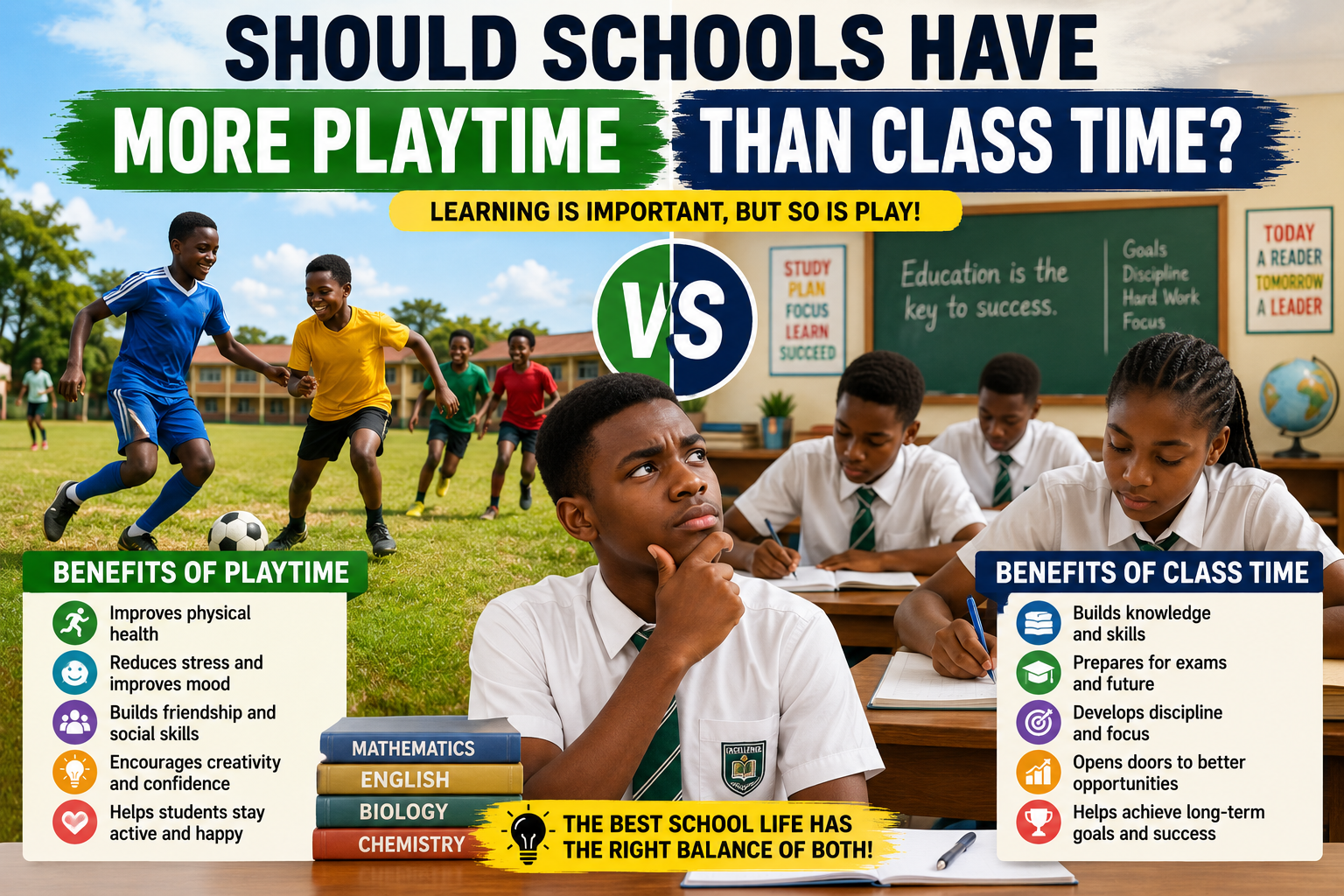
School is a place for learning, but should students spend more time playing than sitting in the classroom?
This is an interesting question, especially for secondary school students in Nigeria.
Many students wake up early, prepare for school, spend several hours attending lessons, complete assignments, participate in extra classes, and sometimes return home with even more homework to do.
After Mathematics comes English.
Then Biology.
Then Economics.
Then Chemistry.
Before long, the school day feels like one long series of lessons.
Naturally, many students would love to hear that schools should increase playtime.
But should playtime actually be longer than class time?
The answer is not as simple as yes or no.
Play is extremely important for students. It improves physical health, reduces stress, encourages friendship, develops creativity, and can even help students concentrate better when they return to class.
However, the main purpose of school is still education.
Students need enough classroom time to learn important subjects, prepare for examinations such as WAEC and NECO, develop useful skills, and prepare for university, work, or entrepreneurship.
Therefore, schools should provide students with more meaningful opportunities for recreation, sports, and breaks, but playtime should generally not be longer than academic class time.
The best school system should create a healthy balance between learning and play.
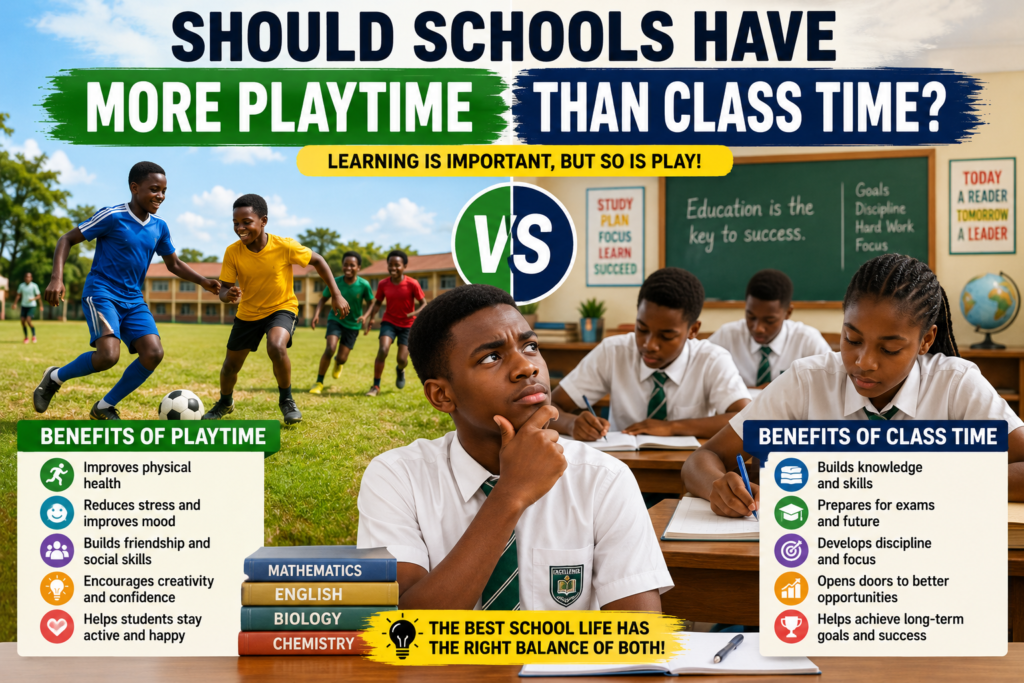
Let us look at both sides of the argument.
What Is Playtime in School?
Playtime is any period during the school day when students are allowed to relax, play, exercise, socialize, or participate in recreational activities.
It may include:
Break time,
Football,
Basketball,
Table tennis,
Running,
Skipping,
Board games,
Drama,
Creative clubs,
Outdoor games,
Or simply talking and relaxing with friends.
For younger students, play may be an important part of learning itself.
For secondary school students, recreation is also important because teenagers need opportunities to move, socialize, relax, and take a mental break from academic pressure.
The real question is not whether students need playtime.
They clearly do.
The debate is about how much playtime schools should provide compared with classroom learning.
Reasons Schools Should Have More Playtime
There are several strong arguments in favour of increasing playtime in Nigerian schools.
See now How to Study for Multiple Choice Questions: The Secret to Acing JAMB and WAEC
1. Playtime Reduces Stress
Secondary school students can experience a lot of pressure.
They may worry about:
Tests,
Assignments,
WAEC,
NECO,
JAMB preparation,
Parents’ expectations,
Competition with classmates,
And choosing a future career.
Spending many hours sitting in classrooms can become mentally tiring.
Playtime gives students an opportunity to relax.
Running around, playing football, talking with friends, or participating in enjoyable activities can help students return to class feeling refreshed.
A tired brain does not always learn effectively.
Sometimes taking a break actually helps a student learn better afterward.
2. Physical Activity Keeps Students Healthy
Students should not spend the entire school day sitting at desks.
The human body needs movement.
Physical activities such as:
Football,
Running,
Basketball,
Volleyball,
Skipping,
And athletics
can help students stay physically active.
Regular movement can improve fitness, strength, coordination, and general wellbeing.
This is especially important today because many young people spend a lot of time sitting with phones, computers, televisions, and video games.
School playtime can encourage students to become more physically active.
3. Play Can Improve Concentration
Imagine sitting through five lessons without a proper break.
By the fifth lesson, even a very serious student may struggle to concentrate.
Students may begin:
Daydreaming,
Talking,
Sleeping,
Looking out of the window,
Or secretly checking their phones.
A short period of recreation can help reset attention.
After moving around and relaxing, students may return to the classroom with more energy.
This is one reason schools should not treat break time as wasted time.
A good break can make the next lesson more productive.
4. Playtime Helps Students Build Friendships
School is not only about textbooks.
It is also where students learn how to interact with other people.
During playtime, students:
Talk,
Play games,
Resolve disagreements,
Work in teams,
Share,
Compete,
And build friendships.
These experiences develop social skills.
For example, a football match teaches more than how to kick a ball.
Students learn:
Teamwork,
Communication,
Leadership,
Patience,
Fairness,
And how to handle winning or losing.
These are important life skills.
5. Playtime Can Discover Hidden Talents
Not every talented student will become famous because of Mathematics or English.
Some students are gifted in:
Football,
Basketball,
Athletics,
Drama,
Dance,
Music,
Chess,
Art,
Or other activities.
Without enough opportunities for recreation and extracurricular activities, these talents may never be discovered.
Nigeria has produced successful athletes, entertainers, and creative professionals whose talents were not limited to academic subjects.
Schools should help students discover what they are good at.
Playtime and extracurricular activities can provide that opportunity.
6. Play Encourages Creativity
Structured classroom lessons usually have clear rules.
There is often one topic.
One teacher.
One timetable.
One expected answer.
Play can be different.
Students may create games.
Invent rules.
Solve problems.
Develop stories.
Build things.
Imagine situations.
This can encourage creativity.
Creativity is useful far beyond school.
Entrepreneurs, engineers, artists, writers, scientists, and inventors all need creative thinking.
7. Students Need a Break From Academic Pressure
Some Nigerian secondary schools have very demanding schedules.
Students may attend:
Regular classes,
Morning lessons,
After-school lessons,
Weekend lessons,
Holiday lessons,
And private tutorials.
Too much academic pressure can make students dislike learning.
Education should be challenging, but students should not feel as though every minute of childhood must be spent preparing for an examination.
Young people also need time to relax.
See more Art Is Better Than Science: 15 Powerful Reasons Creativity Shapes the World
8. Playtime Can Improve School Attendance
Students are more likely to enjoy coming to school when school includes activities they enjoy.
A school environment that offers:
Sports,
Clubs,
Competitions,
Games,
Music,
And social activities
may feel more exciting.
Students may become more connected to their school community.
This can improve motivation.
A student who enjoys school may also become more willing to participate in academic activities.
9. Play Teaches Leadership
Games often create opportunities for leadership.
Someone becomes:
Team captain.
Club president.
Game organizer.
Referee.
Group leader.
These roles teach students how to:
Make decisions,
Communicate,
Take responsibility,
Encourage others,
And solve problems.
Leadership cannot always be learned from a textbook.
Sometimes students learn it by doing.
10. Play Can Support Mental Wellbeing
Teenagers experience emotional challenges just like adults.
Students may feel:
Anxious,
Lonely,
Frustrated,
Overwhelmed,
Or under pressure.
Healthy recreation can provide an emotional release.
Exercise, friendship, laughter, and enjoyable activities can help students feel better.
Schools should care about students’ mental and emotional wellbeing as well as their examination results.
Reasons Schools Should Not Have More Playtime Than Class Time
Although play is important, there are strong reasons why it should not take more time than academic lessons.
1. The Main Purpose of School Is Education
Students go to school primarily to learn.
Schools exist to help young people develop:
Knowledge,
Skills,
Discipline,
Critical thinking,
Communication,
And preparation for adult life.
If students spend more time playing than learning, the school may struggle to complete its academic responsibilities.
Play should support education.
It should not completely replace it.
2. Nigerian Students Have a Large Curriculum to Cover
Secondary school students in Nigeria study many subjects.
Depending on the class and subject combination, these may include:
English Language,
Mathematics,
Biology,
Chemistry,
Physics,
Economics,
Government,
Literature,
Geography,
Commerce,
Agricultural Science,
Civic Education,
Computer Studies,
And others.
Teachers need enough time to cover important topics properly.
If too much class time is replaced with play, students may rush through lessons.
That can affect understanding.
3. Students Need Time to Prepare for Examinations
Examinations remain an important part of Nigerian education.
Students may need to prepare for:
WAEC,
NECO,
JAMB,
School examinations,
Scholarship examinations,
And university entrance requirements.
These examinations require serious preparation.
Students need time to:
Learn concepts,
Practice questions,
Read,
Revise,
Complete assignments,
And receive feedback from teachers.
Too much playtime could reduce the time available for these activities.
Read more The Lekki Headmaster: Themes and Symbolism (Complete Literature Guide)
4. Not Every Student Uses Playtime Productively
Extra playtime sounds attractive.
But how would students use it?
Some might participate in sports.
Others may join educational clubs.
But some students may simply:
Waste time,
Fight,
Use phones excessively,
Gossip,
Or cause trouble.
Increasing playtime does not automatically create educational benefits.
Schools need structured recreational programmes.
5. Too Much Play Can Reduce Academic Discipline
Students need to develop the ability to concentrate even when something is difficult.
Life will not always be entertaining.
University students must study.
Workers must complete responsibilities.
Business owners must solve difficult problems.
If school becomes mostly recreation, students may not develop strong academic discipline.
There must be balance.
6. Teachers Already Have Limited Time
In many schools, teachers already struggle to complete the curriculum before examinations.
Reducing class time further could make this problem worse.
Teachers may begin rushing lessons.
Students who need extra explanation may be left behind.
This could negatively affect learning.
7. More Playtime Could Create Supervision Problems
Large schools may have hundreds or even thousands of students.
More recreational time means schools need enough:
Teachers,
Sports staff,
Security,
Facilities,
And supervision.
Without proper supervision, increased playtime could lead to:
Accidents,
Bullying,
Fighting,
Damage to property,
Or students leaving school grounds.
Schools need proper planning before increasing recreational periods.
Should Nigerian Schools Increase Break Time?
In many cases, yes.
Increasing reasonable break and recreation time may benefit students, especially in schools where the academic timetable is extremely packed.
But increasing break time does not mean students should spend most of the day playing.
Schools could improve balance by introducing:
A proper morning break,
A reasonable lunch break,
Regular physical education,
Sports periods,
Club activities,
Creative arts,
And occasional recreational programmes.
This would allow students to relax without sacrificing important academic learning.
Is Playtime Important for Secondary School Students?
Yes.
Some people wrongly assume that play is only for primary school children.
Teenagers also need recreation.
Secondary school students benefit from:
Exercise,
Sports,
Friendship,
Relaxation,
Creative activities,
And extracurricular programmes.
However, play for teenagers may look different from play for younger children.
It can include:
Football.
Basketball.
Debate clubs.
Drama.
Chess.
Music.
Coding clubs.
Entrepreneurship clubs.
Athletics.
Science competitions.
These activities can be enjoyable while also developing useful skills.
See more How to Handle Panic Attacks in the Exam Hall: A Survival Guide for Nigerian Students
Does More Playtime Help Students Learn Better?
Reasonable playtime can support learning.
Students who receive appropriate breaks may return to lessons feeling more alert.
Physical activity can also reduce boredom.
But simply making students play for most of the school day would not necessarily improve academic achievement.
The key word is:
Balance.
Students need enough time to:
Learn,
Play,
Rest,
Socialize,
Exercise,
And explore interests.
A well-designed school timetable should include all of these.
What Are the Advantages of Playtime in School?
The main benefits include:
Reducing stress.
Improving physical health.
Building friendships.
Encouraging teamwork.
Developing leadership.
Discovering talents.
Improving concentration.
Supporting creativity.
Making school more enjoyable.
Improving emotional wellbeing.
These are strong reasons schools should protect recreational time.
What Are the Disadvantages of Too Much Playtime?
Too much playtime may:
Reduce teaching time.
Make curriculum completion difficult.
Affect examination preparation.
Encourage time-wasting.
Create supervision challenges.
Reduce academic discipline.
Lead to poor academic performance if not properly managed.
This is why the solution should not simply be:
“More play and less learning.”
The better solution is a balanced timetable.
Should Schools Have More Sports?
Many Nigerian schools could benefit from stronger sports programmes.
Sports can develop:
Fitness,
Discipline,
Teamwork,
Confidence,
Leadership,
And talent.
Schools should not treat sports as something students do only when teachers have nothing else planned.
Physical education and sports deserve proper organisation.
However, not every student enjoys competitive sports.
Schools should also provide other activities such as:
Drama,
Music,
Art,
Chess,
Coding,
Debate,
Reading clubs,
Science clubs,
And entrepreneurship programmes.
Recreation should provide options for different interests.
Should Schools Reduce Class Time?
See also Father Is More Important Than Mother – Debate Argument
Schools should not necessarily reduce the total amount of important learning.
Instead, they should improve how class time is used.
A three-hour boring lesson is not automatically better than a focused one-hour lesson.
Good teaching should involve:
Discussion,
Practical activities,
Experiments,
Group work,
Technology,
Questions,
And student participation.
Learning itself can become more engaging.
The real problem may not always be “too much class.”
Sometimes it is poorly designed class time.
Playtime vs Class Time: Which Is More Important?
Both are important, but they serve different purposes.
Class time helps students gain:
Academic knowledge.
Literacy.
Numeracy.
Scientific understanding.
Critical thinking.
Examination preparation.
Playtime helps students develop:
Physical health.
Social skills.
Creativity.
Friendships.
Leadership.
Emotional wellbeing.
Students need both.
However, because the central purpose of school is education, classroom learning should normally receive more total time than recreation.
That does not mean students should be kept in classrooms all day.
It means schools should find the right balance.
Should Schools Have More Playtime Than Class Time? Debate Points
Students preparing for a debate can use the following arguments.
Points Supporting More Playtime
Play reduces stress.
It improves physical health.
It helps students concentrate.
It develops social skills.
It encourages teamwork.
It discovers sporting and creative talents.
It improves mental wellbeing.
It can make students enjoy school more.
Points Against More Playtime Than Class Time
School is primarily for education.
Students need time to complete the curriculum.
Examinations require serious preparation.
Too much play may encourage indiscipline.
Schools may lack enough sports facilities.
Teachers need enough instructional time.
More play does not automatically improve learning.
These points can help students argue either side confidently.
See also Should Voting Age Be Lowered? The Real Debate
How Can Nigerian Schools Balance Learning and Play?
A balanced school timetable could include:
Focused academic lessons.
Short breaks between long periods of learning.
A proper lunch period.
Regular physical education.
Weekly sports.
Clubs and societies.
Creative activities.
Occasional competitions.
Enough time for rest.
Schools should also avoid unnecessary repetition.
Students do not need endless lessons simply because administrators believe “more classroom hours” automatically means better education.
Quality matters.
A student who learns effectively for six balanced hours may benefit more than a student forced through ten exhausting hours of lessons.
Final Verdict: Should Schools Have More Playtime Than Class Time?
Schools should provide more opportunities for meaningful play and recreation, but playtime should not normally be longer than class time.
Education remains the main purpose of school.
Students need enough classroom instruction to:
Learn important subjects,
Prepare for examinations,
Develop academic skills,
And prepare for their future.
However, schools should not treat students like machines.
Students also need:
Exercise.
Rest.
Friendship.
Sports.
Creativity.
Fun.
Social interaction.
A school that focuses only on academic results may produce students who can pass examinations but struggle with stress, teamwork, creativity, or physical health.
On the other hand, a school that focuses mostly on play may fail to give students the academic foundation they need.
The best answer is balance.
Nigerian schools should create timetables where students have enough time to learn seriously and enough time to breathe, move, play, socialize, and develop talents outside the classroom.
So, should schools have more playtime than class time?
Probably not. But schools should definitely make playtime a more important and meaningful part of education.
Students do not need to choose between learning and enjoying school.
A good education should provide both.