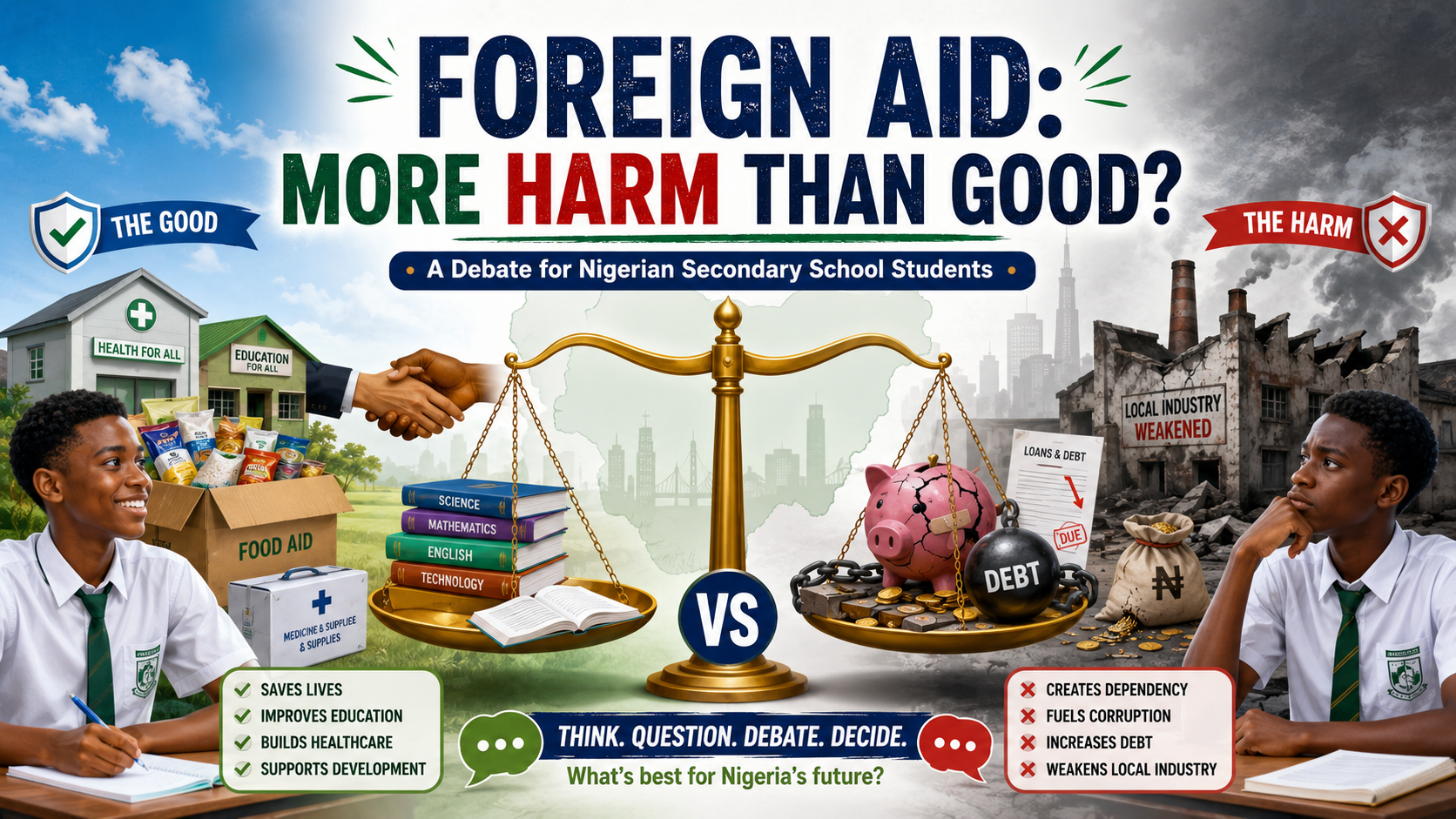
Foreign aid has helped many countries during wars, disease outbreaks, natural disasters, food shortages, and economic problems. Wealthier countries, international organisations, charities, and development agencies often give money, food, medicine, equipment, or professional support to countries in need.
However, foreign aid is also controversial.
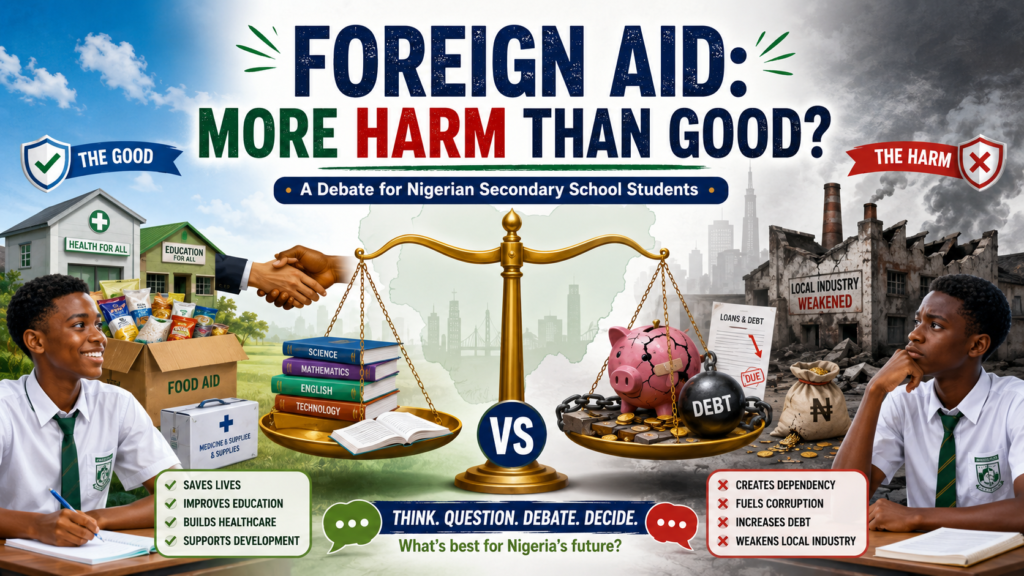
Some people believe it saves lives, supports education, improves healthcare, and helps poor countries develop. Others argue that it creates dependency, encourages corruption, weakens local industries, and allows donor countries to influence the decisions of developing nations.
This leads to an important debate topic:
Foreign aid does more harm than good.
The motion asks us to decide whether the negative effects of foreign aid are greater than its benefits.
For Nigerian secondary school students, this debate is important because Nigeria and many other African countries have received different forms of foreign assistance over the years.
Understanding the advantages and disadvantages of aid can help young people think critically about development, independence, leadership, and international relations.
What Is Foreign Aid?
Foreign aid is assistance given by one country, international organisation, or charity to another country.
See more How to Study for Multiple Choice Questions: The Secret to Acing JAMB and WAEC
Aid may be provided in different forms, including:
- Money
- Food
- Medicine
- Medical equipment
- School materials
- Agricultural support
- Loans
- Technical training
- Military assistance
- Emergency relief
- Infrastructure projects
Foreign aid may be given by governments, the United Nations, international financial institutions, non-governmental organisations, religious bodies, or private charities.
For example, when a country experiences flooding, another country may send food, tents, medicine, and rescue equipment.
When a developing country lacks enough healthcare workers, an international organisation may provide doctors, training, vaccines, or hospital equipment.
Types of Foreign Aid
Foreign aid can be divided into several categories.
Humanitarian Aid
Humanitarian aid is emergency assistance given during disasters, wars, famine, or disease outbreaks.
Examples include food, water, shelter, medicine, and rescue support.
Development Aid
Development aid is meant to improve a country over a longer period.
It may support:
- Education
- Healthcare
- Agriculture
- Electricity
- Roads
- Water supply
- Employment
- Technology
Bilateral Aid
Bilateral aid is assistance given directly from one country to another.
For example, Country A may provide funding to Country B for a road or hospital project.
Multilateral Aid
Multilateral aid is provided through international organisations involving several countries.
Examples may include support given through global development or humanitarian organisations.
Tied Aid
Tied aid comes with conditions.
The receiving country may be required to buy goods, hire companies, or follow policies chosen by the donor country.
This type of aid is often criticised because it may benefit the donor as much as—or more than—the receiving country.
Arguments Supporting the Motion
Those supporting the motion argue that foreign aid does more harm than good.
Check out The Lekki Headmaster: Themes and Symbolism (Complete Literature Guide)
1. Foreign Aid Can Create Dependency
One major criticism is that long-term aid may make a country dependent on outside assistance.
If a government becomes used to receiving food, money, or services from foreign donors, it may stop making serious efforts to solve its own problems.
For example, a country that receives imported food every year may invest less in local farming, irrigation, storage, and agricultural research.
Over time, the country may lose the ability to feed itself without outside help.
Aid should ideally help a country become stronger and more independent. When it creates permanent dependence, it may become harmful.
2. Foreign Aid Can Encourage Corruption
Foreign aid often involves large amounts of money.
In countries with weak institutions, dishonest officials may steal, misuse, or redirect the funds.
Money intended for hospitals, schools, roads, or poor families may end up in private bank accounts.
For example, a foreign organisation may provide money to build classrooms. If officials inflate the cost of construction and divide the extra money among themselves, the pupils may receive poorly built classrooms or no classrooms at all.
The aid may then enrich a few powerful people instead of helping the population.
3. Aid Can Reduce Government Accountability
Citizens normally expect their government to use taxes and national resources to provide services.
However, when foreign donors pay for hospitals, education, water projects, or food programmes, the government may feel less pressure to perform its responsibilities.
Leaders may become more accountable to international donors than to their own citizens.
Instead of asking, “What do our people need?” officials may ask, “What project will attract foreign funding?”
This can weaken democracy and responsible government.
4. Foreign Aid Can Harm Local Businesses
Free or heavily subsidised foreign goods can damage local industries.
Suppose foreign donors send large quantities of free rice into a country.
The aid may help hungry families in the short term. However, local farmers may struggle to sell their own rice because people can receive imported rice for free.
Farmers may lose income, reduce production, or leave farming completely.
The country then becomes even more dependent on imported food.
The same problem can affect clothing, medicine, machinery, and other local products.
5. Donor Countries May Control National Decisions
Foreign aid is not always given without conditions.
A donor country may require the receiving country to change economic policies, support certain international decisions, give contracts to foreign companies, or allow access to natural resources.
This can reduce national independence.
A country may accept policies that do not fully benefit its citizens because it fears losing aid.
Critics argue that this allows powerful nations to influence weaker countries without directly ruling them.
6. Aid Projects May Ignore Local Needs
Foreign organisations may design projects without properly consulting the people who will use them.
They may build facilities that are difficult to maintain or introduce solutions that do not fit the local culture and environment.
For example, an organisation may donate expensive farming machines to a rural community.
If the farmers cannot afford fuel, spare parts, or repairs, the machines may soon become useless.
A simple solution chosen by local farmers might have produced better results.
7. Aid Can Support Bad Governments
Foreign assistance may strengthen corrupt, violent, or undemocratic governments.
Money, military equipment, or other resources may help such governments remain in power.
Even when aid is meant for ordinary citizens, leaders may control its distribution and use it to reward supporters.
This can make political change more difficult.
8. Some Foreign Aid Is Really a Loan
Not all aid is free.
Some assistance comes as loans that must be repaid with interest.
A country may use borrowed money for a project that does not produce enough income.
Future generations may then face large debts.
Money that should be used for schools, hospitals, and infrastructure may instead be used to repay foreign lenders.
9. Foreign Aid May Solve Symptoms Instead of Causes
Aid may provide temporary relief without addressing the real causes of poverty.
For example, donating food can help hungry people today.
But hunger may continue if the deeper problems include:
- Poor farming systems
- Insecurity
- Bad roads
- Lack of storage
- Corruption
- Unemployment
- Climate problems
- Weak government policies
If aid only treats the immediate problem, the same crisis may return every year.
10. Aid Can Reduce National Pride and Initiative
Continuous dependence on foreign assistance may create the belief that local people cannot solve their own problems.
Citizens may begin to wait for foreign donors instead of developing local solutions.
Young people may also lose confidence in their country’s ability to progress.
Development is stronger when citizens believe they can create businesses, improve institutions, and solve problems through local knowledge and effort.
Arguments Opposing the Motion
Those opposing the motion argue that foreign aid does more good than harm.
Read more Woman’s Education Does Not End in the Kitchen: A Powerful Debate
1. Foreign Aid Saves Lives
During emergencies, foreign aid can provide immediate help that a country may not be able to provide alone.
After floods, earthquakes, wars, or disease outbreaks, victims may urgently need:
- Food
- Clean water
- Medicine
- Shelter
- Rescue equipment
- Medical workers
Without international support, many more people may die.
Humanitarian aid is especially valuable when local hospitals, roads, and government systems have been damaged.
2. Aid Supports Healthcare
Foreign assistance has helped many countries fight diseases and improve public health.
It can provide:
- Vaccines
- Mosquito nets
- Medicines
- Medical training
- Laboratory equipment
- Maternal healthcare
- Health education
Poor communities may benefit from services they could not otherwise afford.
When aid is well managed, it can reduce preventable deaths and improve the quality of life.
3. Foreign Aid Improves Education
Aid can support education by providing:
- Classrooms
- Textbooks
- Scholarships
- Teacher training
- School meals
- Computers
- Libraries
- Learning materials
Children from poor families may remain in school because of these programmes.
Foreign scholarships can also help students gain knowledge and skills that they later use to develop their countries.
4. Aid Can Build Important Infrastructure
Developing countries may lack enough money to build roads, bridges, electricity systems, hospitals, and clean-water facilities.
Foreign aid can help fund these projects.
Good infrastructure supports:
- Trade
- Education
- Healthcare
- Agriculture
- Employment
- Investment
A well-planned road project, for example, can help farmers transport their goods to markets more quickly.
5. Aid Can Provide Skills and Technology
Foreign assistance is not always about money.
Experts may train local workers in areas such as:
- Medicine
- Engineering
- Agriculture
- Information technology
- Disaster management
- Public administration
The knowledge gained may continue helping the country long after the foreign experts leave.
6. Aid Helps Countries Recover From Conflict
Countries affected by war may have destroyed schools, hospitals, farms, and businesses.
Foreign aid can support reconstruction and help displaced people return home.
It may also assist with peacebuilding, elections, police reform, and the rebuilding of public institutions.
Without such assistance, recovery may take much longer.
Read now Farmer vs Doctor: 10 Compelling Reasons Why the Doctor Is More Important
7. Aid Can Support Poor and Vulnerable People
Even when a government is struggling, foreign organisations may reach people who urgently need help.
Aid programmes may support:
- Orphans
- Refugees
- People with disabilities
- Victims of violence
- Poor rural communities
- Pregnant women
- Unemployed youths
For these groups, aid may provide opportunities they would not otherwise receive.
8. Poor Management Is the Problem, Not Aid Itself
Supporters argue that foreign aid is not naturally harmful.
The real problem is how it is designed and managed.
If aid is transparent, properly monitored, and based on local needs, it can produce positive results.
Corruption should be fought, but the possibility of corruption does not mean all assistance should stop.
Schools also experience misuse of money, but that does not mean education itself is bad.
9. Countries Help One Another in a Connected World
No country can solve every problem alone.
Disease, terrorism, climate change, migration, and economic crises can cross borders.
Foreign aid can be part of international cooperation.
A country receiving help today may be able to help another country in the future.
10. Aid Can Encourage Long-Term Development
Well-designed foreign aid can help countries become more independent.
For example, instead of giving food forever, a development programme may provide:
- Improved seeds
- Irrigation systems
- Farmer training
- Storage facilities
- Market access
This type of aid can increase local production and reduce future dependence.
Foreign Aid in Nigeria
Nigeria has received foreign assistance in areas such as healthcare, education, agriculture, security, humanitarian relief, and community development.
Some programmes have supported disease prevention, maternal health, school attendance, food security, and assistance for people affected by conflict or natural disasters.
However, Nigeria has also experienced problems that reduce the effectiveness of aid.
These may include:
- Corruption
- Weak monitoring
- Poor maintenance
- Political interference
- Duplication of projects
- Lack of community involvement
Nigeria’s experience shows that aid can produce benefits, but it must be managed carefully.
The country should not depend permanently on foreign assistance.
Aid should support national development plans, strengthen local institutions, and help Nigerians build solutions that can continue after donor funding ends.
Does Foreign Aid Cause Dependency?
Foreign aid can cause dependency when it continues for a long time without building local capacity.
For example, continuously supplying imported food without supporting local farmers may weaken domestic agriculture.
However, aid does not always create dependency.
A programme that trains farmers, supports local businesses, and improves infrastructure may increase independence.
The important question is not simply whether aid is given.
We must ask:
- What type of aid is provided?
- How long will it continue?
- Who controls it?
- Does it build local skills?
- Can the project continue without donors?
Does Foreign Aid Promote Corruption?
See more How to Use the Cornell Method to Take Better Lecture Notes (A Guide for Nigerian Students)
Aid can promote corruption when there is poor monitoring and weak accountability.
Large funds may be stolen or misused.
However, corruption can be reduced through:
- Public reporting
- Independent audits
- Community monitoring
- Digital payment systems
- Strong laws
- Punishment for offenders
- Direct support to trusted organisations
The risk of corruption is serious, but it is not a reason to reject every form of aid.
Is Foreign Aid a Form of Modern Colonialism?
Some critics describe foreign aid as a form of modern colonialism because powerful countries may use it to influence weaker countries.
A donor may attach political or economic conditions to its assistance.
The recipient country may be pressured to support the donor’s interests.
However, not all aid involves control.
Humanitarian organisations may provide emergency relief without demanding political loyalty.
The issue depends on the conditions attached to the assistance.
Should Nigeria Stop Accepting Foreign Aid?
Nigeria should not automatically reject all foreign assistance.
Emergency aid, medical support, educational programmes, and technical training can be useful.
However, Nigeria should avoid permanent dependency.
Foreign aid should:
- Support Nigerian priorities
- Strengthen local institutions
- Develop local skills
- Use local workers and businesses
- Include proper monitoring
- Have a clear ending plan
- Promote self-reliance
The goal should be partnership, not dependence.
Debate Points Supporting the Motion
A student supporting the motion can argue that:
- Foreign aid creates dependency.
- It encourages corruption.
- It weakens local industries.
- It reduces government accountability.
- Donors may control national policies.
- Aid can support bad governments.
- Some aid creates heavy debt.
- Projects may ignore local needs.
- Aid may solve symptoms instead of causes.
- It can reduce national confidence and initiative.
See also How to Study for Multiple Choice Questions: The Secret to Acing JAMB and WAEC
Debate Points Opposing the Motion
A student opposing the motion can argue that:
- Foreign aid saves lives during emergencies.
- It supports healthcare and disease prevention.
- It improves education.
- It helps build infrastructure.
- It provides technology and professional training.
- It supports vulnerable people.
- It helps countries recover from conflict.
- International cooperation is necessary.
- Aid can promote long-term development.
- Poor management—not aid itself—is the main problem.
Sample Debate Supporting the Motion
Good morning, Mr Chairman, panel of judges, accurate timekeeper, co-debaters, teachers, and fellow students.
My name is __________, and I am here to support the motion that foreign aid does more harm than good.
Foreign aid may appear helpful, but it often creates long-term problems.
First, it makes developing countries dependent on wealthy nations. When a country depends on foreign food, money, and services, its leaders may fail to develop local solutions.
Second, foreign aid encourages corruption. Money intended for schools, hospitals, and poor families may be stolen by dishonest officials.
Third, free foreign goods can destroy local businesses. If imported food is given out freely, local farmers may be unable to sell their products.
Foreign aid also gives donor countries too much influence. They may attach conditions that force receiving countries to follow policies that do not suit their people.
Some aid comes as loans, leaving poor countries with debts that future generations must repay.
Instead of depending on aid, developing countries should improve leadership, support local industries, fight corruption, and use their natural resources wisely.
For these reasons, I strongly support the motion that foreign aid does more harm than good.
Thank you.
Sample Debate Opposing the Motion
Good morning, Mr Chairman, panel of judges, accurate timekeeper, co-debaters, teachers, and fellow students.
My name is __________, and I am here to oppose the motion that foreign aid does more harm than good.
Foreign aid has saved millions of lives.
During floods, wars, famine, and disease outbreaks, foreign organisations provide food, medicine, clean water, and shelter.
Aid also supports education by building classrooms, training teachers, providing books, and offering scholarships.
In healthcare, foreign assistance helps provide vaccines, medical equipment, and treatment for serious diseases.
Foreign aid can also build roads, hospitals, water systems, and other important infrastructure.
The problem is not foreign aid itself. The problem is poor management and corruption.
Instead of rejecting aid, governments should improve transparency, punish those who steal funds, and ensure that projects meet local needs.
When properly managed, foreign aid can save lives, reduce poverty, and support national development.
For these reasons, I strongly oppose the motion.
Thank you.
Rebuttal Points for the Supporting Side
See now Oppose the Motion: A Female Child Is Better Than a Male Child
If the opposing side says aid saves lives, the supporting side may reply:
Emergency aid may save lives temporarily, but permanent dependence prevents countries from developing lasting solutions.
If the opposing side says aid builds schools and hospitals, the supporting side may reply:
Many projects fail after donors leave because governments cannot maintain them.
If the opposing side says corruption is not the fault of aid, the supporting side may reply:
Donors sometimes continue giving money even when they know the system is corrupt.
Rebuttal Points for the Opposing Side
If the supporting side says aid creates dependency, the opposing side may reply:
Proper development aid builds skills, agriculture, and institutions, which can reduce dependency.
If the supporting side says aid encourages corruption, the opposing side may reply:
Strong monitoring and direct community involvement can reduce theft.
If the supporting side says foreign goods harm local businesses, the opposing side may reply:
Emergency food aid should not be confused with long-term development programmes.
Final Verdict: Does Foreign Aid Do More Harm Than Good?
Foreign aid can do both harm and good.
It becomes harmful when it:
- Creates permanent dependency
- Supports corruption
- Weakens local industries
- Increases debt
- Gives donors too much control
- Ignores community needs
It becomes beneficial when it:
- Responds to emergencies
- Saves lives
- Builds local skills
- Supports education and healthcare
- Strengthens institutions
- Encourages self-reliance
Therefore, the strongest conclusion is not that all foreign aid is bad or that all foreign aid is good.
The real issue is the type of aid, the conditions attached to it, and how it is managed.
Developing countries should accept assistance that supports their own priorities and helps them become more independent.
Aid should be temporary, transparent, and focused on building local capacity.
Foreign support should not replace responsible leadership, local production, strong institutions, or national effort.
In conclusion, foreign aid may do more harm than good when it is badly designed, stolen, politically controlled, or allowed to continue forever.
However, well-managed aid can save lives and support meaningful development.