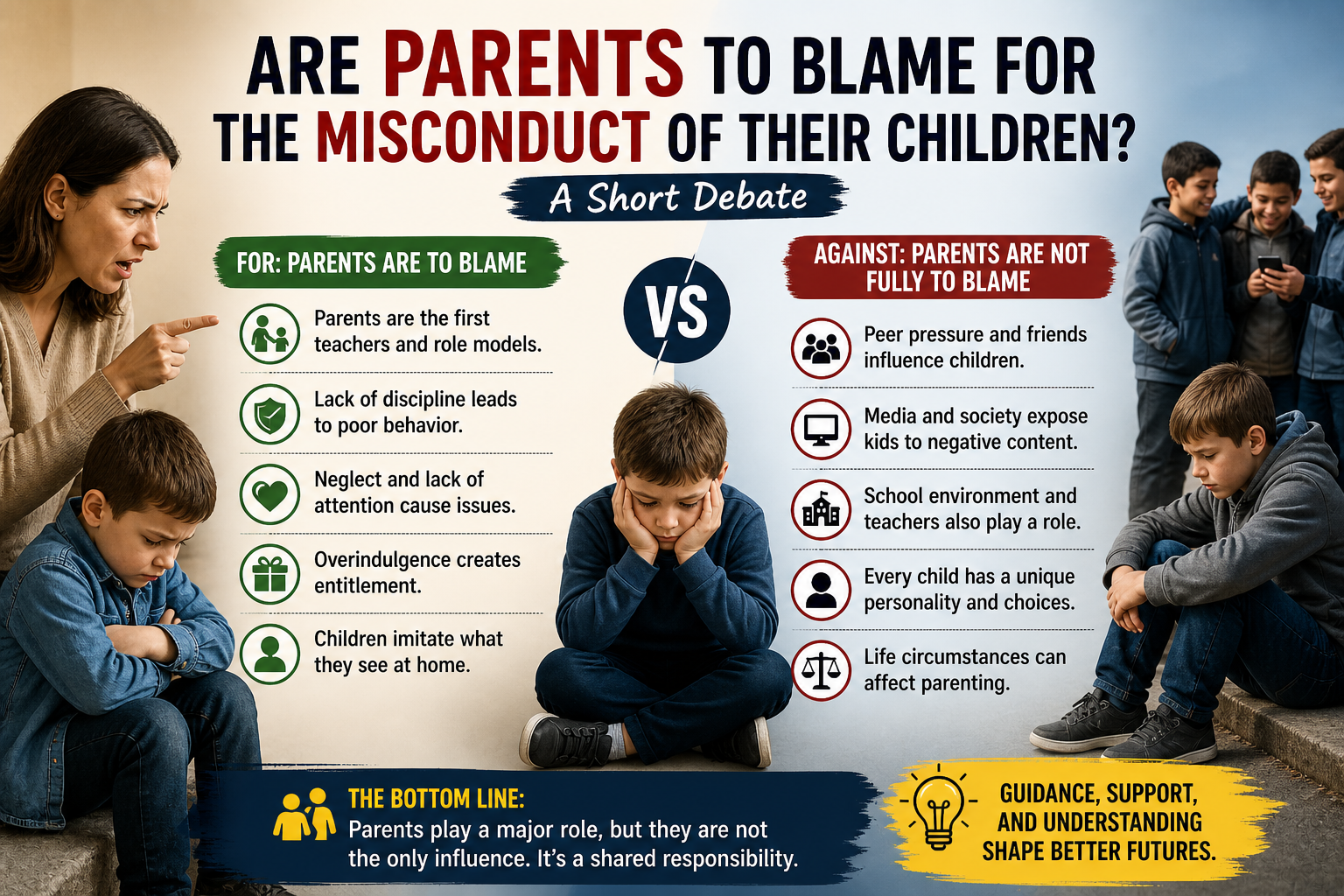
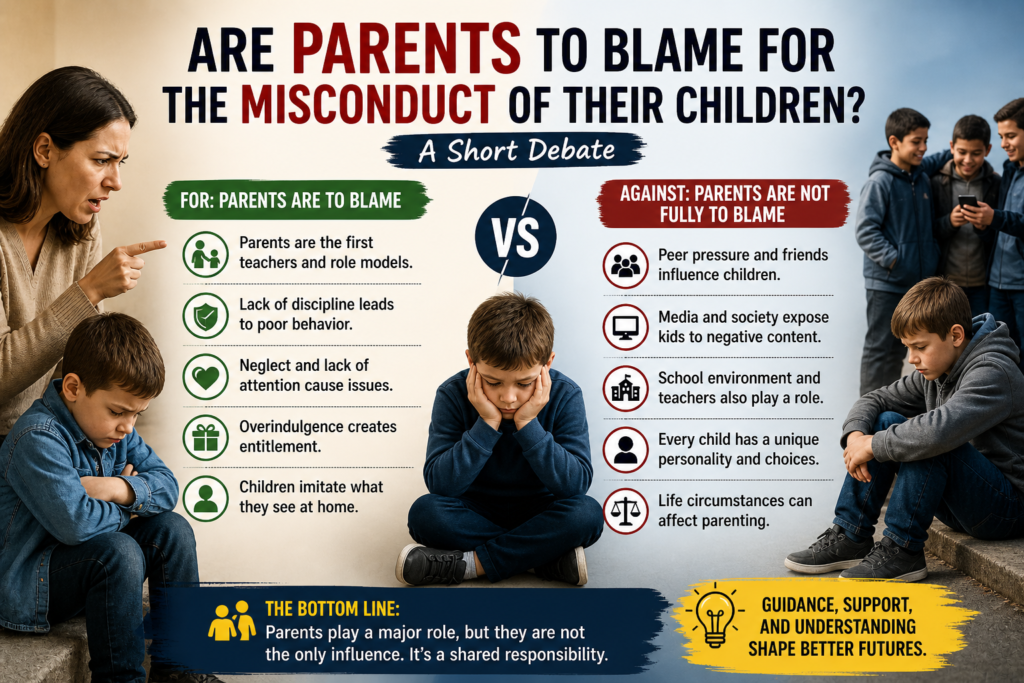
Here’s an interesting short debate on parents are to be blamed for the misconduct of their children…
Few topics spark as much heated discussion as the question: who is responsible when children misbehave?
You’ve probably heard it before—someone shakes their head at a rude child and says, “That’s bad parenting.” Others quickly respond, “Kids make their own choices.”
So, where does the truth really lie?
In this short but engaging debate, we’ll explore both sides of the argument—those who believe parents are largely responsible for children’s misconduct, and those who argue that the issue goes far beyond the home.
Understanding Children’s Misconduct
Before diving into blame, it helps to define what we mean by misconduct.
Children’s misconduct can include:
- Disobedience
- Bullying
- Dishonesty
- Aggressive behavior
- Lack of respect for authority
These behaviors don’t appear out of nowhere. They are often shaped over time by a mix of influences—family, school, peers, and society.
Check out: How To Be Smart In School Without Studying Hard: 6 Secrets For Nigerian Students
Still, many believe the foundation begins at home.
Argument FOR: Parents Are to Blame
1. Parents Are a Child’s First Teachers
From the moment a child is born, parents become their primary role models.
Children learn by observing. If they grow up in an environment where:
- Respect is practiced
- Discipline is consistent
- Values are clearly taught
they are more likely to develop good behavior.
On the flip side, poor parenting habits can lead to negative outcomes. A child exposed to shouting, dishonesty, or neglect may adopt those same behaviors.
2. Lack of Proper Discipline
Discipline doesn’t mean punishment—it means guidance.
When parents fail to set boundaries or enforce rules, children may:
- Struggle to understand right from wrong
- Test limits constantly
- Develop careless attitudes toward consequences
A child who is never corrected may believe their behavior is acceptable, even when it isn’t.
3. Neglect and Lack of Attention
Children crave attention, guidance, and emotional support.
When parents are absent physically or emotionally children may seek validation elsewhere. This can lead them toward:
- Negative peer groups
- Risky behaviors
- Rebellion
In many cases, misconduct becomes a way of seeking attention.
4. Overindulgence and Spoiling
Too much freedom without responsibility can be just as harmful as neglect.
Read now: The Importance of Girl Child Education in Nigeria Debate: Why It Matters More Than Ever
When children are given everything they want without limits, they may:
- Develop entitlement
- Disrespect authority
- Lack self-control
Parents who fail to say “no” may unintentionally raise children who struggle with discipline.
5. Poor Role Modeling
Children don’t just listen—they imitate.
If parents:
- Lie
- Show aggression
- Disrespect others
children are likely to mirror those behaviors.
In this sense, misconduct is often a reflection of what children see at home.
Argument AGAINST: Parents Are Not Fully to Blame
While the points above are valid, blaming parents entirely oversimplifies the issue.
1. Influence of Peer Groups
As children grow, peers become powerful influencers.
Even well-raised children can be affected by:
- Peer pressure
- Desire to fit in
- Social acceptance
A child may behave well at home but act differently in a group setting.
2. Impact of Society and Media
Today’s world is filled with external influences social media, television, and online content.
Children are constantly exposed to:
- Violent or inappropriate content
- Unrealistic lifestyles
- Negative behaviors portrayed as “cool”
These influences can shape behavior in ways parents cannot always control.
Check out: How to Create Flashcards for Quick Revision: The Ultimate Guide for Nigerian Students
3. School Environment Matters
Teachers, classmates, and the overall school atmosphere also play a role.
A negative school environment can lead to:
- Bullying
- Stress
- Behavioral issues
Even with good parenting, a child may struggle in an unhealthy environment.
4. Individual Personality and Choices
Every child is unique.
Some are naturally more:
- Strong-willed
- Rebellious
- Independent
As children grow older, they begin to make their own decisions. At some point, personal responsibility becomes a factor.
5. Parenting Isn’t a Perfect Science
No parent is perfect.
Even loving, attentive parents can have children who misbehave. Life circumstances, financial stress, health issues, or work demands can affect parenting quality.
Blaming parents entirely ignores the complexity of real-life situations.
See more: How to Study for Multiple Choice Questions: The Secret to Acing JAMB and WAEC
Finding a Middle Ground
So, are parents to blame?
The most reasonable answer is: partly, but not entirely.
Parents lay the foundation. They shape values, habits, and early behavior. However, as children grow, other influences come into play.
Think of it like building a house:
- Parents create the foundation
- Society, peers, and experiences build the rest
If the foundation is weak, problems are more likely. But even a strong foundation can face challenges.
What Can Be Done?
Instead of focusing only on blame, it’s more productive to focus on solutions.
1. Strong Parent-Child Relationships
Open communication builds trust and understanding.
2. Consistent Discipline
Clear rules and consequences help children learn responsibility.
3. Positive Role Modeling
Children learn more from actions than words.
4. Monitoring External Influences
Parents should stay aware of their children’s friends and media exposure.
5. Collaboration Between Parents and Schools
A united effort creates a more supportive environment for children.
Read now: Farmer vs Doctor: 10 Compelling Reasons Why the Doctor Is More Important
Conclusion
The debate over whether parents are responsible for children’s misconduct doesn’t have a simple yes-or-no answer.
Parents play a crucial role—there’s no denying that. They shape the early years, instill values, and guide behavior. But they are not the only influence.
Children are also shaped by:
- Friends
- Society
- School environments
- Personal choices
In the end, responsibility is shared.
Rather than placing blame, the focus should be on understanding, guidance, and support—because raising responsible, well-behaved children is a collective effort.