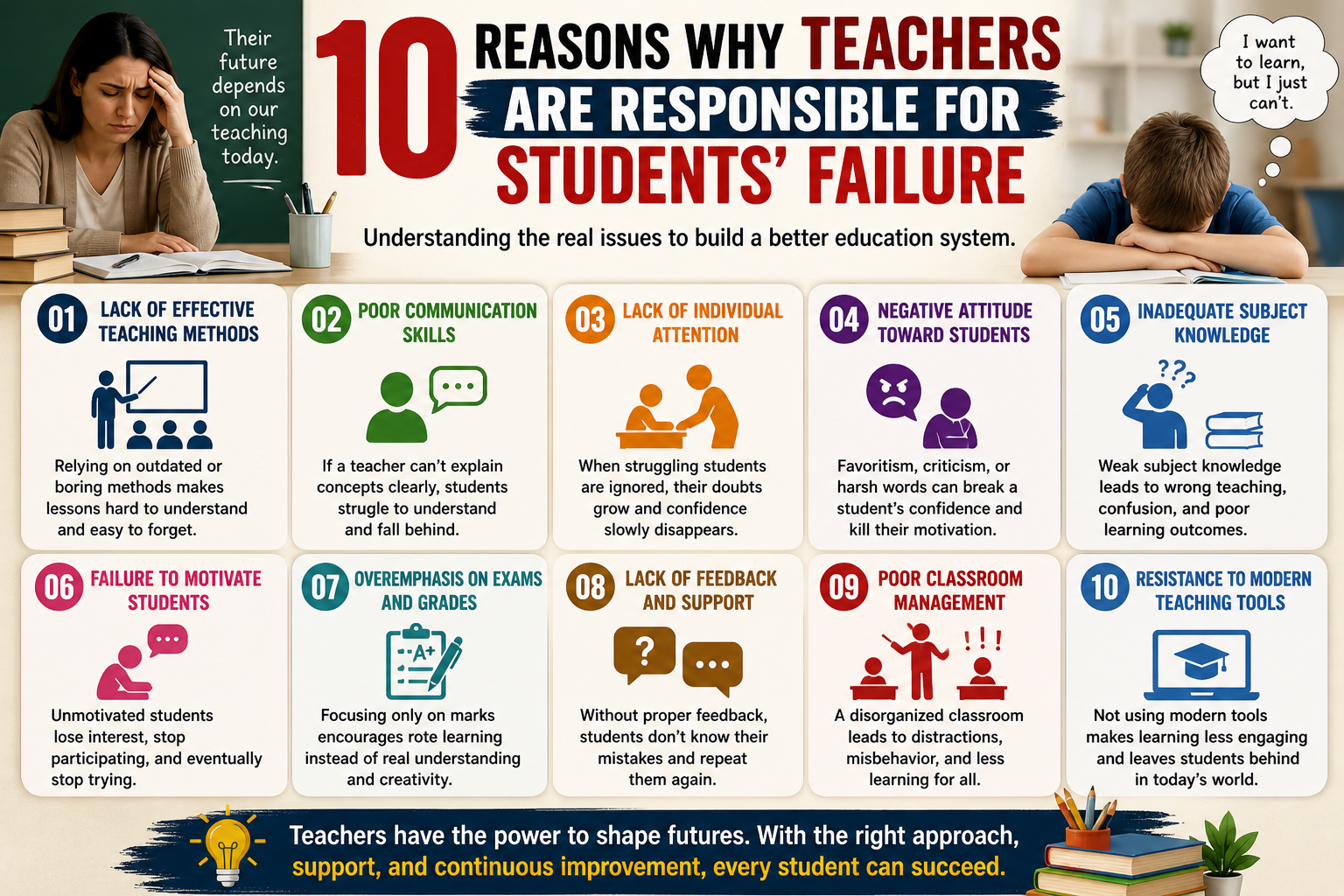
When students fail, the blame game usually begins. However, this post will show you 10 reasons why teachers are responsible for students’ failure.
Some point fingers at the students themselves—lack of effort, poor discipline, or distractions. Others shift the focus to parents, the education system, or even technology. But there’s one factor that often sparks intense debate: teachers.
Now, let’s be clear from the start—this isn’t about attacking teachers. Teaching is one of the most demanding and underappreciated professions in the world. However, it would be unrealistic to ignore the fact that teachers play a powerful role in shaping academic outcomes.
In this article, we’ll explore 10 compelling reasons why teachers can be responsible for students’ failure, while keeping the conversation balanced, thoughtful, and solution-oriented.
Read also: How to Study for Multiple Choice Questions: The Secret to Acing JAMB and WAEC
1. Lack of Effective Teaching Methods
Not all teaching methods work for every student.
Some teachers rely heavily on outdated approaches—long lectures, rote memorization, and minimal interaction. While this may work for a few learners, many students struggle to keep up.
When lessons aren’t engaging or adaptable, students can lose interest quickly, leading to poor understanding and, eventually, failure.
2. Poor Communication Skills
A teacher may understand a subject deeply but still fail to explain it clearly.
Students depend on teachers to break down complex ideas into simple, digestible parts. When explanations are confusing or rushed, students are left behind.
Over time, gaps in understanding grow—and those gaps often show up as poor performance in exams.
3. Lack of Individual Attention
Classrooms today are often crowded.
With so many students to manage, some teachers struggle to give individual attention. As a result:
- Struggling students go unnoticed
- Questions remain unanswered
- Learning differences are ignored
Every student learns at a different pace. When that isn’t acknowledged, failure becomes more likely.
4. Negative Attitude Toward Students
A teacher’s attitude can make or break a student’s confidence.
When teachers:
- Show favoritism
- Dismiss certain students
- Use harsh or discouraging language
…it can deeply affect a student’s motivation.
Students who feel unsupported or judged are less likely to participate, ask questions, or even try.
5. Inadequate Subject Knowledge
This is uncomfortable to admit—but it happens.
Some teachers may not have a strong grasp of the subjects they teach. This leads to:
- Incorrect explanations
- Inability to answer questions
- Shallow understanding of topics
When the foundation is weak, students struggle to build on it.
Read more: Soil Enrichment for Primary 4: Meaning, Importance, Types, and Simple Methods
6. Failure to Motivate Students
Motivation is a powerful driver of success.
Great teachers inspire curiosity and excitement. But when teachers fail to motivate, students often feel:
- Bored
- Disconnected
- Uninterested
Without motivation, even capable students can underperform.
7. Overemphasis on Exams and Grades
Some teachers focus too much on results rather than learning.
Instead of encouraging understanding, they may push students to:
- Memorize answers
- Focus only on test scores
- Ignore creativity
This approach can backfire. Students may pass exams temporarily but fail to truly understand the subject.
8. Lack of Feedback and Support
Feedback helps students improve.
When teachers don’t provide clear, constructive feedback, students are left guessing:
- What they did wrong
- How to improve
- Where they stand
Without guidance, mistakes are repeated—and performance suffers.
9. Poor Classroom Management
A chaotic classroom is not a learning environment.
If a teacher cannot maintain discipline:
- Disruptions increase
- Focus decreases
- Serious students get distracted
Over time, this affects overall academic performance.
10. Resistance to Modern Teaching Tools
Education is evolving rapidly.
Technology has introduced tools like:
- Interactive learning platforms
- Educational videos
- Online assessments
Teachers who resist these tools may limit their students’ learning experience. In today’s world, adapting to new methods is essential.
A Balanced Perspective: It’s Not All on Teachers
While these points highlight the role teachers can play in student failure, it’s important to keep things in perspective.
Student success—or failure—is influenced by multiple factors, including:
- Home environment
- Personal effort
- Peer influence
- School resources
Blaming teachers entirely would be unfair. However, recognizing their impact is necessary for improvement.
What Can Be Done?
Instead of focusing only on blame, the real question should be: how can things improve?
See now: Education Is a Scam vs Education Is the Key: A Balanced Debate for Today’s World
Here are a few solutions:
1. Continuous Teacher Training
Teachers should regularly update their skills and teaching methods.
2. Smaller Class Sizes
This allows for better individual attention.
3. Use of Technology
Incorporating modern tools can make learning more engaging.
4. Positive Teacher-Student Relationships
Encouragement and support go a long way.
5. Focus on Understanding, Not Just Grades
Education should prioritize knowledge over scores.
Final Thoughts
Teachers hold a unique and powerful position in the education system. They are not just instructors—they are mentors, guides, and influencers.
While students must take responsibility for their own learning, it’s impossible to ignore the role teachers play in shaping outcomes.
By addressing the challenges discussed in this article, we can move toward a more effective, supportive, and successful education system—one where fewer students fall through the cracks.