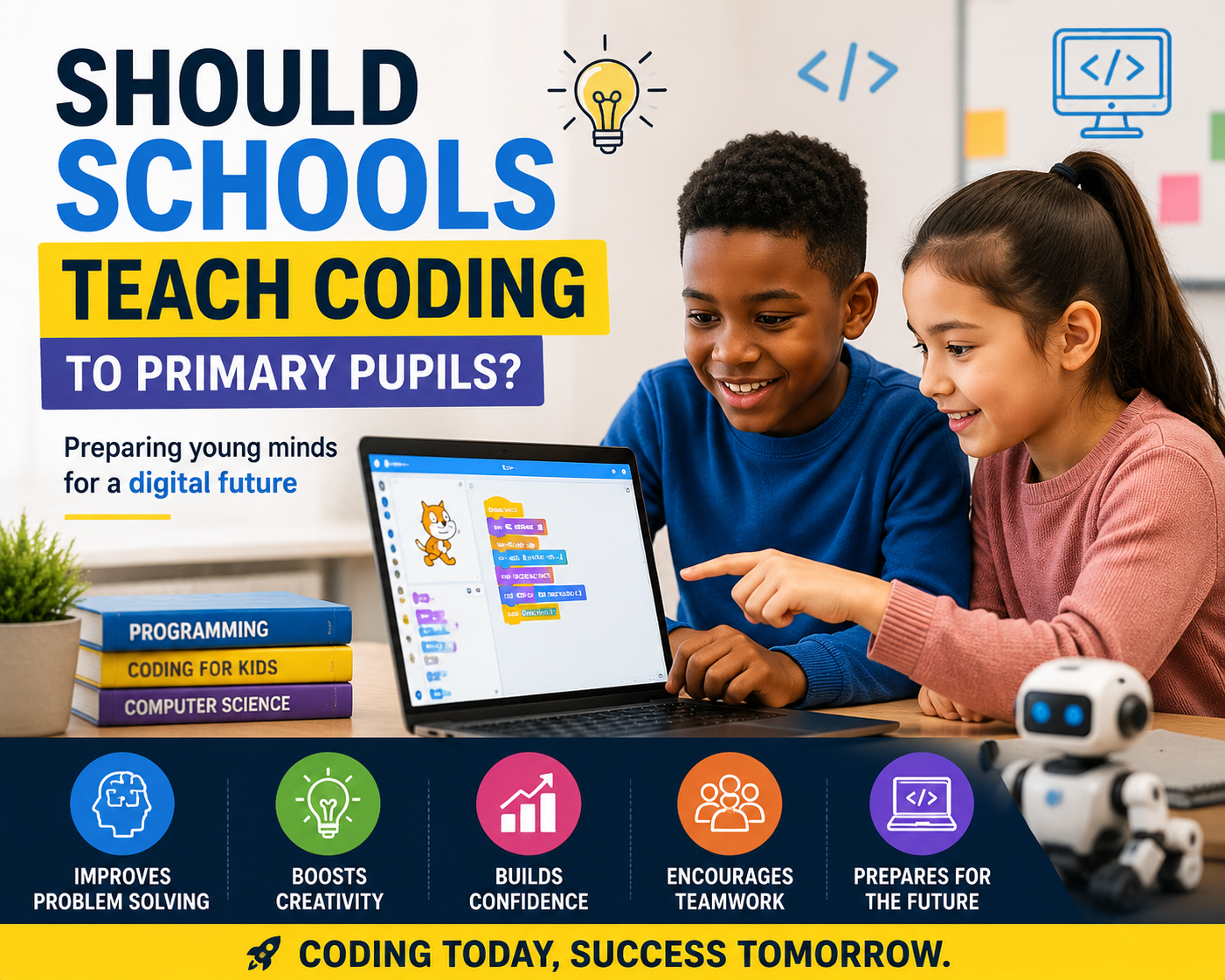
Technology has transformed nearly every aspect of modern life, from how we communicate and learn to how we work and solve problems.
As digital devices become increasingly integrated into education and everyday activities, an important question continues to spark debate among parents, teachers, and policymakers: Should schools teach coding to primary pupils?
Many experts believe that coding should be introduced at an early age because it develops critical thinking, creativity, and problem-solving skills that benefit children far beyond computer science.
Others argue that primary education should focus on foundational subjects such as reading, writing, mathematics, and social development before introducing programming.
This article explores both sides of the discussion, examines the benefits and challenges of teaching coding in primary schools, and explains why digital literacy is becoming one of the most valuable skills children can develop for the future.
What Is Coding?
Coding, also known as computer programming, is the process of writing instructions that tell computers, apps, robots, or other digital devices what to do. Programming languages such as Scratch, Python, JavaScript, and Blockly enable people to create games, websites, animations, mobile applications, and software.
For primary school pupils, coding lessons are usually designed to be interactive and enjoyable. Instead of writing complex computer programs, children often learn through colorful visual programming platforms that use blocks and simple commands to teach logical thinking.
Why Coding Matters in Today’s World
The world is becoming increasingly digital. Children grow up using smartphones, tablets, computers, and smart devices almost every day. However, there is a significant difference between using technology and understanding how it works.
Learning coding helps children become creators rather than just consumers of technology. Instead of simply playing games or watching videos, they gain the skills to design digital solutions, create animations, build websites, and solve problems creatively.
As automation, artificial intelligence, and digital transformation continue to reshape industries, understanding technology is becoming just as important as learning mathematics or science.
Benefits of Teaching Coding to Primary Pupils
1. Develops Problem-Solving Skills
Coding teaches children how to approach problems step by step. They learn to identify challenges, test solutions, fix mistakes, and improve their work through trial and error.
These skills extend beyond programming and can improve performance in mathematics, science, and everyday decision-making.
2. Encourages Critical Thinking
Programming requires logical reasoning. Children learn to analyze situations carefully before deciding how to solve them.
Instead of guessing, they begin thinking systematically, evaluating different solutions, and understanding the consequences of their choices.
Read now How to Avoid Daydreaming/Zoning Out in the Library: A Student’s Guide to Staying Focused
3. Boosts Creativity
Many people assume coding is purely technical, but it also encourages creativity.
Young learners can design:
- Games
- Interactive stories
- Animations
- Music projects
- Educational apps
- Digital artwork
Coding combines imagination with logical thinking, allowing children to express their ideas in innovative ways.
4. Builds Confidence Through Achievement
Completing a coding project gives children a strong sense of accomplishment. Whether they create a simple animation or a basic game, seeing their ideas come to life boosts confidence and encourages perseverance.
Learning to debug errors also teaches resilience, showing pupils that mistakes are part of the learning process.
5. Prepares Children for Future Careers
Technology skills are increasingly valuable across many industries, including healthcare, finance, engineering, education, manufacturing, agriculture, and entertainment.
While not every child will become a software developer, understanding coding can open doors to careers such as:
- Software Engineering
- Artificial Intelligence
- Cybersecurity
- Robotics
- Data Science
- Web Development
- Game Development
- Digital Marketing
- Product Design
Introducing coding early gives children a strong foundation for future learning.
6. Improves Mathematics Skills
Coding reinforces mathematical concepts such as patterns, sequences, coordinates, measurement, and logical reasoning.
Many programming activities naturally involve counting, estimating, and solving numerical problems, making mathematics more engaging and practical.
7. Encourages Teamwork
Coding projects often involve collaboration. Pupils learn to share ideas, work together, solve problems collectively, and communicate effectively—skills that are valuable in school and later in professional life.
Challenges of Teaching Coding in Primary Schools
Despite its many benefits, introducing coding into primary education also presents challenges.
Limited Resources
Some schools lack computers, reliable internet access, or suitable educational software.
Teacher Training
Many teachers may need professional development to confidently teach coding concepts and integrate them into existing lessons.
Curriculum Balance
Schools already cover a wide range of subjects. Adding coding requires careful planning to ensure it complements rather than replaces core learning areas.
Digital Access
Not all pupils have access to computers or internet connectivity at home. Schools should ensure coding education remains inclusive and equitable.
See now How to Handle Panic Attacks in the Exam Hall: A Survival Guide for Nigerian Students
Should Coding Replace Traditional Subjects?
No.
Coding should complement—not replace—core subjects such as literacy, mathematics, science, social studies, and the arts.
Strong reading skills help pupils understand programming instructions. Mathematics supports logical thinking, while creativity and communication enhance coding projects.
A balanced curriculum equips children with both technical and life skills.
How Coding Can Be Introduced Effectively
Primary schools can introduce coding gradually through age-appropriate activities, including:
- Visual block programming
- Educational coding games
- Robotics clubs
- Interactive storytelling
- Puzzle-solving challenges
- Scratch programming
- Simple website design
- Digital creativity projects
The focus should remain on exploration, curiosity, and problem-solving rather than memorizing programming syntax.
Common Misconceptions About Coding
“Coding is only for future programmers.”
False. Coding develops transferable skills useful in many careers and everyday life.
“Coding is too difficult for young children.”
Modern educational platforms make coding accessible through visual, game-based learning that suits young learners.
“Children spend too much time on screens already.”
Quality coding activities encourage active learning and creativity, unlike passive screen use such as endless scrolling or watching videos.
See more The Government Should Prioritize Education Over Infrastructure
Frequently Asked Questions
Should coding be compulsory in primary schools?
Many educators support introducing basic coding because it builds digital literacy and problem-solving skills. Whether it should be compulsory depends on educational priorities, available resources, and curriculum goals.
At what age should children start learning coding?
Many children can begin exploring basic coding concepts between the ages of five and seven using visual programming tools and age-appropriate activities.
Does coding improve academic performance?
Research suggests that coding can strengthen logical reasoning, computational thinking, creativity, and persistence, which may positively influence learning in mathematics and science.
Do children need computers to learn coding?
While computers are helpful, some coding concepts can be taught through “unplugged” activities that use games, puzzles, and physical exercises to develop computational thinking.
Is coding useful if my child doesn’t want to become a programmer?
Absolutely. Coding nurtures analytical thinking, creativity, collaboration, and resilience—skills valuable in almost every profession.
The Future of Education
Education is evolving alongside technology. As artificial intelligence, robotics, automation, and digital innovation continue to shape society, schools have an opportunity to prepare pupils with skills that extend beyond traditional academic subjects.
Coding is not simply about writing software. It teaches children how to think logically, solve problems creatively, communicate effectively, and embrace lifelong learning.
When introduced thoughtfully and supported by trained educators, coding can become a valuable part of a well-rounded primary education.
Conclusion
So, should schools teach coding to primary pupils?
There are compelling reasons to say yes.
Coding helps children develop critical thinking, creativity, resilience, collaboration, and digital literacy. These abilities are increasingly important in a technology-driven world and can benefit pupils regardless of the careers they eventually choose.
Although schools may face challenges such as teacher training, limited resources, and curriculum planning, these obstacles can be addressed through gradual implementation and age-appropriate learning methods.
Rather than replacing traditional subjects, coding should complement them, equipping young learners with practical skills that prepare them for both today’s opportunities and tomorrow’s challenges. By introducing coding in primary schools, educators can help nurture confident, curious, and capable problem-solvers ready to thrive in the digital age.