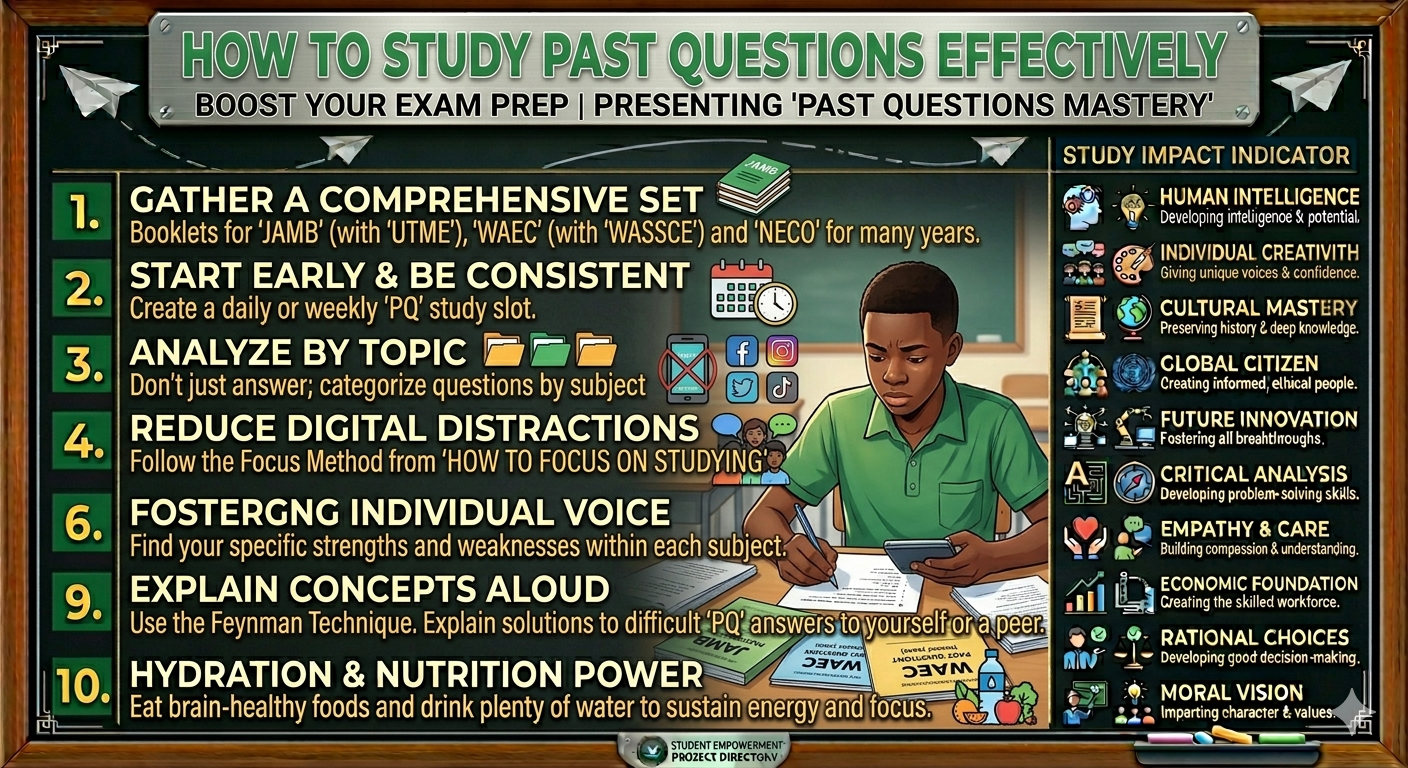
If you’ve ever revised for hours and still felt unprepared, you’re not alone.
The secret many top students use isn’t just “studying harder”—it’s studying smarter with past questions.
In this guide, you’ll learn how to study past questions effectively, avoid common mistakes, and turn previous exam papers into a powerful score-boosting strategy.
Why Past Questions Are So Powerful
Past questions are not just revision tools—they are exam blueprints.
They help you:
- Understand exam patterns
- Identify repeated topics
- Improve time management
- Practice real exam conditions
In fields like Educational Psychology, this method is called active recall + exam simulation, which is proven to improve retention.
1. Don’t Just Read — Practice Actively
One of the biggest mistakes students make is reading past questions instead of solving them.
Do this instead:
- Attempt questions without looking at answers
- Write full solutions
- Think like you’re in the exam
This builds real understanding—not just familiarity.
See now: Parents Are NOT Solely to Blame for the Misconduct of Their Children
2. Study Under Timed Conditions
If you want exam success, practice like it’s the real thing.
How:
- Set a timer
- Answer a full paper
- Avoid distractions
This improves:
- Speed
- Accuracy
- Confidence
3. Analyze Patterns and Repeated Questions
Examiners often repeat topics—even if questions change slightly.
Look for:
- Frequently tested topics
- Common question formats
- Repeated concepts
Focus more energy on high-probability topics.
4. Review Your Mistakes Deeply
Getting answers wrong is part of the process—but ignoring them is the real problem.
After each session:
- Check your answers
- Understand why you were wrong
- Rewrite correct solutions
This is where real learning happens.
Check out: How to Use the Pomodoro Technique to Crush WAEC and JAMB (Without Burning Out)
5. Combine Past Questions With Your Notes
Past questions alone are not enough.
Smart approach:
- Attempt a question
- Go back to your notes
- Fill knowledge gaps
This strengthens both memory and understanding.
6. Repeat Questions Over Time
Don’t just solve a question once and move on.
Instead:
- Revisit difficult questions
- Solve them again days later
This uses Spaced Repetition, which helps you remember information long-term.
7. Group Questions by Topic
Instead of random practice, organize your study.
Example:
- Solve all questions on one topic
- Master it before moving on
This builds deep understanding, not shallow knowledge.
8. Teach What You Learn
If you can explain a question, you truly understand it.
Try this:
- Explain answers out loud
- Teach a friend
- Write simplified explanations
Teaching reinforces memory and clarity.
9. Track Your Progress
You can’t improve what you don’t measure.
Keep track of:
- Scores from practice tests
- Weak areas
- Time spent per question
This helps you study more strategically.
Read more: Parents Are NOT Solely to Blame for the Misconduct of Their Children
Common Mistakes to Avoid
❌ Memorizing answers instead of understanding
❌ Skipping corrections after mistakes
❌ Practicing without time limits
❌ Ignoring weak topics
❌ Relying only on past questions
Avoid these, and your results will improve faster.
Bonus Tips for Maximum Results
- Start past questions early (not just before exams)
- Mix subjects to avoid burnout
- Use marking schemes to understand expectations
- Practice writing clear, structured answers
Final Thoughts
Learning how to study past questions effectively can completely change your academic results.
It’s not about how many hours you study—it’s about:
- Practicing smart
- Reviewing mistakes
- Staying consistent
Master this method, and you’ll walk into exams feeling prepared, confident, and in control.