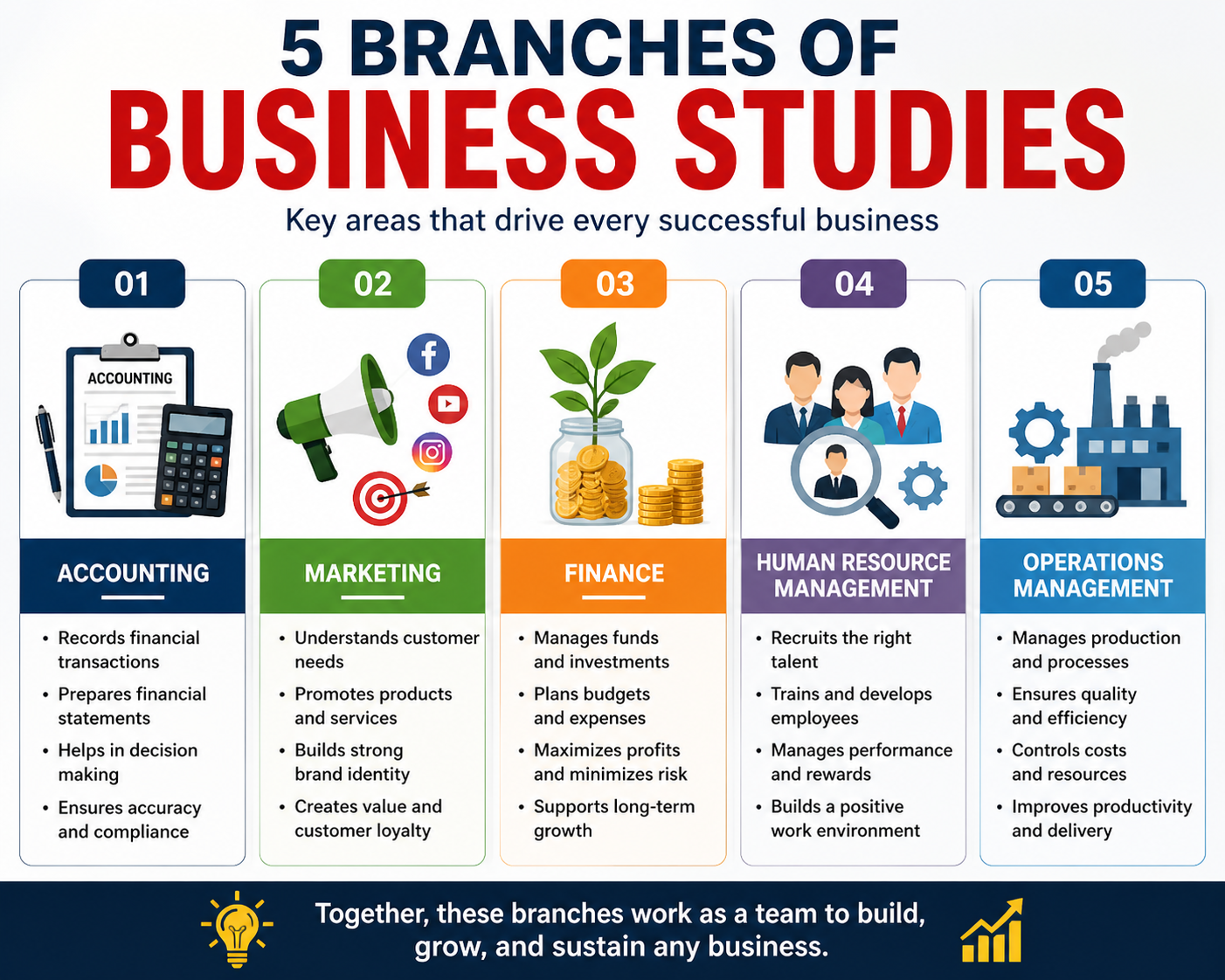
Here’s 5 branches of business studies you should know.
Business isn’t just about buying and selling. It’s a vast field that touches almost every part of our daily lives—from the products we use to the services we rely on. Behind every successful company is a mix of strategy, planning, people management, and financial decisions.
That’s where business studies comes in.
If you’ve ever wondered what makes businesses run smoothly or why some companies thrive while others struggle, understanding the core branches of business studies is a great place to start.
In this article, we’ll break down five major branches of business studies in a simple, engaging way. Whether you’re a student, an aspiring entrepreneur, or just curious, this guide will help you see how each branch plays a crucial role in the business world.
See also: How to Handle Panic Attacks in the Exam Hall: A Survival Guide for Nigerian Students
1. Accounting: The Language of Business
Let’s start with the backbone of every business—accounting.
Accounting is all about tracking, recording, and analyzing financial transactions. In simple terms, it answers questions like:
- How much money is the business making?
- Where is the money going?
- Is the business profitable?
Without accounting, a business would be operating blindly.
Why Accounting Matters
Imagine running a business without knowing your expenses or profits. You wouldn’t know if you’re growing or losing money. Accounting provides clarity and helps business owners make informed decisions.
Key Areas in Accounting
- Financial accounting (preparing reports like balance sheets)
- Managerial accounting (helping managers make decisions)
- Auditing (checking financial accuracy)
- Tax accounting (handling taxes and compliance)
In short, accounting keeps the financial health of a business in check.
2. Marketing: Connecting Products to People
If accounting is the backbone, marketing is the voice of the business.
Marketing focuses on understanding customer needs and promoting products or services effectively. It’s not just about advertising—it’s about creating value and building relationships.
Check out: How to Use the Cornell Method to Take Better Lecture Notes (And Stop Cramming)
What Marketing Involves
- Market research
- Branding
- Advertising and promotions
- Customer engagement
Think about your favorite brands. The reason you trust or recognize them is largely due to strong marketing strategies.
Why Marketing Is Important
Even the best product won’t sell if people don’t know about it. Marketing ensures that the right message reaches the right audience at the right time.
In today’s digital age, marketing has expanded into areas like:
- Social media marketing
- Search engine optimization (SEO)
- Content marketing
It’s one of the most dynamic branches of business studies.
3. Finance: Managing Money and Investments
While accounting focuses on recording financial data, finance is about managing and growing money.
Finance deals with decisions related to:
- Investments
- Budgeting
- Risk management
- Capital allocation
The Role of Finance in Business
Every business needs funds to operate—whether it’s for buying equipment, paying employees, or expanding operations. Finance helps determine:
- Where to get money (loans, investors, etc.)
- How to use it wisely
- How to maximize returns
Key Areas in Finance
- Corporate finance
- Investment analysis
- Financial planning
- Risk management
Finance is crucial for long-term growth and sustainability. A business with poor financial planning can struggle—even if it has great products.
4. Human Resource Management (HRM): Managing People
A business is only as strong as its people. That’s where Human Resource Management (HRM) comes in.
See more: Farmers Are More Important Than Teachers: A Thought-Provoking Perspective on Society’s Backbone
HRM focuses on managing employees—from hiring to training to maintaining a positive work environment.
What HRM Covers
- Recruitment and selection
- Employee training and development
- Performance management
- Compensation and benefits
Why HRM Is Essential
Employees are the driving force behind every organization. HR ensures that the right people are in the right roles and that they remain motivated and productive.
A strong HR department can:
- Improve employee satisfaction
- Reduce turnover
- Boost overall performance
In today’s competitive world, companies that invest in their people often outperform those that don’t.
5. Operations Management: Making Things Work Efficiently
Last but not least, we have operations management.
This branch focuses on the processes involved in producing goods and services. It’s about efficiency, productivity, and quality control.
See more: 7 SECRET METHODS FOR STUDYING THAT CAN BOOST YOUR SCORES BY 2X (BACKED BY SCIENCE)
What Operations Management Does
- Oversees production processes
- Manages supply chains
- Ensures quality standards
- Improves efficiency
Why It Matters
Imagine a company that produces great products but delivers them late or with defects. Customers won’t stick around for long.
Operations management ensures that:
- Products are delivered on time
- Costs are minimized
- Quality is maintained
It’s the engine that keeps the business running smoothly.
How These Branches Work Together
While we’ve discussed each branch separately, the truth is—they are all interconnected.
For example:
- Marketing generates demand
- Operations fulfill that demand
- Finance manages the money involved
- Accounting tracks financial performance
- HR ensures the right people are in place
A successful business doesn’t rely on just one branch—it depends on how well all these areas work together.
Why Studying Business Matters
Understanding these five branches gives you a strong foundation in how businesses operate.
See now: 10 reasons why farmer is better than teacher debate points
Whether you want to:
- Start your own business
- Work in a corporate environment
- Improve your financial knowledge
…business studies equips you with practical, real-world skills.
It also helps you think critically, make better decisions, and understand how the economy works.
Conclusion
Business studies isn’t just a subject—it’s a gateway to understanding the world of commerce and entrepreneurship.
The five branches—accounting, marketing, finance, human resource management, and operations management—each play a unique role in shaping successful organizations.
By learning how these areas function and interact, you gain valuable insights that can be applied in almost any career path.
So whether you’re a student preparing for exams or someone exploring new opportunities, mastering these branches is a smart move.
Because at the end of the day, every business—big or small—relies on these fundamentals to survive and thrive.