Education is one of the most important parts of childhood, but so is play. For years, schools around the world have focused heavily on classroom learning; math, science, reading, writing—while reducing the amount of time children spend playing.
This raises an important question: Should schools have more playtime than class time?
While traditional education systems prioritize academic instruction, many educators and psychologists now believe that play is not just a break from learning, it is learning. In fact, play may be just as important, if not more important, than classroom instruction in early and even middle childhood development.
Let’s explore both sides of this debate in detail.
Why This Topic Matters in Modern Education
In today’s fast-paced academic environment, students are often under pressure to perform well in exams, complete assignments, and meet strict curriculum goals. As a result, recess and playtime are sometimes shortened or removed entirely.
However, research in child development shows that children learn best when they are active, engaged, and emotionally balanced. This is where play becomes essential.
Searches for topics like:
- “importance of play in schools”
- “should schools reduce class time”
- “benefits of recess”
- “child development and learning through play”
are increasing because parents and educators are rethinking how children learn best.
What Is the Role of Play in Learning?
Read more The Importance of Girl Child Education in Nigeria Debate: Why It Matters More Than Ever
Play is not just fun or entertainment. It is a critical part of how children develop cognitive, emotional, social, and physical skills.
Through play, children learn how to:
- Solve problems
- Work in teams
- Think creatively
- Manage emotions
- Build communication skills
- Develop motor coordination
Unlike structured classroom lessons, play allows children to explore freely, make mistakes, and learn naturally.
For example:
- Building blocks teaches spatial reasoning
- Team games teach cooperation
- Role-playing improves communication
- Outdoor play improves physical health
In many ways, play prepares children for real-life situations more effectively than memorizing facts.
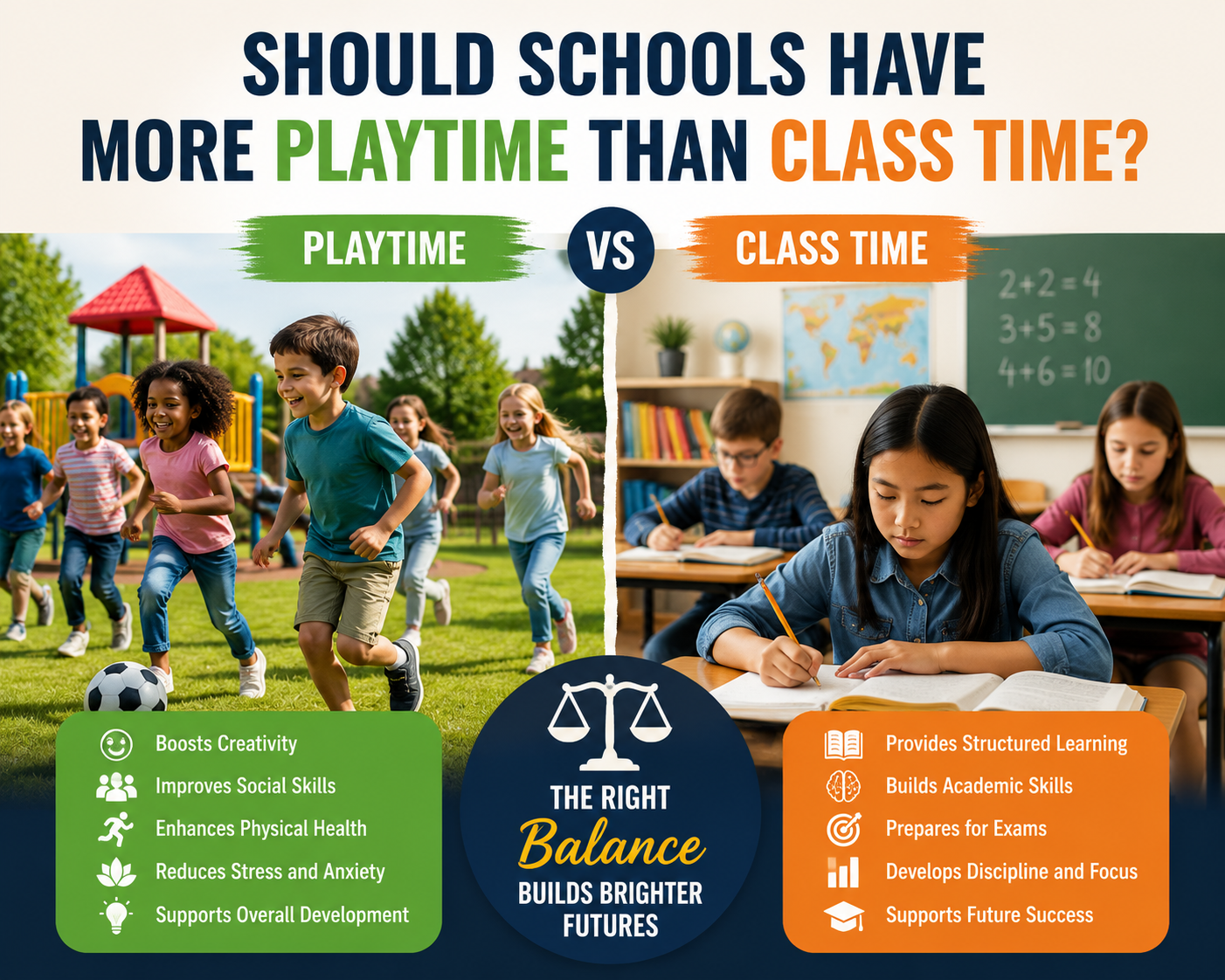
The Case for More Playtime Than Class Time
Supporters of increased playtime argue that children are naturally designed to learn through movement, interaction, and exploration—not long hours of sitting still.
Here are some strong reasons why playtime may deserve more emphasis than classroom time.
1. Improves Brain Development
Studies show that physical activity increases blood flow to the brain, improving memory, focus, and learning capacity.
Children who play regularly often perform better academically because their brains are more active and engaged.
2. Reduces Stress and Anxiety
Modern students experience stress at younger ages than ever before. Exams, homework, and performance pressure can create anxiety.
Play acts as a natural stress reliever, helping children reset emotionally and return to class with better focus.
3. Enhances Creativity
Unstructured play encourages imagination. Whether children are pretending, building, or inventing games, they are strengthening creative thinking skills.
These skills are essential for future careers in technology, science, business, and the arts.
4. Builds Social Skills
Play teaches children how to:
- Share
- Negotiate
- Resolve conflicts
- Work in groups
These social skills are just as important as academic knowledge in real life.
5. Supports Physical Health
With rising concerns about childhood obesity and inactivity, playtime is essential for physical fitness.
Running, jumping, climbing, and playing sports help children stay healthy and active.
The Argument for More Class Time
While play is important, some educators believe increasing playtime at the expense of class time could negatively affect academic performance.
Here’s why they argue for more classroom learning:
1. Academic Pressure and Curriculum Demands
Schools have strict learning goals. Subjects like math, science, and literacy require structured instruction and time.
Reducing class time could make it harder for students to meet academic standards.
2. Standardized Testing Requirements
Many education systems rely on exams and assessments to measure performance. More classroom instruction is often seen as necessary to prepare students for these tests.
See more How to Use the Cornell Method to Take Better Lecture Notes (A Guide for Nigerian Students)
3. Knowledge-Based Learning
Some skills require direct teaching. For example:
- Reading comprehension
- Mathematical formulas
- Scientific concepts
These are not always easily learned through play alone.
4. Discipline and Structure
Classroom environments teach discipline, focus, and routine. Too much playtime without structure could make it harder for students to adapt to formal learning environments later.
The Balanced Perspective: Why It Should Not Be One or the Other
The real solution is not choosing between playtime and class time—it is finding the right balance.
Experts in education suggest that learning through play combined with structured teaching is the most effective approach.
Countries with high-performing education systems, such as Finland, have already adopted models that include:
- Shorter classroom sessions
- Frequent breaks
- Longer recess periods
- Play-based early education
These systems show that children can perform well academically while still enjoying more playtime.
How Play Actually Improves Academic Performance
One of the biggest misconceptions is that play reduces learning time. In reality, it often improves learning outcomes.
Here’s how:
- After play, children return to class more focused
- Active children retain information better
- Social play improves communication, helping classroom participation
- Emotional balance improves attention span
So instead of distracting from learning, play can actually enhance it.
See now How to Study for Multiple Choice Questions: The Secret to Acing JAMB and WAEC
Should Schools Have More Playtime Than Class Time?
The answer depends on age and learning stage.
For younger children (ages 3–10):
Yes—playtime should often be equal to or greater than classroom time because early development depends heavily on exploration and interaction.
For older students (ages 11–18):
A balanced approach is better. Academic learning becomes more structured, but play, sports, and recreational activities are still essential for mental health and development.
The Future of Education: Learning Through Play
Modern education is gradually shifting toward a more flexible system where play is not separate from learning.
This includes:
- Game-based learning apps
- Interactive classroom activities
- Outdoor education programs
- Project-based learning
- Creative group activities
These methods blend academic content with play, making learning more engaging and effective.
Conclusion
So, should schools have more playtime than class time?
The most accurate answer is that play should not be seen as less important than class—it should be seen as part of learning itself.
For younger children especially, increasing playtime can lead to better emotional, social, and cognitive development. For older students, a balanced mix is ideal.
Instead of treating play as a reward after learning, schools should treat it as a core part of learning.
A well-designed education system does not choose between play and class—it combines both to create healthier, smarter, and more creative students.